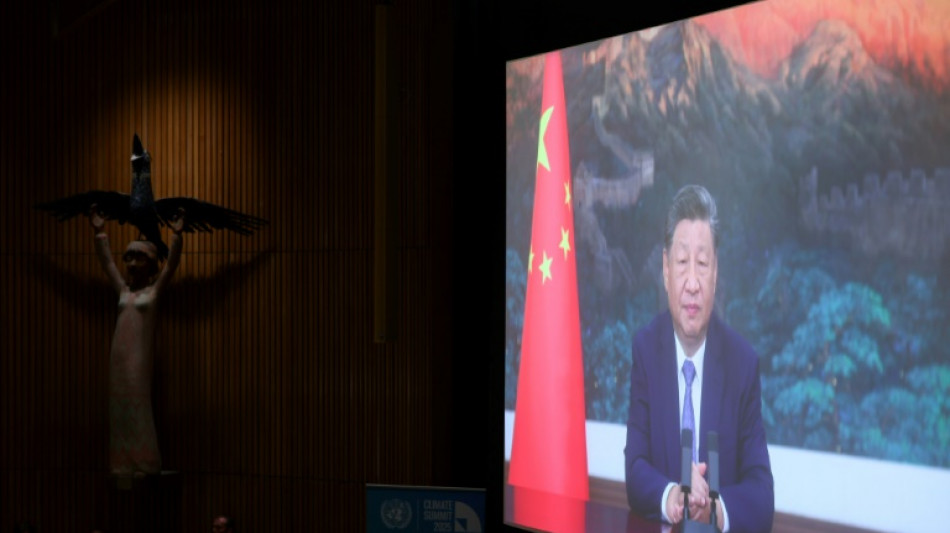
In first, China unveils specific emissions targets / Photo: CHARLY TRIBALLEAU - AFP

 Typhoon Dujuan leaves four dead in Japan, 45,000 houses without power

 Stocks rise on AI buzz, drop in oil prices

 UK king braces as memoir by Diana's brother goes on sale

 Infantino proposes consulting federations to reform FIFA
 South Africa arrests three more suspects, after nine women murdered
 Paramount settles with US states to clear Warner Bros. mega-merger

 Climate crisis a job for world leaders, not just activists: UK FM
 COP31 host says AI's climate footprint to be a summit priority

 EU proposes energy rating for data centres

 TradersYard Shifts Focus to Futures Trading

 Indonesia doing 'everything' but struggling to curb fires

 FQ-42 Vengeance Finds New Home at Creech Air Force Base

 Multi-Asset Trading Venue Monochrome Exchange Announces IEO of Its Native Token, $MCR
 Data centre command hub keeps AI up and running

 Leo XIV, first US pope transcends his restrained style

 France's debt climbs to highest since 1978: ministry

 Thousands protest inaction over climate crisis in Switzerland

 UK actor Naomi Watts honoured at Spain film festival

 Trump signs bill authorizing sweeping Russia sanctions

 Anthropic picks Accenture for in-house AI safety evaluation

 Hushing and hedging: US companies retreat on climate

 Crisis-wracked Volkswagen warns of 10-bn-euro hit to profits

 Shakira to cap off world tour with Madrid 12-gig run

 Isolated Syrian-Druze city shortages

 UNESCO can be 'moderator' in AI debate: chief to AFP

China on Wednesday issued its first ever absolute targets for cutting planet-warming gases, a landmark pledge from the world's top polluter as the United States doubles down on fossil fuels and Europe falters.
The announcement was delivered via video by President Xi Jinping to a UN climate summit where some 120 nations will outline plans to curb global warming, which is intensifying disasters worldwide from floods in Pakistan to raging wildfires in Spain.
Under the new plan, China will reduce economy-wide emissions by 7–10 percent by 2035 relative to the year of the country's peak emissions, believed to be 2025.
Observers said that while the absolute figure may seem modest, China has a record of under-promising while over-delivering, driven by its green technology boom.
It comes as the United States under President Donald Trump, who called climate change a "con job" at the UN a day earlier, boosts fossil fuels both at home and abroad.
"Green and low carbon transition is the trend of our time," said Xi in an official translation. "While some country is acting against it, the international community should stay focused in the right direction."
China, responsible for nearly 30 percent of global emissions, had previously pledged to peak its carbon output before 2030 and achieve carbon neutrality by 2060, without ever previously setting near-term numeric targets for total emissions reductions.
The new goal is backed by commitments to expand wind and solar six times over 2020 levels, drastically expand forests, and ramp up electric cars production.
Most wealthy nations, historically the biggest contributors to warming, peaked decades ago but still lack credible plans to reach carbon neutrality by 2050.
- Behind schedule -
"Beijing's commitment is a cautious step that favors steadiness and delivery over ambition" Li Shuo, an expert at the Asia Society think tank who is well-connected in Beijing, told AFP.
"The good news is that in a world increasingly driven by self-interest, China may be better positioned than most to advance climate action," he added.
The stated trajectory is similar to the path followed by the US and EU in the decade after their peak emissions but would fall well short of what is needed to limit warming to 1.5C above pre-industrial levels -- the target set by the 2015 Paris Agreement to avoid the worst climate catastrophes.
But by presenting a target well ahead of COP30, the year's main climate gathering in Belem, Brazil, China signals its ongoing commitment to the international process after the United States departed the Paris agreement for a second time.
Under the 2015 accord -- which nearly every country is part of -- nations freely set their own targets but must strengthen them every five years.
Most are behind schedule, notably the European Union, where several states fear moving too fast could hurt industry.
France, for example, faces shaky finances and political turmoil, and wants more clarity on investment frameworks before committing to deeper decarbonization.
But French President Emmanuel Macron used his turn at the podium to rebut Trump's broadside on climate change, telling fellow leaders the science is "clear enough."
- Catastrophe v hope -
The UN meanwhile is trying to strike a balance between warning of catastrophe and maintaining hope.
On one hand, UN Secretary-General Antonio Guterres told AFP last week that chances of limiting warming to 1.5C are on the verge of "collapsing," a view echoed by climatologists, with current temperatures already about 1.4C above pre-industrial levels.
But on Wednesday, he struck a more positive note, saying the landmark Paris climate accord "has made a difference," as he opened the summit.
"In the last 10 years, projected global temperature rise has dropped from four degrees Celsius to less than three," he said.
Part of that progress stems from China. A decade ago, three-quarters of its electric mix came from coal -- a figure now down to half. Its booming exports of solar panels, batteries, and electric cars are cutting emissions abroad as well.
Ch.Lefebvre--CPN