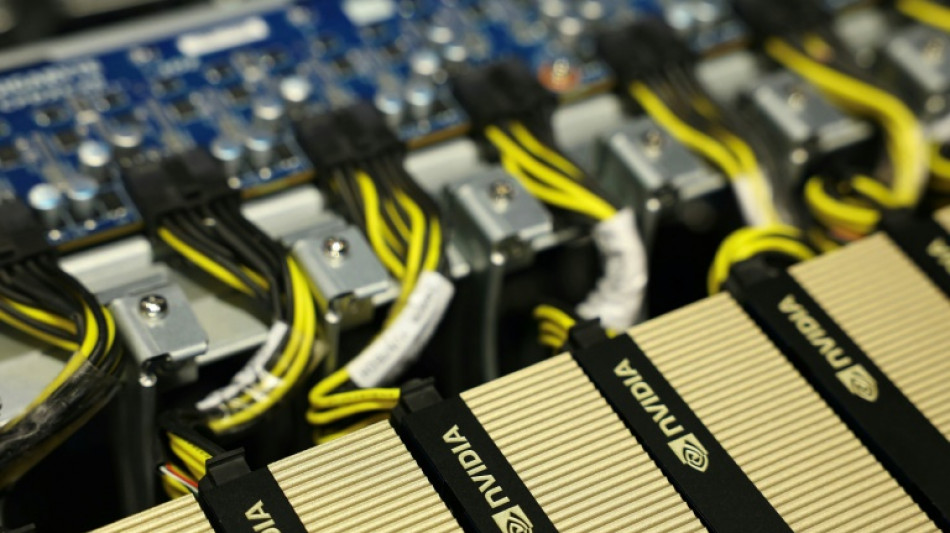
Europe's fastest supercomputer to boost AI drive / Photo: Thomas SAMSON - AFP/File

 Archaelogical 'breakthrough' could confirm origins of Paris

 Fendi brings disco bling, Italian style, to Milan Fashion Week

 アレックス・ボディ氏とシュテファン・ハウプト教授、ルーマニアの伝説的な美術コレクションをめぐり提携に合意

 Stocks dip, oil rises as traders eye chances of Iran deal

 Oil falls, stocks steady as Trump hails 'good' Iran talks

 Canada judge to decide prison term for suicide poison seller

 Meta leans into AI, smart glasses amid privacy pushback

 Oil prices fall after Trump hails 'good' talks with Iran
 AI political ads warp reality ahead of US midterms
 Oil prices retreat as markets welcome US-Iran talks

 French prosecutors probe secret filming of women with smart glasses

 Trump renames AI "super intelligence," rejects international oversight

 How is the EU approaching record fuel prices?

 11 hurt as teen opens fire outside school in western Turkey

 UN chief says 'Big Oil' treats atmosphere as open sewer

 Memoir by Diana's brother goes on sale after rocking UK monarchy

 Stocks climb as oil slides, AI buzz returns

 MEXC Launches “Real Stocks, Real Friends” with Rewards for Bringing Friends to Wall Street

 Stocks rise on AI buzz, oil prices cool

 In Bangladesh, Pakistan's Jinnah photo stirs anger

 China's robot dancers limber up for America's Got Talent final

 Green policies just good politics, says UK minister

 El Nino weather pattern enters record territory: scientist

 US networks halt Trump coverage in revolt over White House ban

 NOWPayments Releases Cross-Chain Payout Data Revealing Key Performance Benchmarks Across TRON, BNB Chain, and Solana

Europe's fastest supercomputer Jupiter is set to be inaugurated Friday in Germany with its operators hoping it can help the continent in everything from climate research to catching up in the artificial intelligence race.
Here is all you need to know about the system, which boasts the power of around one million smartphones.
- What is the Jupiter supercomputer? -
Based at Juelich Supercomputing Centre in western Germany, it is Europe's first "exascale" supercomputer -- meaning it will be able to perform at least one quintillion (or one billion billion) calculations per second.
The United States already has three such computers, all operated by the Department of Energy.
Jupiter is housed in a centre covering some 3,600 metres (38,000 square feet) -- about half the size of a football pitch -- containing racks of processors, and packed with about 24,000 Nvidia chips, which are favoured by the AI industry.
Half the 500 million euros ($580 million) to develop and run the system over the next few years comes from the European Union and the rest from Germany.
Its vast computing power can be accessed by researchers across numerous fields as well as companies for purposes such as training AI models.
"Jupiter is a leap forward in the performance of computing in Europe," Thomas Lippert, head of the Juelich centre, told AFP, adding that it was 20 times more powerful than any other computer in Germany.
- How can it help Europe in the AI race? -
Lippert said Jupiter is the first supercomputer that could be considered internationally competitive for training AI models in Europe, which has lagged behind the US and China in the sector.
According to a Stanford University report released earlier this year, US-based institutions produced 40 "notable" AI models -- meaning those regarded as particularly influential -- in 2024, compared to 15 for China and just three for Europe.
"It is the biggest artificial intelligence machine in Europe," Emmanuel Le Roux, head of advanced computing at Eviden, a subsidiary of French tech giant Atos, told AFP.
A consortium consisting of Eviden and German group ParTec built Jupiter.
Jose Maria Cela, senior researcher at the Barcelona Supercomputing Center, said the new system was "very significant" for efforts to train AI models in Europe.
"The larger the computer, the better the model that you develop with artificial intelligence," he told AFP.
Large language models (LLMs) are trained on vast amounts of text and used in generative AI chatbots such as OpenAI's ChatGPT and Google's Gemini.
Nevertheless with Jupiter packed full of Nvidia chips, it is still heavily reliant on US tech.
The dominance of the US tech sector has become a source of growing concern as US-Europe relations have soured.
- What else can the computer be used for? -
Jupiter has a wide range of other potential uses beyond training AI models.
Researchers want to use it to create more detailed, long-term climate forecasts that they hope can more accurately predict the likelihood of extreme weather events such as heatwaves.
Le Roux said that current models can simulate climate change over the next decade.
"With Jupiter, scientists believe they will be able to forecast up to at least 30 years, and in some models, perhaps even up to 100 years," he added.
Others hope to simulate processes in the brain more realistically, research that could be useful in areas such as developing drugs to combat diseases like Alzheimer's.
It can also be used for research related to the energy transition, for instance by simulating air flows around wind turbines to optimise their design.
- Does Jupiter consume a lot of energy? -
Yes, Jupiter will require on average around 11 megawatts of power, according to estimates -- equivalent to the energy used to power thousands of homes or a small industrial plant.
But its operators insist that Jupiter is the most energy-efficient among the fastest computer systems in the world.
It uses the latest, most energy-efficient hardware, has water-cooling systems and the waste heat that it generates will be used to heat nearby buildings, according to the Juelich centre.
D.Avraham--CPN