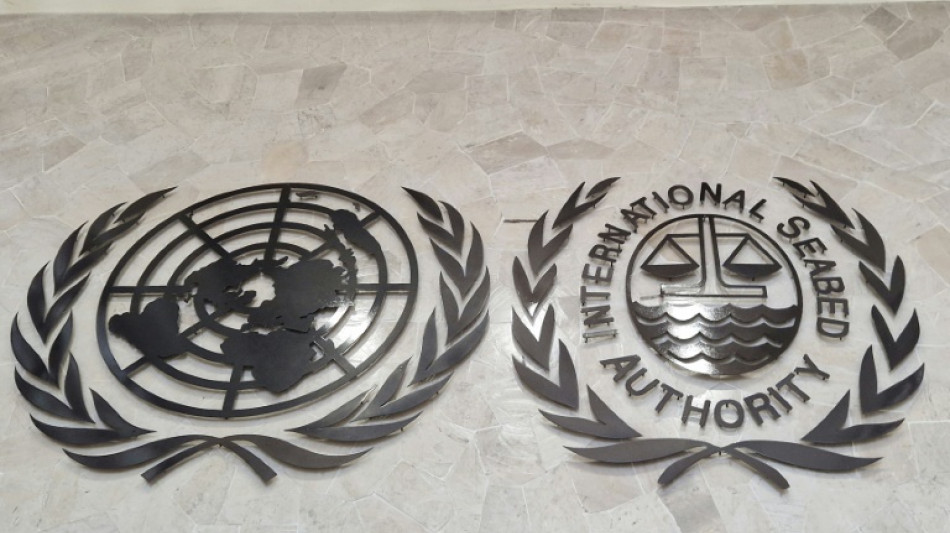
New deep sea mining rules lack consensus despite US pressure / Photo: Amélie BOTTOLLIER-DEPOIS - AFP/File

 First US trial against TikTok to open Monday

 French literary prize removes novel from longlist after AI claims

 Trump accuser E. Jean Carroll finally has her damages

 Heavy fighting, internet disruption as Ethiopia conflict rages

 Asian markets mixed after oil gains

 UN approves resolution on dealing with rising sea levels

 Global stocks mostly fall as oil prices and bond yields rise

 Starbucks to close 250 more cafes in North America

 Stocks fall as oil prices rise and bonds back under pressure
 Top ECB official to resign to take up IMF role

 Eviction of pensioner puts Spain housing crisis in spotlight
 Average EU diesel price hits record 2.23 euros a litre: AFP analysis

 Whitetip Investments Marks 10 Years of Regulation, Transparency & Responsible Trading

 Stocks fall, oil prices rise as global bonds under pressure

 Hungary detects invasive spotted lanternfly for first time in EU

 Forex Expo Dubai 2026 Breaks Guinness World Record Again With 23,816 Attendees

 Asian markets fall on US-China jitters as leaders meet

 As Moscow steps up attacks, Kyiv residents brace for harsh winter

 Markets mixed as China's Xi arrives for US talks

 Archaeological 'breakthrough' could confirm origins of Paris
 Australian PM says OpenAI hacked government health website

 Rio breaks record for rainiest September amid powerful El Nino
 Mandela Digital Extends Early Access Programme to 11 February 2027 Following Strong Response

 McDonald's to boost franchisees as inflation weighs on consumers
 Archaelogical 'breakthrough' could confirm origins of Paris
After two weeks of negotiations, the International Seabed Authority (ISA) is still far from finalizing rules for extracting coveted metals on the high seas despite heightened pressure triggered by US efforts to fast-track the controversial practice.
Following a meeting in March and the current session in Jamaica, the 36 members of the ISA's executive council completed on Thursday a line-by-line reading of the proposed "mining code" and its 107 regulations for exploitation of the ocean floor in international waters.
The minerals and metals in question, such as cobalt, nickel and manganese, are used for electric vehicles and other emerging technologies.
"This marks a significant milestone," council president Duncan Muhumuza Laki said to applause.
But after more than a decade of talks, crucial sections of the proposed rules including mechanisms for protecting the marine environment are far from winning consensus, and several delegations have publicly opposed calls from Laki to work quickly to finalize the code this year, as envisioned in a 2023 roadmap.
"The exploitation activities cannot begin as long as we do not have a solid, equitable framework," Chilean representative Salvador Vega Telias, whose country is one of 37 asking for a moratorium on deep sea mining, told the plenary session.
He also said mining could not begin until experts could pinpoint "all the scientific knowledge that we need to have to identify the potential impacts and effects on the marine environment."
For ISA Secretary-General Leticia Carvalho, "the deep sea needs rules."
But, she added, "I firmly believe that the success of deep sea governance will depend on our ability to draw from robust science, inclusive dialogue, and the wisdom to act with precaution."
- Message for Canadian mining firm? -
The ISA session, which will continue next week with the assembly of all 169 member states, comes as US President Donald Trump threw a monkey wrench into the process in April.
The Republican instructed his administration to fast-track the granting of permits for deep sea mining in domestic and international waters, citing an obscure 1980 US law and sidestepping the process undertaken by the ISA.
The United States is not party to the independent ISA or to the UN Convention on the Law of the Sea (UNCLOS), under which the ISA was established in 1994.
Canada's The Metals Company (TMC) quickly jumped at the opportunity, lodging the first request for a high seas mining license -- a short-circuiting of the ISA process that was slammed by non-governmental organizations and some member states.
Those parties appear to want to send a message to TMC on Friday, the last day of the council's session.
A draft text still under discussion, seen by AFP, calls on the ISA's legal and technical commission to investigate "possible issues of non-compliance of contractors that may arise out of the facilitation of or the participation in actions intended to appropriate resources... contrary to the multilateral legal framework."
The draft calls on the commission to report any instances of non-compliance or potential violations of the Law of the Sea and "recommend, where appropriate, measures to be taken by the Council."
Nori (Nauru Ocean Resources Inc.), a subsidiary of TMC, has held since 2011 an exploration contract for an area of the Clarion-Clipperton Zone in the Pacific Ocean, which expires in one year.
The Canadian firm had hoped to be the first recipient of an ISA-awarded commercial mining license to be used in that area, before pivoting to apply to Washington to work there.
- 'Common heritage' -
The talks in Kingston have been tense at times, with several delegations miffed about the rules put in place by the council president, including convening some negotiations behind closed doors.
What the council is discussing currently is the common heritage of humankind," Emma Watson of the Deep Sea Conservation Coalition, an alliance of NGOs, told AFP, criticizing what she called a "big shift" in procedure.
Ocean defenders have battled against what they say is the advent of an industry that will threaten isolated ecosystems, which have still not been thoroughly studied.
Company executives and some countries say the world needs these strategic minerals and metals to propel clean energy technologies, such as electric cars.
M.Mendoza--CPN