Three dead as South Korean region hit by most rain in 120 years / Photo: Jung Yeon-je - AFP

 First US trial against TikTok to open Monday

 French literary prize removes novel from longlist after AI claims

 Trump accuser E. Jean Carroll finally has her damages

 Heavy fighting, internet disruption as Ethiopia conflict rages

 Asian markets mixed after oil gains

 UN approves resolution on dealing with rising sea levels

 Global stocks mostly fall as oil prices and bond yields rise

 Starbucks to close 250 more cafes in North America

 Stocks fall as oil prices rise and bonds back under pressure
 Top ECB official to resign to take up IMF role

 Eviction of pensioner puts Spain housing crisis in spotlight

 Average EU diesel price hits record 2.23 euros a litre: AFP analysis

 Whitetip Investments Marks 10 Years of Regulation, Transparency & Responsible Trading

 Stocks fall, oil prices rise as global bonds under pressure

 Hungary detects invasive spotted lanternfly for first time in EU

 Forex Expo Dubai 2026 Breaks Guinness World Record Again With 23,816 Attendees

 Asian markets fall on US-China jitters as leaders meet

 As Moscow steps up attacks, Kyiv residents brace for harsh winter

 Markets mixed as China's Xi arrives for US talks

 Archaeological 'breakthrough' could confirm origins of Paris

 Australian PM says OpenAI hacked government health website

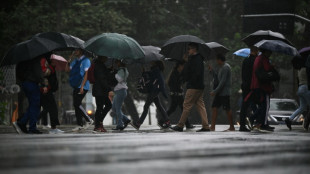 Rio breaks record for rainiest September amid powerful El Nino

 Mandela Digital Extends Early Access Programme to 11 February 2027 Following Strong Response

 McDonald's to boost franchisees as inflation weighs on consumers

 Archaelogical 'breakthrough' could confirm origins of Paris

At least three people were killed and more than 1,000 evacuated Thursday after South Korea was hit by torrential rains, officials said, with one region pummelled by the most rainfall per hour since full records began.
South Korea typically experiences monsoon rains in July, but three areas in the country's South Chungcheong province this week saw some of the heaviest hourly downpours on record, official weather data showed.
Three people were killed Thursday, the Ministry of Interior and Safety said, all in South Chuncheong province.
"As of 4pm local time at least three people have died today due to torrential rains," a Ministry of Interior and Safety official told AFP, adding that more than 1,000 people had been evacuated.
Police told AFP that one person was found inside a submerged vehicle, an elderly man was swept away near a stream, and another elderly man had been found dead in a flooded basement apartment after his son reported him missing.
The western Seosan area was hit by rainfall peaking at 114.9 millimetres (4.5 inches) per hour, "a level typically seen only once in 100 years", a weather agency official told AFP, adding that this was the highest rate since full records began in 1904.
The heavy rains were due to "warm and moist air flowing in along the edge of the North Pacific High, triggering strong atmospheric instability", the official added.
South Korean broadcasters ran videos of severe flooding in Seosan, with water swamping markets and apartment complexes, as well as submerging parked cars.
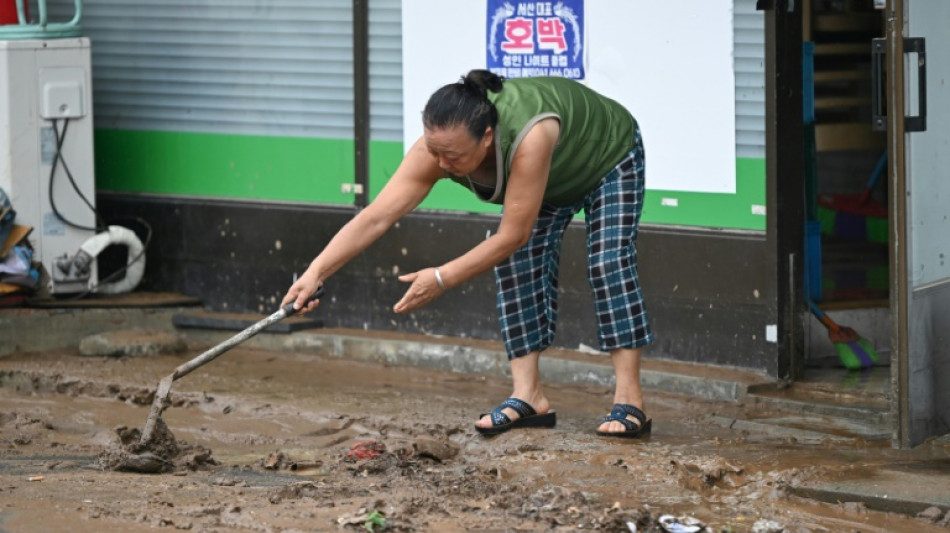
AFP reporters saw residents in Seosan struggling to clean up the aftermath of the floods on Thursday, with parking lots and shops still seen flooded with muddy water.
Choi Hee-jin, a nightclub owner, told AFP it had been "heartbreaking" to return to her business after the floods had swept through.
"Water had completely filled the club, and everything -- sofas, fridges, furniture, even computers -- was just floating around," Choi said.
"How do you think it feels to see that? Honestly, it felt like the world was collapsing. There are no words to describe it."
The national weather agency said in a statement that nearly 440 mm (about 17.3 inches) of rain had fallen in Seosan by 10:30 am on Thursday -- equivalent to 35 percent of the region's average annual rainfall.
"The water is just too deep and so much mud has been pushed in that I've already been working for about five hours trying to drain it all out," said Kim Min-seo, a 50-year-old restaurant worker, as she scrubbed the muddy floor.
"I'm still not done," she added.
- Evacuation orders -
Residents in Hongseong county, in South Chungcheong province, were ordered to "evacuate immediately to a safe location" early Thursday morning due to flooding from a nearby stream.
Several schools and nurseries in the county were also closed.
South Korea is regularly hit by flooding during the summer monsoon period, but is typically well-prepared and the death toll is usually relatively low.
Scientists say climate change has made weather events around the world more extreme and frequent.
South Korea also endured record-breaking rains and flooding in 2022, which left at least 11 people dead.
They included three people who died trapped in a Seoul basement apartment of the kind that became internationally known because of the Oscar-winning Korean film "Parasite".
The government said at the time that the rainfall was the heaviest since records began, blaming climate change for the extreme weather.
Y.Ibrahim--CPN