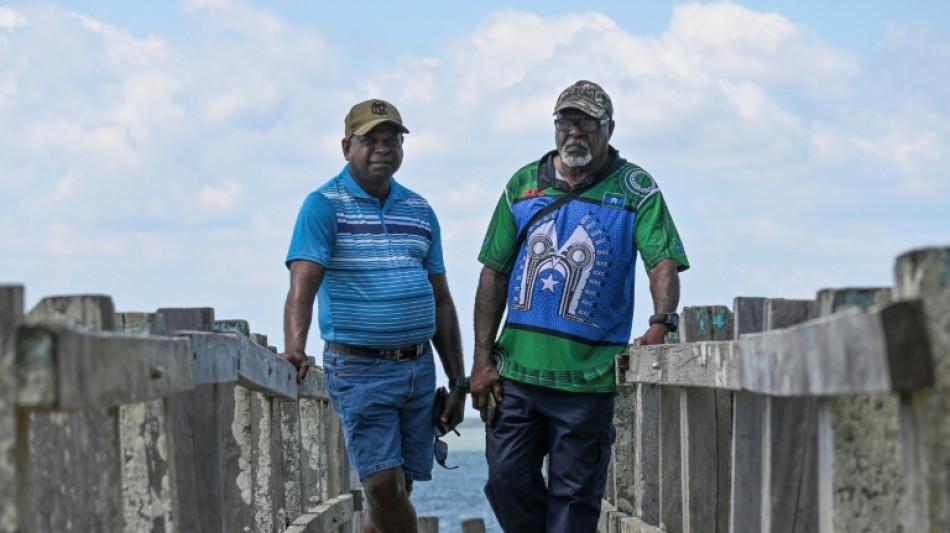
Indigenous Australians lose landmark climate court case against government / Photo: TALEI ELU - GRATA FUND/AFP

 First US trial against TikTok to open Monday

 French literary prize removes novel from longlist after AI claims

 Trump accuser E. Jean Carroll finally has her damages

 Heavy fighting, internet disruption as Ethiopia conflict rages
 Asian markets mixed after oil gains

 UN approves resolution on dealing with rising sea levels

 Global stocks mostly fall as oil prices and bond yields rise

 Starbucks to close 250 more cafes in North America

 Stocks fall as oil prices rise and bonds back under pressure

 Top ECB official to resign to take up IMF role

 Eviction of pensioner puts Spain housing crisis in spotlight

 Average EU diesel price hits record 2.23 euros a litre: AFP analysis

 Whitetip Investments Marks 10 Years of Regulation, Transparency & Responsible Trading

 Stocks fall, oil prices rise as global bonds under pressure

 Hungary detects invasive spotted lanternfly for first time in EU

 Forex Expo Dubai 2026 Breaks Guinness World Record Again With 23,816 Attendees

 Asian markets fall on US-China jitters as leaders meet

 As Moscow steps up attacks, Kyiv residents brace for harsh winter

 Markets mixed as China's Xi arrives for US talks

 Archaeological 'breakthrough' could confirm origins of Paris

 Australian PM says OpenAI hacked government health website

 Rio breaks record for rainiest September amid powerful El Nino

 Mandela Digital Extends Early Access Programme to 11 February 2027 Following Strong Response

 McDonald's to boost franchisees as inflation weighs on consumers

 Archaelogical 'breakthrough' could confirm origins of Paris

Indigenous Australians living on a string of climate-threatened islands on Tuesday lost a landmark court bid to hold the government responsible for lacklustre emissions targets.
Scattered through the warm waters off Australia's northernmost tip, the sparsely populated Torres Strait Islands are threatened by seas rising much faster than the global average.
Torres Strait elders have spent the past four years fighting through the courts to prove the government failed to protect them through meaningful climate action.
Australia's Federal Court found the government was not obliged to shield the Torres Strait Islands from climate change.
"I thought that the decision would be in our favour, and I'm in shock," said Torres Strait Islander Paul Kabai, who helped to bring the case.
"What do any of us say to our families now?"
Fellow plaintiff Pabai Pabai said: "My heart is broken for my family and my community."
Federal Court Justice Michael Wigney criticised the government for setting emissions targets between 2015 and 2021 that failed to consider the "best available science".
But these targets would have had little impact on global temperature rise, he found.
"Any additional greenhouse gases that might have been released by Australia as a result of low emissions targets would have caused no more than an almost immeasurable increase in global average temperatures," Wigney said.
Australia's previous conservative government sought to cut emissions by around 26 percent before 2030.
The incumbent left-leaning government in 2022 adopted new plans to slash emissions by 40 percent before the end of the decade, and reach net zero by 2050.
- 'Climate refugees' -
Fewer than 5,000 people live in the Torres Strait, a collection of about 274 mud islands and coral cays wedged between Australia's mainland and Papua New Guinea.
Lawyers for traditional land owners from Boigu and Saibai -- among the worst-impacted islands -- asked the court to order the government "to reduce greenhouse gas emissions to a level that will prevent Torres Strait Islanders from becoming climate refugees".
Sea levels in some parts of the archipelago are rising almost three times faster than the global average, according to official figures.
Rising tides have washed away graves, eaten through huge chunks of exposed coastline, and poisoned once-fertile soils with salt.
The lawsuit argued some islands would soon become uninhabitable if global temperatures rose more than 1.5 degrees Celsius above pre-industrial levels.
The World Meteorological Organization has warned this threshold could be breached before the end of the decade.
While Australia's emissions pale in comparison to the likes of China and the United States, the fossil fuel powerhouse is one of the largest coal exporters in the world.
L.Peeters--CPN