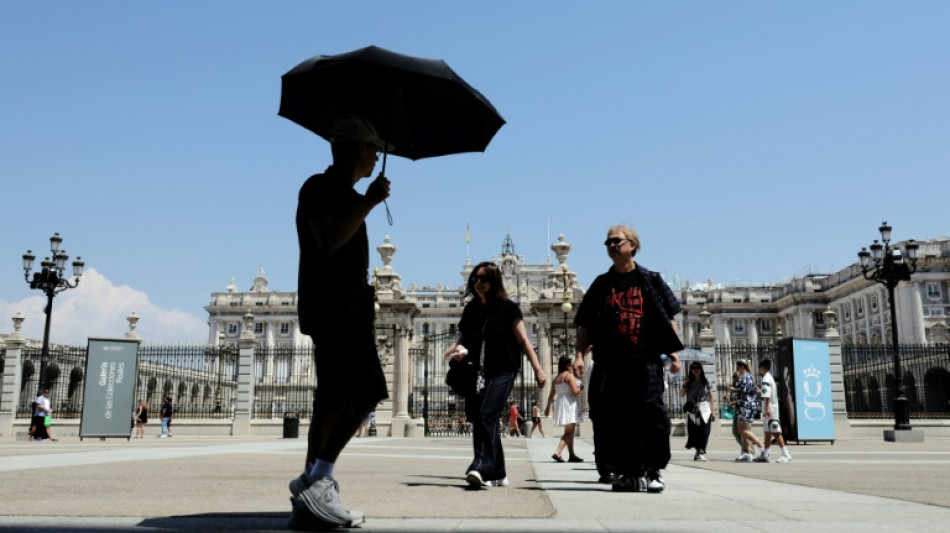
Climate change made European heatwave up to 4C hotter: study / Photo: Thomas COEX - AFP

 Trump's photo of Xi greeting carries signs of AI

 First US trial against TikTok to open Monday

 French literary prize removes novel from longlist after AI claims
 Trump accuser E. Jean Carroll finally has her damages
 Heavy fighting, internet disruption as Ethiopia conflict rages

 Asian markets mixed after oil gains

 UN approves resolution on dealing with rising sea levels

 Global stocks mostly fall as oil prices and bond yields rise

 Starbucks to close 250 more cafes in North America

 Stocks fall as oil prices rise and bonds back under pressure
 Top ECB official to resign to take up IMF role

 Eviction of pensioner puts Spain housing crisis in spotlight

 Average EU diesel price hits record 2.23 euros a litre: AFP analysis

 Whitetip Investments Marks 10 Years of Regulation, Transparency & Responsible Trading

 Stocks fall, oil prices rise as global bonds under pressure

 Hungary detects invasive spotted lanternfly for first time in EU

 Forex Expo Dubai 2026 Breaks Guinness World Record Again With 23,816 Attendees

 Asian markets fall on US-China jitters as leaders meet

 As Moscow steps up attacks, Kyiv residents brace for harsh winter
 Markets mixed as China's Xi arrives for US talks

 Archaeological 'breakthrough' could confirm origins of Paris

 Australian PM says OpenAI hacked government health website

 Rio breaks record for rainiest September amid powerful El Nino

 Mandela Digital Extends Early Access Programme to 11 February 2027 Following Strong Response

 McDonald's to boost franchisees as inflation weighs on consumers
Human-caused climate change made recent European heatwaves up to 4C hotter in many cities, scientists said on Wednesday, pushing temperatures into deadly territory for thousands of vulnerable people.
This likely led to far more heat-related deaths than would have occurred without the influence of global warming, concluded a rapid study of the episode by over a dozen researchers from five European institutions.
Temperatures between late June and early July soared well above 40 degrees Celsius (104F) in many European countries as the first heatwave of the summer broke records and triggered health warnings.
The EU's climate monitor Copernicus on Wednesday said it was the hottest June on record in western Europe, where some schools and tourist sites were shuttered as the mercury soared.
To assess what role climate change played, scientists compared how intense a heatwave would have been in a world that had not warmed due to burning masses of fossil fuels.
Using historical weather data, they concluded the heatwave "would have been 2-4C cooler" without human-induced climate change in all but one of the 12 cities studied.
The added degrees greatly elevated the risk in these cities, which have a combined population of more than 30 million and include major capitals Paris, London and Madrid.
"What that does is it brings certain groups of people into more dangerous territory," said researcher Ben Clarke from Imperial College London, which co-led the study with the London School of Hygiene and Tropical Medicine.
"For some people it's still warm, fine weather. But for now a huge sector of the population, it's more dangerous," he told reporters.
- Life and death -
The study, for the first time, also sought to estimate the death toll from the heatwave in the 12 cities studied, and how many could be attributed to climate change.
Based on peer-reviewed scientific methods and established research on heat and mortality, the study concluded the heatwave likely caused about 2,300 deaths between June 23 and July 2 across the 12 cities studied.
But about 1,500, or roughly two thirds, of all these deaths would not have occurred had climate change not pushed temperatures to such dangerous highs, researchers said.
The authors -- from research institutions in the UK, Netherlands, Denmark and Switzerland -- stressed this estimate was just a snapshot of the wider heatwave, as no official count was yet available.
Heatwaves are particularly dangerous for the elderly, the sick, young children, outdoor workers, and anyone exposed to high temperatures for prolonged periods without relief.
The effect on health is compounded in cities, where heat is absorbed by paved surfaces and buildings, making urban areas much hotter than their surroundings.
Copernicus said large parts of southern Europe experienced so-called "tropical nights" during the heatwave, when overnight temperatures don't fall low enough to let the body recover.
"An increase in heatwave temperature of just two or four degrees can mean the difference between life and death for thousands of people," said Garyfallos Konstantinoudis, a lecturer at Imperial College London.
"This is why heatwaves are known as silent killers. Most heat-related deaths occur in homes and hospitals out of public view and are rarely reported," he told reporters.
Authorities say it could take weeks to tally a more definitive death toll from the recent heatwave, but similar episodes have claimed tens of thousands of lives in Europe during previous summers.
St.Ch.Baker--CPN