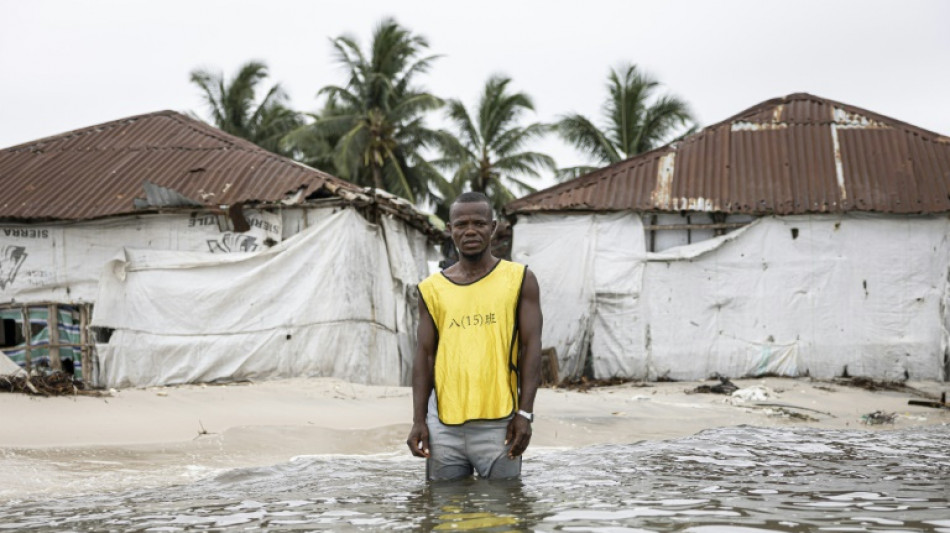
S.Leone islanders despair as rising ocean threatens survival / Photo: PATRICK MEINHARDT - AFP

 Trump's photo of Xi greeting carries signs of AI

 First US trial against TikTok to open Monday
 French literary prize removes novel from longlist after AI claims

 Trump accuser E. Jean Carroll finally has her damages

 Heavy fighting, internet disruption as Ethiopia conflict rages
 Asian markets mixed after oil gains

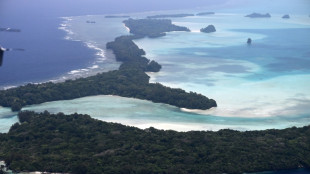 UN approves resolution on dealing with rising sea levels
 Global stocks mostly fall as oil prices and bond yields rise

 Starbucks to close 250 more cafes in North America

 Stocks fall as oil prices rise and bonds back under pressure
 Top ECB official to resign to take up IMF role

 Eviction of pensioner puts Spain housing crisis in spotlight

 Average EU diesel price hits record 2.23 euros a litre: AFP analysis

 Whitetip Investments Marks 10 Years of Regulation, Transparency & Responsible Trading

 Stocks fall, oil prices rise as global bonds under pressure

 Hungary detects invasive spotted lanternfly for first time in EU

 Forex Expo Dubai 2026 Breaks Guinness World Record Again With 23,816 Attendees

 Asian markets fall on US-China jitters as leaders meet
 As Moscow steps up attacks, Kyiv residents brace for harsh winter
 Markets mixed as China's Xi arrives for US talks

 Archaeological 'breakthrough' could confirm origins of Paris

 Australian PM says OpenAI hacked government health website

 Rio breaks record for rainiest September amid powerful El Nino
 Mandela Digital Extends Early Access Programme to 11 February 2027 Following Strong Response

 McDonald's to boost franchisees as inflation weighs on consumers
Wading through water up to his knees, Hassan Kargbo points to the vast ocean before him, which is eroding the land and imperilling residents' survival on his island off Sierra Leone.
"Where we are now, it used to be my house, and we used to have a big football field," Kargbo said, but "the water destroyed everything".
Over the past five years the 35-year-old fisherman has seen the losses pile up as the rising Atlantic waters, which threaten millions across his west African nation, have claimed enormous portions of his island.
The inhabitants of Nyangai, located in the Turtle Islands off southern Sierra Leone, have made virtually no contribution to global warming, driven by humanity's burning of fossil fuels.
Yet they are widely considered the country's first people displaced by climate change, as the ever-hotter temperatures melt more of the Earth's ice caps, swelling the seas around the archipelago.
The majority of Nyangai's exhausted residents have lost their belongings and homes several times over, as they crowd further into the island's interior.
An AFP team was able to visit several of the Turtle Islands, travelling seven hours by canoe in rough seas from the capital, Freetown.
On arrival in Nyangai, pelican colonies, white sand beaches and palm trees make the island appear almost like a paradise.
Then the devastation comes into focus: palm trees uprooted by wind and wave, beaches littered with branches and debris, sandbags serving as insufficient ramparts, abandoned furniture scattered by people who have long moved on.
In less than 10 years, the island has lost two-thirds of its surface area, and now measures only about 200 metres long and 100 metres wide (approximately 650 by 330 feet).
Seen from above, all that remains is a small islet ringed by fishing canoes, with thatched-roof shacks clustered tightly in the centre.
- Water 'always coming' -
Ten years ago, Nyangai still had a thousand inhabitants. Although there is no official census, community leaders estimate that fewer than 300 residents remain.
Goats and chickens roam between houses made of white tarpaulins stretched around wooden frames. Fishermen mend their nets, women smoke and dry fish on the sand, and children scamper on the beach.
Due to the shrinking space, the island is incredibly overcrowded. Drinkable water is lacking due to the soil's saltiness and there are no toilets, electricity or health clinics. Residents use the beach as an open-air washroom.
Impoverished Sierra Leone is one of the nations most threatened by global warming.
More than two million people along Sierra Leone's coast are threatened by rising sea levels, according to a June 2024 study by the country's National Disaster Management Agency (NDMA) and the NGO Internal Displacement Monitoring Centre (IDMC).
The country is "highly vulnerable to the increased frequency and severity of coastal erosion and sea level rise linked to the effects of climate change and human activities", the study said.
Fisherman and community chief Amidou Bureh stood on the beach looking far out into the ocean where the land used to be.
"We had many trees here, mangoes, coconut and other trees, but over the years water has destroyed all of them," the 60-year-old said.
Letting out a sudden cry of despair, he said: "The water is always coming, coming, coming and destroying us and our properties. All the people need is help, and we are asking for more help."
Officials and international organisations have not provided any concrete assistance beyond recommending relocation, he added.
Kargbo said that his family has already lost its belongings and rebuilt their house in Nyangai twice. But the sea is at their door once again.
"I have no confidence that Nyangai will continue to exist," he said, explaining that he has made the difficult decision to prepare to move to Sei island, where the terrain is less flat.
"It costs me a lot of money to buy sticks, to buy zinc, anytime I want to construct a new house after moving from the other one," he said, lamenting his poor wages as a fisherman.
"To live in this island is really stressful." he said. "I don't want to continue that."
- 'Devastating' -
Sierra Leone's environment and climate change minister, Jiwoh Abdulai, told AFP that what is happening on the islands is now beyond an emergency.
"It is really heart-wrenching to see how devastating the impact is on people's lives," he said.
On AFP's first morning in Nyangai, parts of the island had been washed out by an overnight storm.
Mohamed Kamara, a 19-year-old father, surveyed the damage sustained by his property following the violent winds and rain.
Other shacks nearby were gutted, with tarps and planks covering holes caused by the tempest.
In his small family courtyard several women were busy sorting through items swept onto the soggy sand floor: plastic basins, drenched clothes, pieces of fishing nets.
Kamara said his family had been suffering from similar weather since 2018, including in February when an uprooted tree badly damaged their home.
Feeling sapped and defeated, they plan to leave the island for the capital or another major city this year.
- Islands 'will go' -
Several hours away from Nyangai by canoe on Plantain island, some 355 school children attend class in a building located precariously on a ravaged bank.
In July 2023, tragedy was avoided when the waters swept away an empty part of the building, where children had been studying just the day before.
Ousmane Kamara, the school's director and the island's imam, told AFP there was no other place for the children to study
In the ocean in front of him, the minaret of a now-submerged mosque poked out.
Beyond it lies an islet that used to be part of Plantain but is now a separate body of land. In the surrounding waters, there had been hundreds of homes, according to community members.
The island's new mosque has been fitted with stones and wood in an attempt to keep water from reaching the interior.
That endeavour has only been somewhat successful.
"We have a fear that maybe one day while we are in the mosque, the waves will come and will trash everything," Kamara said.
Plantain, whose population once numbered in the thousands, has been losing land and residents for decades due to rising water.
The island has traditionally been a crossroads for trade, agriculture, fishing and maritime transport in addition to a tourist spot, particularly for its ruins dating back to the slave trade.
But its structures have gradually been submerged.
Those who were unable to leave due to a lack of financial resources were forced to move further inland, where they are once again under threat.
Joseph Rahall, a Sierra Leone environmental expert, gives the Turtle Islands 10 to 15 years before they disappear.
"The entire archipelago will go, it's just a question of time," he said.
- 'Our home' -
The crisis also threatens the islanders' social and cultural traditions.
"When the sea takes over, everything goes, a culture of fishing disappears," Rahall said.
Climate change erases an entire way of life, he said, including "traditions, culture, the way of doing business".
For Abdulai, the environment minister, the residents "need interventions now".
"We need to get them out of there, we are just trying to get the resources to be able to do so", he said.
But the cost is an issue.
"What we keep telling the world is that climate change is having a devastating impact not just on our people but on our budget", he said.
Many Nyangai and Plantain residents told AFP they feel abandoned by the authorities as their homes disappear.
As the muezzin's call for late afternoon prayers carried across the small island of Nyangai, Bureh contemplated the ocean engulfing his life.
"Our worry is the water, that the water will destroy us," he said.
But he added: "For me I don't plan to go anywhere because this is our home".
Y.Tengku--CPN