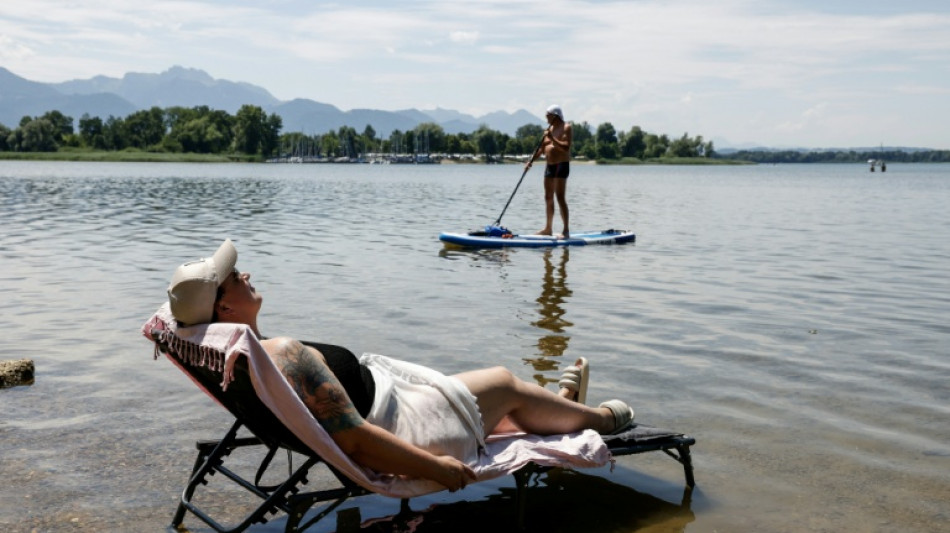
Germany swelters as European heatwave moves eastwards / Photo: Michaela STACHE - AFP

 Jay-Z rape accuser says she made 'false accusations'

 Trump's photo of Xi greeting carries signs of AI

 First US trial against TikTok to open Monday

 French literary prize removes novel from longlist after AI claims

 Trump accuser E. Jean Carroll finally has her damages

 Heavy fighting, internet disruption as Ethiopia conflict rages

 Asian markets mixed after oil gains

 UN approves resolution on dealing with rising sea levels

 Global stocks mostly fall as oil prices and bond yields rise

 Starbucks to close 250 more cafes in North America

 Stocks fall as oil prices rise and bonds back under pressure
 Top ECB official to resign to take up IMF role

 Eviction of pensioner puts Spain housing crisis in spotlight

 Average EU diesel price hits record 2.23 euros a litre: AFP analysis

 Whitetip Investments Marks 10 Years of Regulation, Transparency & Responsible Trading

 Stocks fall, oil prices rise as global bonds under pressure

 Hungary detects invasive spotted lanternfly for first time in EU

 Forex Expo Dubai 2026 Breaks Guinness World Record Again With 23,816 Attendees

 Asian markets fall on US-China jitters as leaders meet

 As Moscow steps up attacks, Kyiv residents brace for harsh winter

 Markets mixed as China's Xi arrives for US talks

 Archaeological 'breakthrough' could confirm origins of Paris

 Australian PM says OpenAI hacked government health website

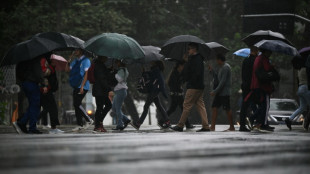 Rio breaks record for rainiest September amid powerful El Nino

 Mandela Digital Extends Early Access Programme to 11 February 2027 Following Strong Response

A punishing early summer heatwave that has already scorched western and southern Europe spread east Wednesday, bringing extreme weather warnings to Germany and reportedly causing motorways to buckle.
But some relief is due to arrive from the Atlantic and spread across the continent.
Germany's national weather service (DWD) warned of "exceptionally high" temperatures reaching close to 40C degrees (104F) in places Wednesday.
In Berlin, 18-year-old Nora said her strawberry stand on the side of the road felt "like a sauna" before temperatures had even reached their peak.
Her boss had told her to close the stall if she felt unwell, as the German capital sweated under a hot sun, Nora told AFP.
The heat was causing disruptions to transport, with Germany's national rail operator Deutsche Bahn warning of impaired services in the west of the country, where temperatures were highest.
In the north-west close to the city of Bremen, the heat had caused the surface of the motorway to buckle in places, creating a danger for drivers, local media reported.
The acute high temperatures added to an extended period of unusually hot and dry weather through the first half of the year.
As well as an increased risk of forest fires, Germany's rivers are also running low, causing problems for navigating the country's waterways.
- 'Strange' -
In the eastern city of Dresden, the level of the Elbe river has sunk to just 64 centimetres (25 inches), compared with an average of around two metres.
Holger Boehme, the owner of a floating theatre said it was "strange" to see the usually wide river shrink to a fraction of its usual size.
"There has always been high water and low water, but this type of extreme high water and extreme low is truly new in recent years," Boehme told AFP.
The current levels of Germany's rivers were typically more likely to be seen at the end of the summer, Matthias Roeser from the Federal Association of German Inland Navigation said.
In France, temperatures had cooled slightly overnight into Wednesday but remained high. Paris was expected to experience highs of around 35C after hitting 40C on Tuesday, according to weather service Meteo-France.
French Health Minister Catherine Vautrin confirmed it was "too early to take stock" of the consequences of the heatwave.
But for the Paris metro area there had been a "serious" increase in emergency services' activity of around 15 percent as the mercury rose.
An official estimate of the excess mortality linked to the heatwave would take two weeks for French authorities to compile, the ministry indicated.
- 'Feel the heat' -
Residents in Spain and Italy may have to wait until the weekend before they experience a drop in temperatures.
In Madrid, care worker Grace Guerrero, 65, told AFP she could really "feel the heat" but the air was cooler at her home outside the Spanish capital.
A 75-year-old man died in the southern city of Cordoba, bringing the total number of heat related deaths over the last 10 days in Spain to at least four.
Barcelona adopted plans to extend protections for sanitation workers in heatwaves, including more water breaks, after a woman died Saturday following her shift.
In Italy, at Rome's ancient forum, archeological excavation work stopped early at around 12:30 pm (1030 GMT) as temperatures soared to 35C.
Elena Civitelli, an archeologist with two decades of experience, told AFP she could not remember "suffering so much in the early hours of the morning" as she had in recent days.
In Belgium, the Atomium attraction in Brussels, where highs of 34C were expected, was also set to maintain reduced opening hours for the second day in a row on Wednesday to spare visitors from the afternoon heat.
But coastal areas in Belgium were already experiencing lower temperatures Wednesday, and cool winds blowing in from the Atlantic were expected to see highs in France drop to near 28C on Thursday.
The colder front would however bring with it the possibility of heavy thunderstorms, according to Meteo-France.
The German weather service also warned of storms in eastern Germany and had already issued the weather warnings for severe winds and rain in isolated areas in the western part of the country as of Wednesday afternoon, with temperatures expected to drop to around 30C or below over the next two days.
burs-sea/jsk/gv
C.Smith--CPN