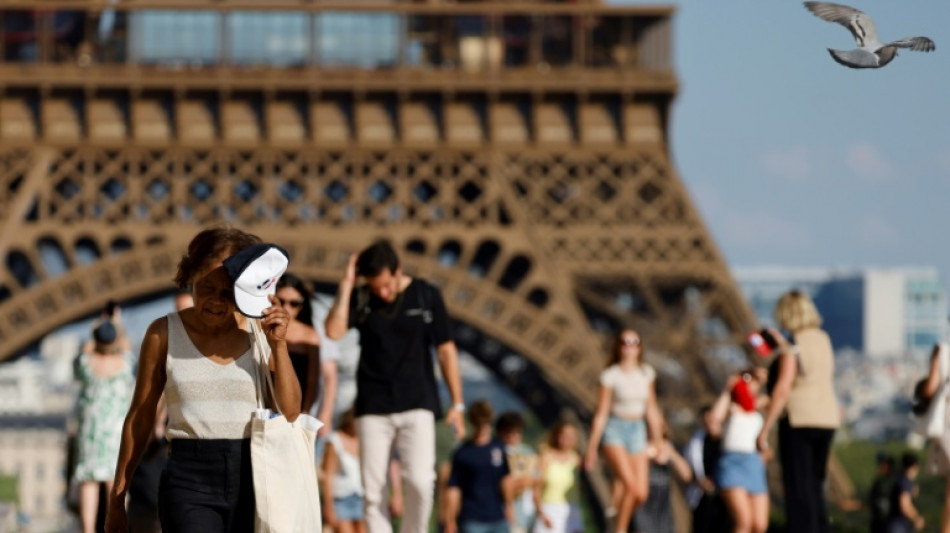
Europe swelters as surprise early summer heatwave spreads / Photo: Ludovic MARIN - AFP

 Jay-Z rape accuser says she made 'false accusations'

 Trump's photo of Xi greeting carries signs of AI

 First US trial against TikTok to open Monday
 French literary prize removes novel from longlist after AI claims
 Trump accuser E. Jean Carroll finally has her damages
 Heavy fighting, internet disruption as Ethiopia conflict rages

 Asian markets mixed after oil gains

 UN approves resolution on dealing with rising sea levels

 Global stocks mostly fall as oil prices and bond yields rise
 Starbucks to close 250 more cafes in North America

 Stocks fall as oil prices rise and bonds back under pressure
 Top ECB official to resign to take up IMF role

 Eviction of pensioner puts Spain housing crisis in spotlight

 Average EU diesel price hits record 2.23 euros a litre: AFP analysis

 Whitetip Investments Marks 10 Years of Regulation, Transparency & Responsible Trading

 Stocks fall, oil prices rise as global bonds under pressure
 Hungary detects invasive spotted lanternfly for first time in EU

 Forex Expo Dubai 2026 Breaks Guinness World Record Again With 23,816 Attendees

 Asian markets fall on US-China jitters as leaders meet

 As Moscow steps up attacks, Kyiv residents brace for harsh winter
 Markets mixed as China's Xi arrives for US talks

 Archaeological 'breakthrough' could confirm origins of Paris

 Australian PM says OpenAI hacked government health website

 Rio breaks record for rainiest September amid powerful El Nino
 Mandela Digital Extends Early Access Programme to 11 February 2027 Following Strong Response

Nearly 2,000 schools were shut in France, monuments closed to tourists, and cities across Europe put on high alert as a record-breaking early summer heatwave spread across the continent Tuesday.
Withering conditions that have baked southern Europe for days crept northward where such extremes are much rarer, with Paris on "red alert" and warnings issued in Belgium, Switzerland and Germany.
Tens of thousands of people have died in Europe during past heatwaves, prompting authorities to issue warnings for old and young, the sick, and others vulnerable to what experts call a "silent killer".
On Tuesday, police in Spain said a two-year-old died in the country's northeast after being left in a car in the sun for several hours.
The EU's Copernicus Climate Change Service (C3S) warned that millions of Europeans were exposed to high heat stress, and that temperatures would remain "well above average" across most of the continent in coming days.
"This event is unusual because it's extreme, because it's very early on in the summer period, and climate change has almost certainly made it worse than it otherwise would have been," climate scientist and C3S deputy director Samantha Burgess told AFP.
Records have already tumbled, with the Netherlands experiencing its hottest opening day of July, France and Portugal their highest-ever single-day temperatures in June, and Spain and England their warmest June months.
On Sunday, in a case of two extremes, the Mediterranean Sea hit a new June temperature record while Mont Blanc, the highest peak in Europe, went above freezing, a rarity for this time of year.
- 'Living like moles' -
The summit of the Eiffel Tower was shut for a second straight day while in Brussels the city's Atomium monument -- famed for its giant stainless steel balls -- was exceptionally shut as temperatures reached 37 degrees Celsius (98 degrees Fahrenheit).
Under scorching skies, Paris imposed its first "red alert" in five years, empowering officials to limit or ban sporting events, festivals and school outings for children.
The heat is expected to peak on Tuesday, with Paris facing highs of 38C, but authorities have extended the alert into Wednesday.
"We're living a bit like moles," Nicole, 85, told AFP in the stifling air of her apartment in a tower block in Paris.
Some parks will remain open all night, pools have extended visiting hours, and cooling centres in churches and museums are offering respite from the lack of greenery and concrete surfaces that amplify the heat.
Nearly 2,000 schools were closed at midday on Tuesday across France, according to the Ministry of Education, with teachers complaining that overheated and unventilated classrooms were making students unwell.
Authorities are fanning out to check on the elderly, chronically ill and the homeless.
"When it's cold, I add blankets and hats. But when it's hot like this, what can I do?" said Jo, a 55-year-old homeless man in Bordeaux, in southwestern France.
- 'Unbearable' -
As far north as the Netherlands, some regions were on the second-highest alert Tuesday, with temperatures forecast to reach 38C.
"I also live in a rooftop apartment, which means it gets insanely hot during the day, and it's unbearable," student Liva Freimane told AFP in The Hague.
Schools in Rotterdam and across West Brabant province adopted "tropical schedules" to ensure students started and finished earlier to avoid the worst of the day's heat.
In Germany, temperatures could peak at 40C on Wednesday.
In Spain and Portugal, where highs of 46C were recorded in some locations over the weekend, a level of respite was expected, though temperatures could still exceed 40C in parts.
"Extreme heat doesn't have to be a disaster: knowledge, preparedness and early action make all the difference," said Tommaso Della Longa from the International Federation of Red Cross and Red Crescent Societies (IFRC), whose volunteers were fanning out across Europe.
Burgess said European cities were adapting "but not quick enough or extensive enough".
"We're still seeing infrastructure challenges associated with heatwaves, pressure on national healthcare systems, and we still have excess deaths," she said.
Heat kills more people than hurricanes, floods, wildfires or any other climate-related extreme weather. A heatwave in 2022 killed an estimated 60,000 people across Europe, mostly elderly.
The death toll from this "silent killer" was under-reflected in official statistics, the World Meteorological Organization said Tuesday.
Spokeswoman Clare Nullis said society would have to adapt a harsher, hotter future.
"What can we expect in the future? More of the same, even worse," Nullis said.
burs-np-bl/phz
M.Davis--CPN