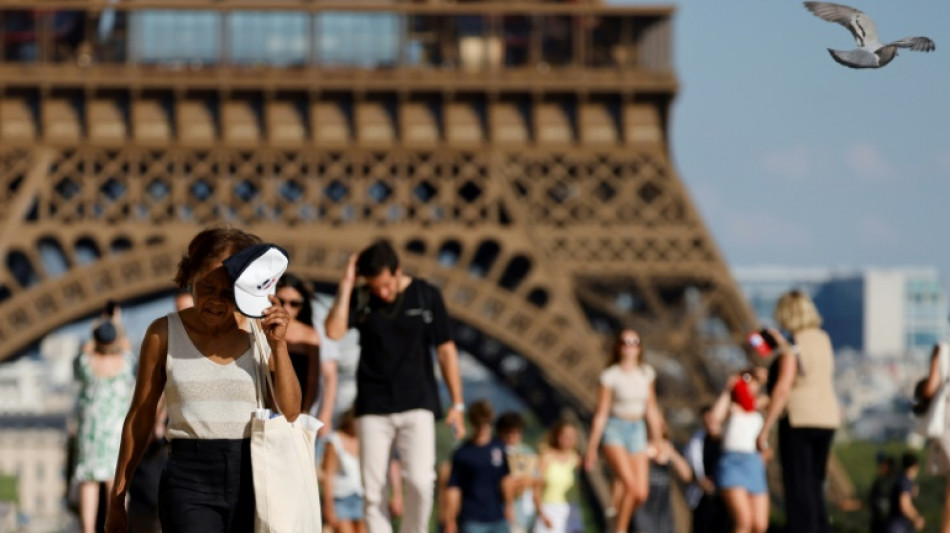
Europe on high alert as surprise early heatwave creeps north / Photo: Ludovic MARIN - AFP

 Jay-Z rape accuser says she made 'false accusations'

 Trump's photo of Xi greeting carries signs of AI

 First US trial against TikTok to open Monday
 French literary prize removes novel from longlist after AI claims

 Trump accuser E. Jean Carroll finally has her damages

 Heavy fighting, internet disruption as Ethiopia conflict rages

 Asian markets mixed after oil gains

 UN approves resolution on dealing with rising sea levels

 Global stocks mostly fall as oil prices and bond yields rise

 Starbucks to close 250 more cafes in North America

 Stocks fall as oil prices rise and bonds back under pressure
 Top ECB official to resign to take up IMF role

 Eviction of pensioner puts Spain housing crisis in spotlight

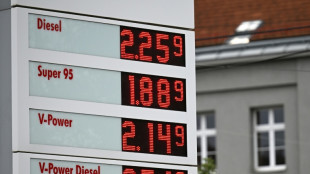 Average EU diesel price hits record 2.23 euros a litre: AFP analysis

 Whitetip Investments Marks 10 Years of Regulation, Transparency & Responsible Trading

 Stocks fall, oil prices rise as global bonds under pressure

 Hungary detects invasive spotted lanternfly for first time in EU

 Forex Expo Dubai 2026 Breaks Guinness World Record Again With 23,816 Attendees

 Asian markets fall on US-China jitters as leaders meet

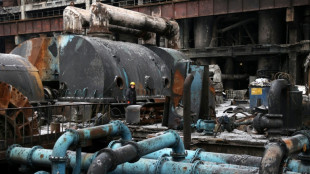 As Moscow steps up attacks, Kyiv residents brace for harsh winter
 Markets mixed as China's Xi arrives for US talks

 Archaeological 'breakthrough' could confirm origins of Paris

 Australian PM says OpenAI hacked government health website

 Rio breaks record for rainiest September amid powerful El Nino
 Mandela Digital Extends Early Access Programme to 11 February 2027 Following Strong Response

Paris braced for blistering temperatures on Tuesday, with the French capital on red alert as an early summer heatwave spread into parts of northern Europe less accustomed to such extremes.
Withering conditions that have baked southern Europe for days crept northward, shutting some schools and daycare centres in France and the Netherlands, and sparking health warnings.
Scientists said it was unusual for such heat to hit Europe this early in the season, but that human-caused climate change from burning fossil fuels was making these once-rare events far more likely.
Such prolonged and powerful events in recent decades have killed tens of thousands in Europe, and extraordinary health measures have been imposed across Spain and Portugal through France and Italy to the Balkans and Greece.
"More and more European cities are adapting, but arguably it's not quick enough or extensive enough," Samantha Burgess, deputy director of the Copernicus Climate Change Service, told AFP.
"We're still seeing infrastructure challenges associated with heatwaves, pressure on national healthcare systems, and we still have excess deaths."
The French national weather service expected the heat to peak on Tuesday after the country experienced its hottest June day on record on Monday.
Some areas were tipped to soar past 40 degrees Celsius (104 degrees Fahrenheit) on Tuesday.
"We have air-conditioning but it's not very powerful," said 27-year-old Raphael in Paris, where the first "red alert" in five years has been imposed.
"Today is going to be a struggle."
A red alert is the highest possible warning, and empowers officials to limit or ban sporting events, festivals and school outings for children.
Authorities said these exceptional measures would extend into Wednesday.
- 'What can I do?' -
The iconic peak of the 330-metre (1,083-feet) Eiffel Tower was shut on Monday and operators said it would remain closed until Wednesday.
Across France, the government said it expected nearly 1,350 schools to be partially or completely shut -- nearly double the number on Monday -- with teachers complaining that overheated and unventilated classrooms were making students unwell.
Warnings were issued for young children, older people, and those on the street or with chronic illnesses.
"When it's cold, I add blankets and hats. But when it's hot like this, what can I do? Nothing, just wait for it to pass and hope I don't faint," said Jo, a 55-year-old homeless man in Bordeaux.
As far north as the Netherlands, some regions were placed on the second-highest alert on Tuesday with temperatures forecast to reach to 38C.
In Amsterdam, extra measures were put in place to protect the homeless while officials in Eindhoven and Arnhem deployed teams to check-in on vulnerable elderly people.
Schools in Rotterdam and across West Brabant have adopted "tropical schedules" that mean shorter hours and additional water breaks for pupils to reduce heat exposure.
- 'Unusual, extreme' -
Portugal is expecting some respite on Tuesday after two days on red alert in several regions, including Lisbon, and warnings will be downgraded in all but eight areas inland.
But temperatures were still expected to reach 40C in the central city of Castel Branco, Beja and Evora in the south, and 34C in the capital.
Similar temperatures in the high 30s to mid 40s were forecast in Spain after they soared to 46C in the south -- a new record for June, according to the national weather agency.
Red alerts have been issued for 18 Italian cities in the coming days, including Rome, Milan, Verona, Perugia and Palermo, as well as across the Adriatic on the Croatian coast and Montenegro.
"This event is unusual because it's extreme, because it's very early on in the summer period and climate change has almost certainly made it worse than it otherwise would have been," said Burgess.
These events were lasting longer and impacting a wider area, she added.
"We need to adapt, and adaptation is no future problem. It's a current problem."
The risk of forest fires remains high in a number of Portuguese regions. On Monday night, some 250 firefighters were tackling a blaze in the southern Aljustrel area.
In Turkey, rescuers evacuated more than 50,000 people threatened by a string of wildfires, most from the western province of Izmir, where winds of 120 kilometres (75 miles) per hour fanned the blazes.
Greece has also been tackling wildfires.
burs-np-bl/yad
C.Smith--CPN