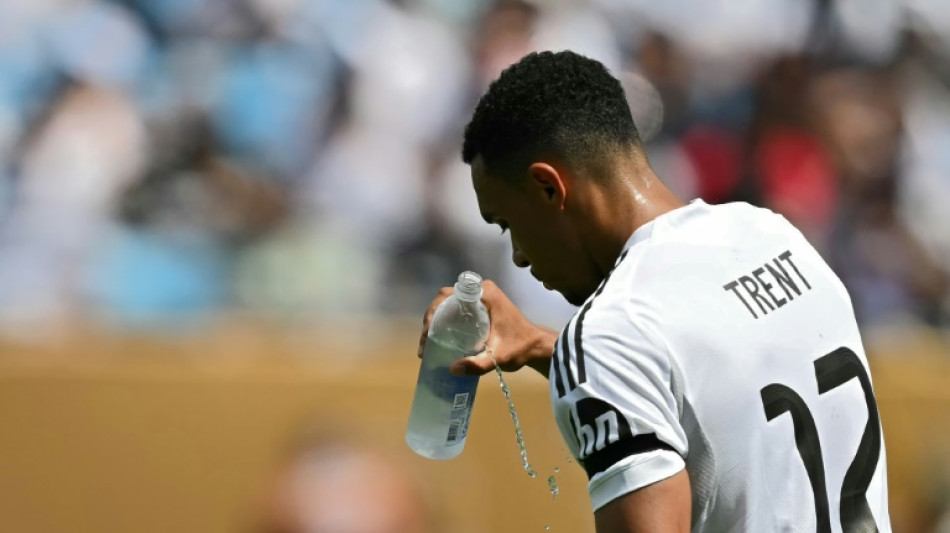
FIFPro warns of 'wake-up call' over extreme heat at Club World Cup / Photo: Paul ELLIS - AFP/File

 Jay-Z rape accuser says she made 'false accusations'

 Trump's photo of Xi greeting carries signs of AI

 First US trial against TikTok to open Monday
 French literary prize removes novel from longlist after AI claims
 Trump accuser E. Jean Carroll finally has her damages
 Heavy fighting, internet disruption as Ethiopia conflict rages

 Asian markets mixed after oil gains

 UN approves resolution on dealing with rising sea levels

 Global stocks mostly fall as oil prices and bond yields rise

 Starbucks to close 250 more cafes in North America
 Stocks fall as oil prices rise and bonds back under pressure

 Top ECB official to resign to take up IMF role

 Eviction of pensioner puts Spain housing crisis in spotlight
 Average EU diesel price hits record 2.23 euros a litre: AFP analysis

 Whitetip Investments Marks 10 Years of Regulation, Transparency & Responsible Trading

 Stocks fall, oil prices rise as global bonds under pressure
 Hungary detects invasive spotted lanternfly for first time in EU

 Forex Expo Dubai 2026 Breaks Guinness World Record Again With 23,816 Attendees

 Asian markets fall on US-China jitters as leaders meet

 As Moscow steps up attacks, Kyiv residents brace for harsh winter

 Markets mixed as China's Xi arrives for US talks
 Archaeological 'breakthrough' could confirm origins of Paris

 Australian PM says OpenAI hacked government health website

 Rio breaks record for rainiest September amid powerful El Nino
 Mandela Digital Extends Early Access Programme to 11 February 2027 Following Strong Response

Global footballers' union FIFPro on Monday called for longer half-time breaks at next year's World Cup to mitigate the effects of extreme heat, saying challenges faced by players at the ongoing Club World Cup should be a "wake-up call" for FIFA.
Conditions have often been brutal for players at the Club World Cup due to the heat across much of the United States, with coaches of several competing teams complaining about the challenges posed by the temperatures.
With the 2026 World Cup across North America on the horizon, a FIFPro study warned that six of the 16 venues for next year's tournament present an "extremely high risk" of heat-stress injury for players -- including Miami which is one of the cities hosting games at the Club World Cup.
"This tournament is probably a really good wake-up call for everyone to look at the scheduling of matches in future tournaments," said Alexander Bielefeld, FIFPro's director of policy and strategic relations.
Many matches during the Club World Cup have kicked off at midday local time or at 3:00 pm. Atletico Madrid's Marcos Llorente complained of conditions being "impossible, a terrible heat" as his team lost 4-0 to Paris Saint-Germain in searing temperatures in Pasadena.
"We have a couple of tournaments ahead of us where we will look at that side," Bielefeld added, with the World Cup next year now an obvious concern as well as the 2030 tournament set to be played in challenging summer heat in Spain, Portugal and Morocco.
The organisation's general secretary, Alex Phillips, said FIFPro had been in discussions with FIFA, world football's governing body, about avoiding playing matches at the hottest times of the day at certain venues.
However, he admitted they cannot ultimately do anything if, for example, FIFA chooses to play matches early in the afternoon in the United States in order to suit a prime-time audience in Europe.
"That is basically what has happened with this tournament. We make a submission not to kick off at certain times, but then we have no veto," said Phillips.
"Based on this experience they are likely to be more flexible but we have no absolute power to force anything.
"We will do our best to try to influence the outcome but without any formal coercive powers."
The union said it was happy with some measures put in place to deal with high temperatures at the Club World Cup, such as making more water and cold towels available by the pitch for players.
"We are partially happy because FIFA have been quite responsive, once the tournament was underway," Phillips said.
- Longer half-time break? -
Yet Vincent Gouttebarge, FIFPro's medical director, suggested that half-time could be extended from 15 minutes to 20 minutes in the event of high temperatures.
He also said that current protocols surrounding drinks breaks should be modified, insisting that stopping games half an hour into each half to allow players to rest and take on fluids was not enough.
"We are looking at more regular cooling breaks, shorter ones, but maybe every 15 minutes," he said.
As well as issues with heat, six matches at the Club World Cup have been hit by lengthy delays due to widely-used rules in the United States that require outdoor sporting events to be halted if there is a chance of thunderstorms.
FIFPro said it understood the inconvenience of those delays to matches but insisted its focus for now was on the dangers of excess temperatures.
"It is at the moment a legal requirement in some US states so I don't think there is much football can do at this point," Bielefeld said of the interruptions.
"Football would always take a health and safety approach.
"If these are the laws then we have to work with it but of course we understand if a coach or players sees it as severely disruptive."
L.Peeters--CPN