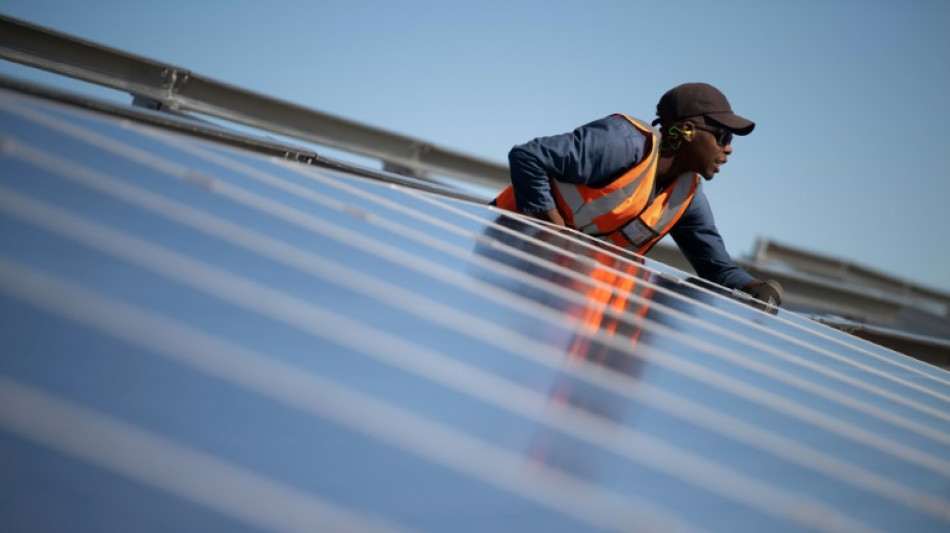
World Bank and IMF climate snub 'worrying': COP29 presidency / Photo: RODGER BOSCH - AFP/File

 Jay-Z rape accuser says she made 'false accusations'

 Trump's photo of Xi greeting carries signs of AI

 First US trial against TikTok to open Monday
 French literary prize removes novel from longlist after AI claims
 Trump accuser E. Jean Carroll finally has her damages
 Heavy fighting, internet disruption as Ethiopia conflict rages

 Asian markets mixed after oil gains

 UN approves resolution on dealing with rising sea levels

 Global stocks mostly fall as oil prices and bond yields rise
 Starbucks to close 250 more cafes in North America

 Stocks fall as oil prices rise and bonds back under pressure
 Top ECB official to resign to take up IMF role

 Eviction of pensioner puts Spain housing crisis in spotlight
 Average EU diesel price hits record 2.23 euros a litre: AFP analysis

 Whitetip Investments Marks 10 Years of Regulation, Transparency & Responsible Trading

 Stocks fall, oil prices rise as global bonds under pressure
 Hungary detects invasive spotted lanternfly for first time in EU
 Forex Expo Dubai 2026 Breaks Guinness World Record Again With 23,816 Attendees

 Asian markets fall on US-China jitters as leaders meet
 As Moscow steps up attacks, Kyiv residents brace for harsh winter
 Markets mixed as China's Xi arrives for US talks
 Archaeological 'breakthrough' could confirm origins of Paris

 Australian PM says OpenAI hacked government health website

 Rio breaks record for rainiest September amid powerful El Nino
 Mandela Digital Extends Early Access Programme to 11 February 2027 Following Strong Response

The hosts of the most recent UN climate talks are worried international lenders are retreating from their commitments to help boost funding for developing countries' response to global warming.
This anxiety has grown as the Trump administration has slashed foreign aid and discouraged US-based development lenders like the World Bank and the International Monetary Fund from focussing on climate finance.
Developing nations, excluding China, will need an estimated $1.3 trillion a year by 2035 in financial assistance to transition to renewable energy and climate-proof their economies from increasing weather extremes.
But nowhere near this amount has been committed.
At last year's UN COP29 summit in Azerbaijan, rich nations agreed to increase climate finance to $300 billion a year by 2035, an amount decried as woefully inadequate.
Azerbaijan and Brazil, which is hosting this year's COP30 conference, have launched an initiative to plug the shortfall that includes expectations of "significant" contributions from international lenders.
But so far only two -- the African Development Bank and the Inter-American Development Bank -- have responded to a call to engage the initiative with ideas, said COP29 president Mukhtar Babayev.
"We call on their shareholders to urgently help us to address these concerns," he told climate negotiators at a high-level summit in the German city of Bonn this week.
"We fear that a complex and volatile global environment is distracting" many of those expected to play a big role in bridging the climate finance gap, he added.
His team travelled to Washington in April for the IMF and World Bank's spring meetings hoping to find the same enthusiasm for climate lending they had encountered a year earlier.
But instead they found institutions "very much reluctant now to talk about climate at all", said Azerbaijan's top climate negotiator Yalchin Rafiyev.
This was a "worrisome trend", he said, given expectations these lenders would extend the finance needed in the absence of other sources.
"They're very much needed," he said.
The United States, the World Bank's biggest shareholder, has sent a different message.
On the sidelines of the April spring meetings, US Treasury Secretary Scott Bessent urged the bank to focus on "dependable technologies" rather than "distortionary climate finance targets."
This could mean investing in gas and other fossil fuel-based energy production, he said.
- Money matters -
Under the Paris Agreement, wealthy developed countries -- those most responsible for global warming to date -- are obligated to pay climate finance to poorer nations.
But other countries, most notably China, do make their own voluntary contributions.
Finance is a source of long-running tensions at UN climate negotiations.
Donors have consistently failed to deliver on past finance pledges, and committed well below what experts agree developing nations need to prepare for the climate crisis.
The issue flared again this week in Bonn, with nations at odds over whether to debate financial commitments from rich countries during the formal meetings.
European nations have also pared back their foreign aid spending in recent months, raising fears that budgets for climate finance could also face a haircut.
At COP29, multilateral development banks (MDBs) led by the World Bank Group estimated they could provide $120 billion annually in climate financing to low and middle income countries, and mobilise another $65 billion from the private sector by 2030.
Their estimate for high income countries was $50 billion, with another $65 billion mobilised from the private sector.
Rob Moore, of policy think tank E3G, said these lenders are the largest providers of international public finance to developing countries.
"Whilst they are facing difficult political headwinds in some quarters, they would be doing both themselves and their clients a disservice by disengaging on climate change," he said.
The World Bank in particular has done "a huge amount of work" to align its lending with global climate goals.
"If they choose to step back this would be at their own detriment, and other banks like the regionally based MDBs would likely play a bigger role in shaping the economy of the future," he said.
The World Bank did not immediately respond to a request for comment.
St.Ch.Baker--CPN