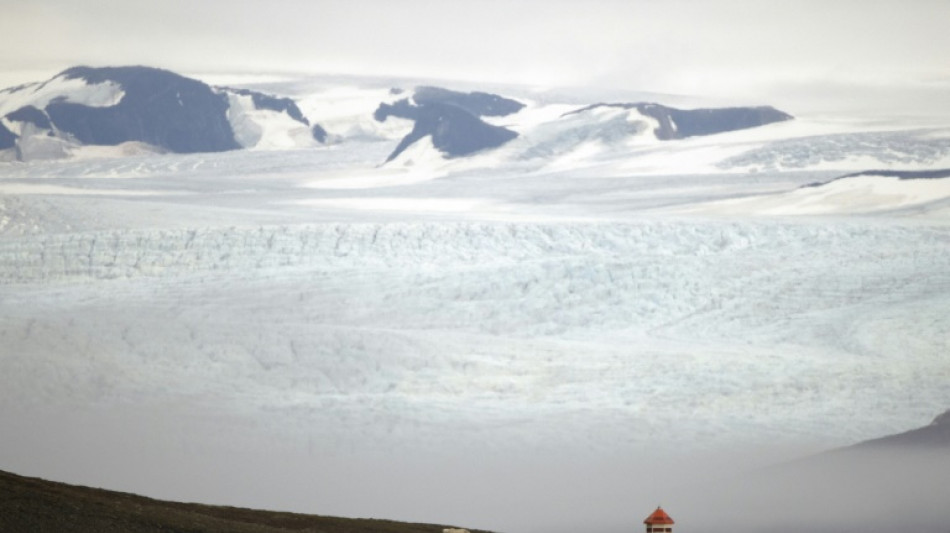
Arctic warming spurs growth of carbon-soaking peatlands / Photo: Olivier MORIN - AFP/File

 Jay-Z rape accuser says she made 'false accusations'

 Trump's photo of Xi greeting carries signs of AI

 First US trial against TikTok to open Monday

 French literary prize removes novel from longlist after AI claims

 Trump accuser E. Jean Carroll finally has her damages

 Heavy fighting, internet disruption as Ethiopia conflict rages

 Asian markets mixed after oil gains

 UN approves resolution on dealing with rising sea levels

 Global stocks mostly fall as oil prices and bond yields rise

 Starbucks to close 250 more cafes in North America

 Stocks fall as oil prices rise and bonds back under pressure

 Top ECB official to resign to take up IMF role

 Eviction of pensioner puts Spain housing crisis in spotlight

 Average EU diesel price hits record 2.23 euros a litre: AFP analysis

 Whitetip Investments Marks 10 Years of Regulation, Transparency & Responsible Trading

 Stocks fall, oil prices rise as global bonds under pressure

 Hungary detects invasive spotted lanternfly for first time in EU

 Forex Expo Dubai 2026 Breaks Guinness World Record Again With 23,816 Attendees

 Asian markets fall on US-China jitters as leaders meet

 As Moscow steps up attacks, Kyiv residents brace for harsh winter

 Markets mixed as China's Xi arrives for US talks

 Archaeological 'breakthrough' could confirm origins of Paris

 Australian PM says OpenAI hacked government health website

 Rio breaks record for rainiest September amid powerful El Nino

 Mandela Digital Extends Early Access Programme to 11 February 2027 Following Strong Response

Arctic peatlands are expanding as the climate warms, new research showed Thursday, a change that could slow global heating in the near term but have the opposite effect in future.
Peatlands are the largest terrestrial store of carbon, locking away twice as much heat-trapping CO2 from the atmosphere in their waterlogged soils as all the world's forests.
These carbon-rich reservoirs, composed of partially decayed organic matter, only cover three percent of Earth's surface, and generally fade out in the far north where harsh weather limits plant growth.
But warmer temperatures caused by climate change have improved growing conditions for plants in the Arctic, and satellite data has shown a general "greening" of this frosty region.
Using drones, satellite imagery and on-the-ground observations, an international team of scientists assessed peatlands in the European and Canadian Arctic to see if they had benefited from warmer climes.
They found strong evidence that peatlands "have likely undergone lateral expansion over the last 40 years" in the Arctic, which is the fastest warming region on Earth.
"The permafrost thaws a little, provides a water source for vegetation, and surface vegetation recovers. In this study, we specifically see a lateral expansion," Michelle Garneau, a professor at the University of Quebec in Montreal, and co-author of the study, told AFP.
The most marked change was observed where summer temperatures have risen the most, such as in the Norwegian archipelago of Svalbard.
"All these new vegetated surfaces that didn't exist three decades ago are currently actively absorbing carbon," Garneau added.
This suggests Arctic peatlands "are an increasingly important natural carbon sink, at least in the near term", said study co-author Karen Anderson, a professor from the University of Exeter, which led the research.
But how they respond to climate change in future is "still highly uncertain", said the study published in the peer-reviewed journal Communications Earth and Environment.
Recent modelling suggests that northern peatlands "may become a carbon source from mid-century" as they dry out and permafrost thaws, the study said.
They are also at risk from wildfires, which release masses of stored up carbon at once.
"If temperatures continue to rise, we are likely to see changes in rainfall, and we are not sure how sustainable new or existing peatlands will be," said Anderson.
More peatlands also means more natural emissions of methane, a potent greenhouse gas far more effective at trapping heat than CO2.
"So while our study gives us some positive news, it does not detract from the urgent need to reduce greenhouse gas emissions and stabilise our climate," said Anderson.
T.Morelli--CPN