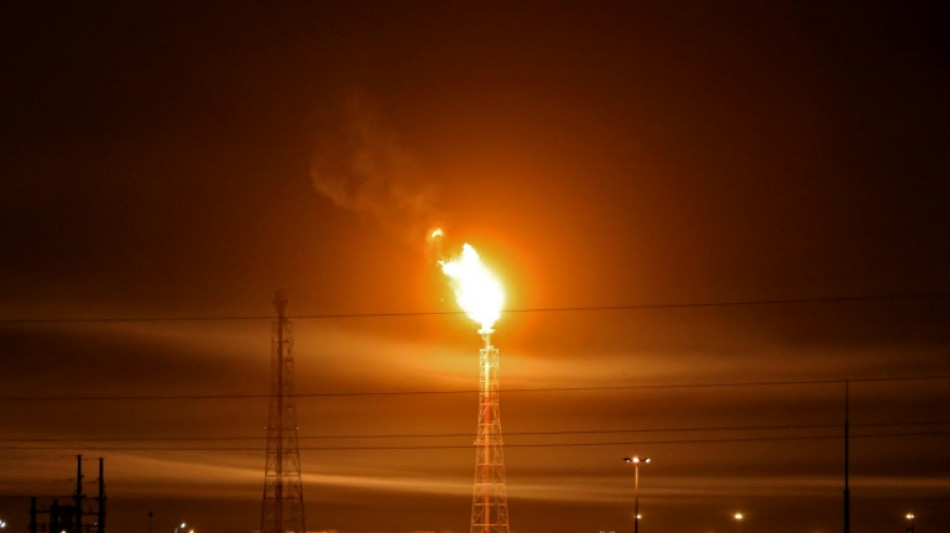
Global oil demand to dip in 2030, first drop since Covid: IEA / Photo: Asaad NIAZI - AFP/File

 Jay-Z rape accuser says she made 'false accusations'

 Trump's photo of Xi greeting carries signs of AI

 First US trial against TikTok to open Monday

 French literary prize removes novel from longlist after AI claims

 Trump accuser E. Jean Carroll finally has her damages

 Heavy fighting, internet disruption as Ethiopia conflict rages

 Asian markets mixed after oil gains

 UN approves resolution on dealing with rising sea levels

 Global stocks mostly fall as oil prices and bond yields rise

 Starbucks to close 250 more cafes in North America

 Stocks fall as oil prices rise and bonds back under pressure

 Top ECB official to resign to take up IMF role

 Eviction of pensioner puts Spain housing crisis in spotlight
 Average EU diesel price hits record 2.23 euros a litre: AFP analysis

 Whitetip Investments Marks 10 Years of Regulation, Transparency & Responsible Trading

 Stocks fall, oil prices rise as global bonds under pressure

 Hungary detects invasive spotted lanternfly for first time in EU

 Forex Expo Dubai 2026 Breaks Guinness World Record Again With 23,816 Attendees

 Asian markets fall on US-China jitters as leaders meet

 As Moscow steps up attacks, Kyiv residents brace for harsh winter

 Markets mixed as China's Xi arrives for US talks

 Archaeological 'breakthrough' could confirm origins of Paris

 Australian PM says OpenAI hacked government health website

 Rio breaks record for rainiest September amid powerful El Nino

 Mandela Digital Extends Early Access Programme to 11 February 2027 Following Strong Response

Global oil demand will fall slightly in 2030, its first drop since the 2020 Covid pandemic, the International Energy Agency said Tuesday.
In an annual outlook for the oil market, the Paris-based agency cited sluggish economic growth, global trade tensions, the rise of electric cars and the shift away from crude to produce power.
Annual demand growth will slow from around 700,000 barrels per day (bpd) in 2025 and 2026 "to just a trickle over the next several years, with a small decline expected in 2030", the IEA said.
Total demand is forecast to reach 105.5 million bpd in 2030 after peaking at 105.6 million bpd in 2029.
Oil demand dropped dramatically in 2020, when countries locked down and shut their borders during the Covid pandemic, falling to 91.7 million bpd before steadily growing again in the following years.
Demand in the world's top consumer, the United States, is expected to peak this year and start to decline in 2026 while consumption in China, the top importer of crude, will fall from 2028, according to the "Oil 2025" report.
Demand in the Middle East will also peak in 2027 and decline the following year.
Saudi Arabia will post the "single largest decline in oil demand for any country" in absolute terms through 2030 as the kingdom replaces crude with gas and renewable energy to produce power, the IEA said.
- US and Saudis to lead output -
The report comes as oil prices have surged since Israel launched air strikes against Iran last week, prompting Tehran to fire missiles back at its arch foe.
The price increases "are not driven by the fundamentals", IEA executive director Fatih Birol said in a news conference. "We have a lot of supply oil in the market. Demand is much weaker than the supply."
"We don't expect high oil prices to be with us for a very long time," Birol said, adding that the IEA stood ready to act if there are any supply disruptions.
While the conflict "focuses attention on immediate energy security risks", the IEA said oil supply growth will "far outpace" the increase in demand in coming years.
World oil production capacity is forecast to rise by 5.1 million bpd -- double the pace of demand -- to 114.7 million bpd by 2030, the report found.
"Combined, Saudi Arabia and the United States will contribute 40 percent to total global oil capacity growth in the forecast period," it said.
P.Kolisnyk--CPN