S.African president blames climate change for 'catastrophic' floods / Photo: EMMANUEL CROSET - AFP

 Iran proposes Hormuz plan, Trump reportedly refuses
 El Nino rewrites the menu in the world's top restaurants

 Jay-Z rape accuser says she made 'false accusations'

 Trump's photo of Xi greeting carries signs of AI

 First US trial against TikTok to open Monday
 French literary prize removes novel from longlist after AI claims

 Trump accuser E. Jean Carroll finally has her damages

 Heavy fighting, internet disruption as Ethiopia conflict rages
 Asian markets mixed after oil gains

 UN approves resolution on dealing with rising sea levels
 Global stocks mostly fall as oil prices and bond yields rise

 Starbucks to close 250 more cafes in North America
 Stocks fall as oil prices rise and bonds back under pressure
 Top ECB official to resign to take up IMF role

 Eviction of pensioner puts Spain housing crisis in spotlight

 Average EU diesel price hits record 2.23 euros a litre: AFP analysis

 Whitetip Investments Marks 10 Years of Regulation, Transparency & Responsible Trading

 Stocks fall, oil prices rise as global bonds under pressure
 Hungary detects invasive spotted lanternfly for first time in EU

 Forex Expo Dubai 2026 Breaks Guinness World Record Again With 23,816 Attendees

 Asian markets fall on US-China jitters as leaders meet
 As Moscow steps up attacks, Kyiv residents brace for harsh winter
 Markets mixed as China's Xi arrives for US talks

 Archaeological 'breakthrough' could confirm origins of Paris

 Australian PM says OpenAI hacked government health website

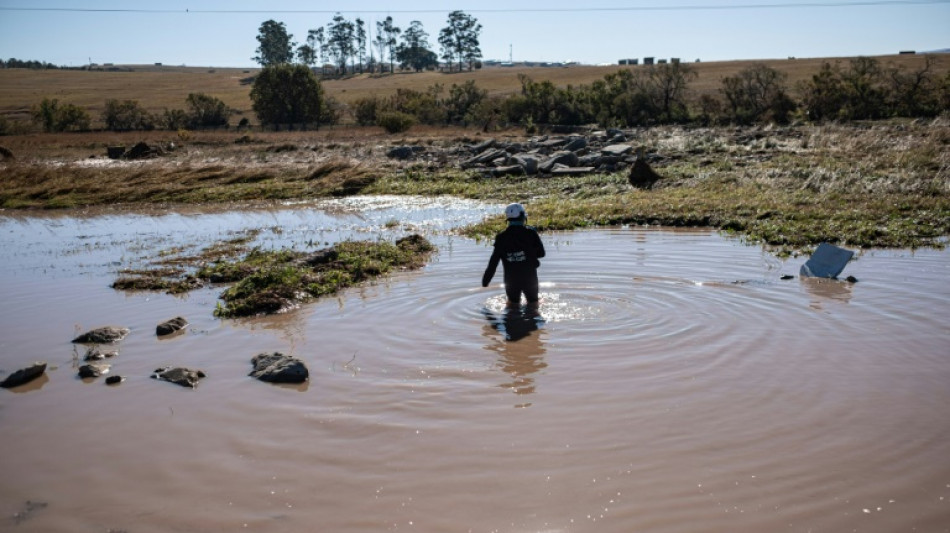
South African President Cyril Ramaphosa met Friday with survivors of devastating floods that killed at least 78 people in the impoverished Eastern Cape province, blaming the "catastrophic disaster" on climate change.
Ramaphosa toured the disaster zone and met with survivors in the region, where thousands of houses, roads, schools and health facilities were left caked in mud after being completely submerged in floodwaters, leaving many people with nothing in one of the poorest parts of the country.
Rescuers were going door to door searching for bodies or possible survivors, as people got stuck inside their homes when the water rushed in during the night. Some managed to escape to their roofs, where they waited long hours for help.
Ramaphosa visited the site where a school bus was swept away, killing at least six children and three adults. Four of the children were still missing.
He also spoke with a woman who lost her mother and at least two of her young nephews. The woman was sobbing as the president listened to her story.
"This is a catastrophic disaster which is caused by climate change," said Ramaphosa, who estimated the flood waters had reached more than four metres (13 feet) high.
"During winter, we expect cold as well as snow here in the Eastern Cape. Now that we are confronting floods, this goes to show the severity of the issue of climate change."
Snow and heavy rainfall are common during winter in South Africa, but coastal parts of the country were hit by "unprecedented" weather conditions, Ramaphosa said on Thursday.
According to the Green Climate Fund, the country is highly vulnerable to the impact of climate variability and change, which increases the frequency and severity of extreme weather.
The death toll from the floods, which officials said stood at 78 on Thursday, could still rise.
Earlier Friday, bodies were still being retrieved from a nearby river.
- 'The furniture was floating' -
The area worst hit by the floods and subsequent landslides was the city of Mthatha, about 800 kilometres (500 miles) south of Johannesburg.
The city is near the village of Qunu, birthplace of Nelson Mandela, the late anti-apartheid hero and former president.
The South African Red Cross Society, which sent aid to the Mthatha area, told AFP at least 3,500 households had been affected, with many people sheltering in community halls.
AFP journalists on Thursday saw a rescue team pull four bodies, some of them children, from a one-roomed house in the late afternoon. The surrounding area was strewn with debris and locals sobbed as they watched the recovery.
"When we came out of the house, the water was above the knee, all the furniture inside was floating," Sopiseka, a survivor, told AFP.
"The homes are fragile, they can collapse anytime. Food is contaminated, so people need to be evacuated," said Sablay.
At least 20 health facilities and 58 schools were damaged in Eastern Cape province, according to local authorities.
T.Morelli--CPN