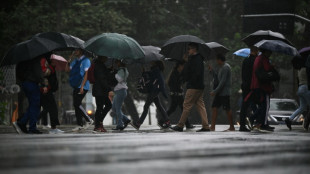
Canada town near Vancouver ready to evacuate as fire nears / Photo: Nav Rahi - AFP

 Iran proposes Hormuz plan, Trump reportedly refuses
 El Nino rewrites the menu in the world's top restaurants

 Jay-Z rape accuser says she made 'false accusations'

 Trump's photo of Xi greeting carries signs of AI

 First US trial against TikTok to open Monday

 French literary prize removes novel from longlist after AI claims

 Trump accuser E. Jean Carroll finally has her damages

 Heavy fighting, internet disruption as Ethiopia conflict rages

 Asian markets mixed after oil gains

 UN approves resolution on dealing with rising sea levels

 Global stocks mostly fall as oil prices and bond yields rise

 Starbucks to close 250 more cafes in North America

 Stocks fall as oil prices rise and bonds back under pressure

 Top ECB official to resign to take up IMF role

 Eviction of pensioner puts Spain housing crisis in spotlight

 Average EU diesel price hits record 2.23 euros a litre: AFP analysis

 Whitetip Investments Marks 10 Years of Regulation, Transparency & Responsible Trading

 Stocks fall, oil prices rise as global bonds under pressure

 Hungary detects invasive spotted lanternfly for first time in EU

 Forex Expo Dubai 2026 Breaks Guinness World Record Again With 23,816 Attendees

 Asian markets fall on US-China jitters as leaders meet

 As Moscow steps up attacks, Kyiv residents brace for harsh winter

 Markets mixed as China's Xi arrives for US talks

 Archaeological 'breakthrough' could confirm origins of Paris

 Australian PM says OpenAI hacked government health website

Residents of a town near Vancouver were on stand-by to evacuate Wednesday as Canada's devastating wildfire season worsened, with officials warning weather conditions through the summer were ripe for further blazes.
A state of emergency has been declared in Squamish, British Columbia, just 64 kilometres (40 miles) north of Vancouver, a city where the greater metropolitan area population exceeds three million.
British Columbia's emergency management department warned late Tuesday that some residents of Squamish district "must be ready to leave on short notice."
Max Whittenburg, a 19-year-old Squamish resident, told AFP he was "in shock" to see the fire encroach so close to the community.
"I've never seen a fire in Squamish, at all, ever," the skateboard coach said.
"We've already prepared most of the stuff in our house just in case we do have to evacuate," he added. "We'll be ready to go."
Luke Procter, also 19, said he was staying up late and rising early to prepare, including by helping his father "hook up the trailer to our jeep just in case we need to go."
Marc-Andre Parisien, a researcher at the Canadian Forest Service, said fires near the coast like the one threatening Squamish are particularly worrying because "these are areas that did not traditionally burn."
They remain less intense than fires further inland, but "we have more and more of them," he told AFP.
Two years after a historically devastating summer, Canada is once again facing a massive fire season, with burned areas already exceeding year-to-date averages from recent years.
More than 220 active fires were burning across the country Tuesday, with half of them considered out of control.
More than 3.3 million hectares (12,700 square miles) have already been consumed by flames -- an area equivalent to the country of Belgium.
Smoke from Canadian fires has reached Europe after drifting across the Atlantic Ocean.
- Increased risk -
Two provinces in central Canada -- Saskatchewan and Manitoba -- had rough starts to fire season, and had to declare a state of emergency at the end of May.
There was positive news in Saskatchewan on Wednesday after what provincial Premier Scott Moe called "a vicious couple of weeks" combatting wildfires "that in some cases have virtually been unstoppable."
Moe said that while the province is still confronting fires in northern Saskatchewan, roughly half of those who had been forced to evacuate are "gearing up" to return home.
Mega wildfires are still burning in western Alberta, British Columbia, and in northern Ontario, the country's most populous province.
In recent years, Canada has experienced warming at least twice as fast as the rest of the globe.
Linked to human-induced climate change, rising temperatures lead to reduced snow, shorter and milder winters, and earlier summer conditions that promote fires, experts say.
Environment Canada forecast this week that much of of the country was likely to see higher than normal temperatures throughout the summer.
That, combined with dry spring conditions in several areas, "could increase the risk of wildfires in the coming months," the weather and climate agency said.
Now, more than a dozen new fires are detected daily across Canada -- often started accidentally by humans, but sometimes ignited by lightning strikes.
P.Gonzales--CPN