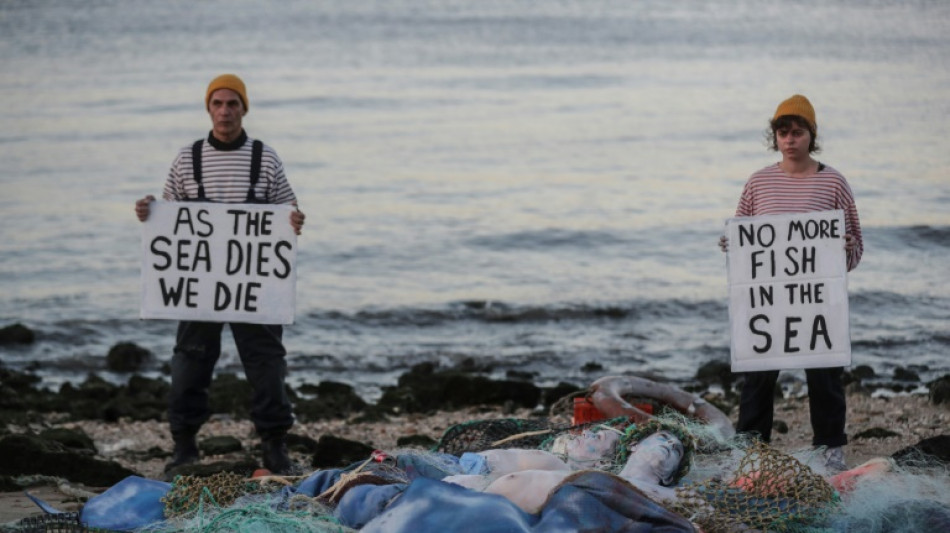
Pledge to protect oceans falling billions short: report / Photo: CARLOS COSTA - AFP

 TikTok agrees to teen limits in US settlement following Meta

 Venezuela's oil cradle pins hopes on US energy deals

 Lula bans sports betting days ahead of Brazil's election

 Spotting AI writing: how reliable are the detectors?
 US court refuses to overturn Pentagon ban on Anthropic

 South Lebanon children return to school destroyed by Israel strike

 European stock markets climb as oil prices drop

 Asian markets mixed after recent oil surge

 Cash for nature protection: hotelier's offer to Principe islanders

 India rape cases turn focus back onto women's safety
 Rich nations should foot climate bill, says Nepal minister
 Italy bans burqas in schools, caps numbers of foreign students per class

 Napoli hoping to build new stadium, says owner
 What happens if the US bans diesel exports

 Oscar-winner Cotillard fears being moved by AI actor

 Stocks fall, oil prices rise as global bonds back under pressure

 Streamex Converts Interest Into Capital as GLDY Investment Strategy Secures $1M+ Institutional Allocation

 STARTRADER Named Best Fintech Forex Broker at Forex Expo Dubai 2026
 German think tanks urge Merz to stick with reforms after election defeats
 France's top-selling newspaper to slash jobs

 BaazEX Enters the Asian Trading Market With a New Approach to Online Forex Trading.
 Sao Tome voters want to stop exodus of 'neglected' youth

 Mexican cartels target Australia with their African meth
 Rapper-turned-PM faces first big test after Nepal disaster

 Meta launches camera-free AI glasses amid privacy pushback
Nations are spending less than 10 percent of what is needed to meet a global target on marine conservation and must commit more at next week's UN oceans summit, NGOs said on Thursday.
In 2022, nearly 200 countries agreed to designate 30 percent of the world's oceans as protected areas by 2030, but so far just 8.4 percent are covered.
Some $15.8 billion is needed every year to achieve the '30x30' target but only $1.2 billion is currently being spent, said a new report by a consortium of environmental groups.
This gap was "alarming" and must be redressed at the UN Ocean Conference (UNOC) starting on June 9 in Nice, France, said Jonathan Kelsey from the Bloomberg Ocean Fund, which co-authored the report.
"UNOC is a critical opportunity for governments to narrow this gap with concrete actions, including... increasing financing that truly delivers on their ocean promises," he said in a statement.
Of all the UN's sustainable development goals, protecting the oceans is the least funded.
Some 90 percent of ocean conservation is financed by public money and "in the short term, governments will need to increase funding flows to meet the capital injections needed, particularly high income countries", the report said.
- Promises on paper -
Environment groups have warned against the spread of "paper parks" -- protected areas in name only that lack the resources to enforce any real conservation measures.
Less than three percent of all marine conservation areas globally are considered truly protected.
Some forbid all forms of fishing while others place no rules, or almost none, on what activities are forbidden, allowing bottom trawling and other intensive industrial operations.
The report -- co-authored by WWF, Campaign for Nature and the Marine Conservation Institute, amongst others -- said that redirecting subsidies from harmful activities could also help fill the funding gap.
For example, the $15.8 billion needed every year is just two-thirds of what the world spends on harmful fishing subsidies, it added.
"We cannot afford promises that remain on paper while our coral reefs bleach, our fisheries decline, and our coastlines wash away," Brianna Fruean from campaign group Together for the Ocean, said in a statement.
"We need real protection, now -- and we need investment that empowers communities on the frontlines of change."
France expects around 50 heads of state and government to attend the oceans conference in Nice, which runs until June 13 and is preceded by a major scientific summit.
Nations present will issue a joint declaration in support of ocean conservation but the conference is not a formal UN negotiation, and any commitments made are voluntary.
A.Mykhailo--CPN