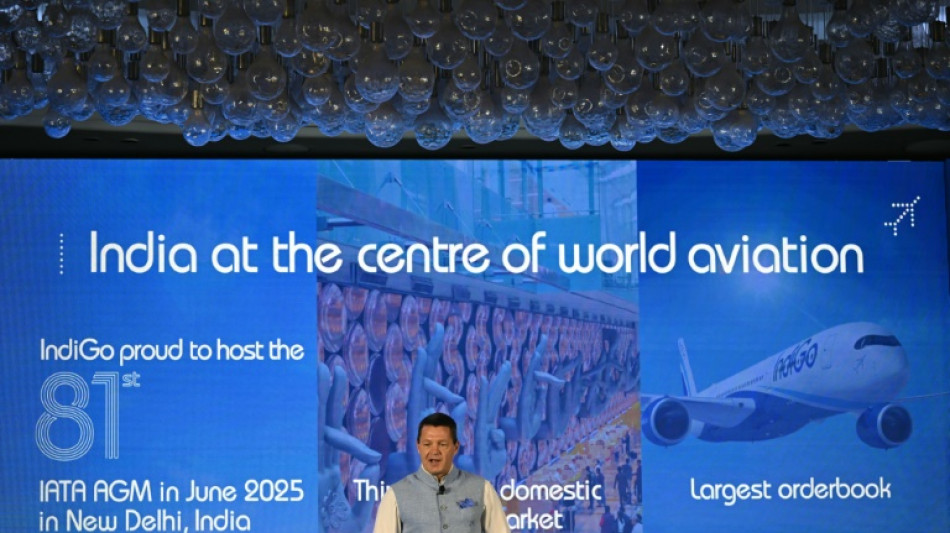
Key climate target of airline decarbonisation 'in peril': IATA / Photo: Money SHARMA - AFP

 TikTok agrees to teen limits in US settlement following Meta
 Venezuela's oil cradle pins hopes on US energy deals

 Lula bans sports betting days ahead of Brazil's election

 Spotting AI writing: how reliable are the detectors?
 US court refuses to overturn Pentagon ban on Anthropic

 South Lebanon children return to school destroyed by Israel strike

 European stock markets climb as oil prices drop

 Asian markets mixed after recent oil surge

 Cash for nature protection: hotelier's offer to Principe islanders

 India rape cases turn focus back onto women's safety

 Rich nations should foot climate bill, says Nepal minister
 Italy bans burqas in schools, caps numbers of foreign students per class

 Napoli hoping to build new stadium, says owner
 What happens if the US bans diesel exports
 Oscar-winner Cotillard fears being moved by AI actor

 Stocks fall, oil prices rise as global bonds back under pressure
 Streamex Converts Interest Into Capital as GLDY Investment Strategy Secures $1M+ Institutional Allocation

 STARTRADER Named Best Fintech Forex Broker at Forex Expo Dubai 2026
 German think tanks urge Merz to stick with reforms after election defeats

 France's top-selling newspaper to slash jobs

 BaazEX Enters the Asian Trading Market With a New Approach to Online Forex Trading.
 Sao Tome voters want to stop exodus of 'neglected' youth
 Mexican cartels target Australia with their African meth
 Rapper-turned-PM faces first big test after Nepal disaster

 Meta launches camera-free AI glasses amid privacy pushback

The airline industry's flagship goal of decarbonising by 2050 is now "in peril" due to climate-sceptic policies, including those of US President Donald Trump, the leading airline association IATA warned on Sunday.
The emergence of leaders favouring fossil fuels and recent regulatory rollbacks are "obviously a setback... it does imperil success on the 2050 horizon", Marie Owens Thomsen, the International Air Transport Association's senior vice president for sustainability, told reporters.
"But I don't think it's going to halt or reverse progress. I think it will just slow progress," she said at the IATA annual industry conference in India.
Trump's Republican administration is supporting the development of fossil fuels in contrast to his Democratic predecessor Joe Biden, who had massively supported the production of renewable aviation fuels through tax credits.
UN aviation agency members, from the International Civil Aviation Organization (ICAO), have set the year 2050 as their goal for achieving net-zero carbon emissions for air travel -- an industry often criticised for its outsized role in climate change.
- 'Entirely achievable' -
The air transportation industry has faced growing pressure to deal with its contribution to the climate crisis.
Currently responsible for 2.5 percent to three percent of global CO2 emissions, the sector's switch to renewable fuels is proving difficult, even if the aeronautics industry and energy companies have been seeking progress.
To achieve net-zero emissions, airlines rely on non-fossil sources known as Sustainable Aviation Fuel (SAF).
However, SAF biofuels are still three to four times more expensive than petroleum-based jet fuel.
"Another problem, which is related, is the fact that oil is so cheap," Owens Thomsen said. "I think that also diminishes the sense of urgency that people have."
A barrel of Brent North Sea crude, the international benchmark, stands below $65 as a result of Trump's tariffs, his call to "drill baby drill" and especially a decision by OPEC+ to hike crude output quotas.
This represents an immediate boon for airlines, whose fuel costs represent between a quarter and a third of operating expenses.
SAF is seen as a crucial ingredient in hitting emissions targets. The biofuel produces lower carbon emissions than traditional jet fuel and is made from plant and animal materials such as cooking oil and fat.
European Union rules require carriers to include two percent of SAF in their fuel mix starting this year, rising to six percent in 2030 before soaring to 70 percent from 2050.
Owens Thomsen estimated on Sunday that $4.7 trillion in investment is needed to establish SAF sectors capable of meeting the needs of air transport by 2050.
"It is entirely achievable," she said, adding that the raw materials and technology already exist and simply need to be developed.
"The money involved is very comparable to the money that was involved in creating the previous new energy markets, notably obviously wind and solar," she said.
That money could be found just by stopping subsidies to oil producers, she said.
"The world is subsidising large oil companies to the height of $1 trillion per year," she said.
"With that money, if it were redirected in its totality, we could solve our energy transition in less than five years."
IATA also indicated on Sunday that it expects global SAF production to double this year compared with 2024 to 2.5 billion litres -- slightly down from its previous projections of 2.7 billion litres.
"This represents only 0.7 percent of total aviation needs," IATA Director General Willie Walsh said.
M.Mendoza--CPN