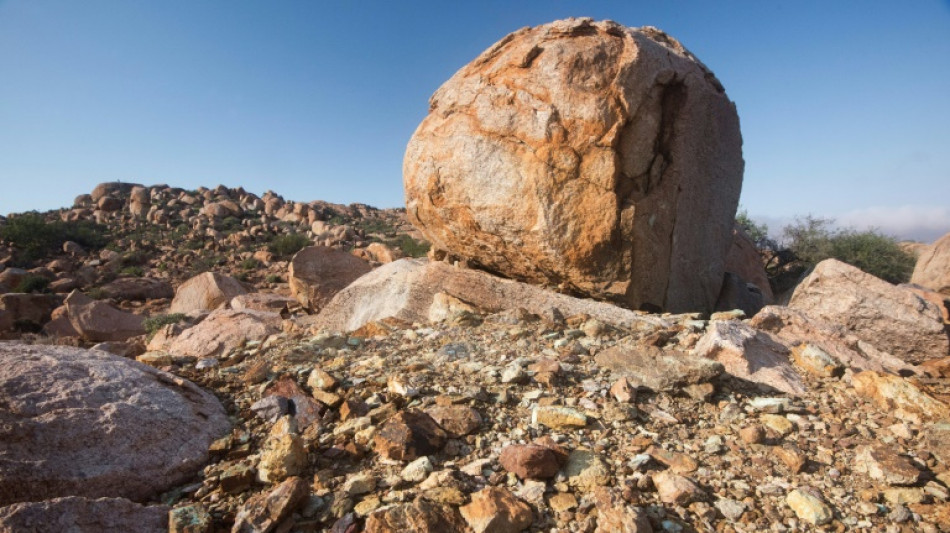
Rare earth production outside China 'major milestone' / Photo: RODGER BOSCH - AFP/File

 S.African women runners arm themselves after string of killings

 Indonesia fires threatens critically-endangered orangutan: IUCN

 Iran proposes Hormuz plan, Trump reportedly refuses
 El Nino rewrites the menu in the world's top restaurants

 Jay-Z rape accuser says she made 'false accusations'

 Trump's photo of Xi greeting carries signs of AI

 First US trial against TikTok to open Monday

 French literary prize removes novel from longlist after AI claims
 Trump accuser E. Jean Carroll finally has her damages
 Heavy fighting, internet disruption as Ethiopia conflict rages

 Asian markets mixed after oil gains

 UN approves resolution on dealing with rising sea levels

 Global stocks mostly fall as oil prices and bond yields rise

 Starbucks to close 250 more cafes in North America

 Stocks fall as oil prices rise and bonds back under pressure

 Top ECB official to resign to take up IMF role

 Eviction of pensioner puts Spain housing crisis in spotlight
 Average EU diesel price hits record 2.23 euros a litre: AFP analysis

 Whitetip Investments Marks 10 Years of Regulation, Transparency & Responsible Trading

 Stocks fall, oil prices rise as global bonds under pressure

 Hungary detects invasive spotted lanternfly for first time in EU

 Forex Expo Dubai 2026 Breaks Guinness World Record Again With 23,816 Attendees

 Asian markets fall on US-China jitters as leaders meet

 As Moscow steps up attacks, Kyiv residents brace for harsh winter

 Markets mixed as China's Xi arrives for US talks

An Australian firm's production of a heavy rare earth, a first outside of China, is a "major milestone" in diversifying a critical supply chain dominated by Beijing, experts say.
But the announcement by Lynas Rare Earths also illustrates how much more needs to be done to broaden the supply of elements critical for electric vehicles and renewable technology.
What are rare earths?
Rare earth elements (REE) are 17 metals that are used in a wide variety of everyday and high-tech products, from light bulbs to guided missiles.
Among the most sought-after are neodymium and dysprosium, used to make super-strong magnets that power electric car batteries and ocean wind turbines.
Despite their name, rare earths are relatively abundant in the Earth's crust. Their moniker is a nod to how unusual it is to find them in a pure form.
Heavy rare earths, a subset of overall REE, have higher atomic weights, are generally less abundant and often more valuable.
China dominates all elements of the rare earths supply chain, accounting for more than 60 percent of mining production and 92 percent of global refined output, according to the International Energy Agency.
What did Lynas achieve?
Lynas said it produced dysprosium oxide at its Malaysia facility, making it the only commercial producer of separated heavy rare earths outside of China.
It hopes to refine a second heavy rare earth -- terbium -- at the same facility next month. It too can be used in permanent magnets, as well as some light bulbs.
It "is a major milestone," said Neha Mukherjee, senior analyst on raw materials at Benchmark Mineral Intelligence.
The announcement comes with China's REE supply caught up in its trade war with Washington.
It is unclear whether a 90-day truce means Chinese export controls on some rare earths will be lifted, and experts say a backlog in permit approvals will snarl trade regardless.
"Given this context, the Lynas development marks a real and timely shift, though it doesn't eliminate the need for broader, global diversification efforts," said Mukherjee.
How significant is it?
Lynas did not say how much dysprosium it refined, and rare earths expert Jon Hykawy warned the firm faces constraints.
"The ore mined by Lynas contains relatively little of the heavy rare earths, so their produced tonnages can't be that large," said Hykawy, president of Stormcrow Capital.
"Lynas can make terbium and dysprosium, but not enough, and more is needed."
The mines most suited for extracting dysprosium are in south China, but deposits are known in Africa, South America and elsewhere.
"Even with Lynas' production, China will still be in a position of dominance," added Gavin Wendt, founding director and senior resource analyst at MineLife.
"However, it is a start, and it is crucial that other possible projects in the USA, Canada, Brazil, Europe and Asia, also prove technically viable and can be approved, so that the supply balance can really begin to shift."
What are the challenges to diversifying?
China's domination of the sector is partly the result of long-standing industrial policy. Just a handful of facilities refining light rare earths operate elsewhere, including in Estonia.
It also reflects a tolerance for "in-situ mining", an extraction technique that is cheap but polluting, and difficult to replicate in countries with higher environmental standards.
For them, "production is more expensive, so they need prices to increase to make any seriously interesting profits," said Hykawy.
That is a major obstacle for now.
"Prices have not supported new project development for over a year," said Mukherjee.
"Most non-Chinese projects would struggle to break even at current price levels."
There are also technical challenges, as processing rare earths requires highly specialised and efficient techniques, and can produce difficult-to-manage waste.
What more capacity is near?
Lynas has commissioned more processing capacity at its Malaysia plant, designed to produce up to 1,500 tonnes of heavy rare earths.
If that focused on dysprosium and terbium, it could capture a third of global production, said Mukherjee.
The firm is building a processing facility in Texas, though cost increases have cast doubt on the project, and Lynas wants the US government to pitch in more funds.
US firm MP Materials has also completed pilot testing for heavy rare earth separation and plans to boost production this year.
Canada's Aclara Resources is also developing a rare earths separation plant in the United States.
And Chinese export uncertainty could mean prices start to rise, boosting balance sheets and the capacity of small players to expand.
"The Lynas announcement shows progress is possible," said Mukherjee.
"It sends a strong signal that with the right mix of technical readiness, strategic demand, and geopolitical urgency, breakthroughs can happen."
A.Mykhailo--CPN