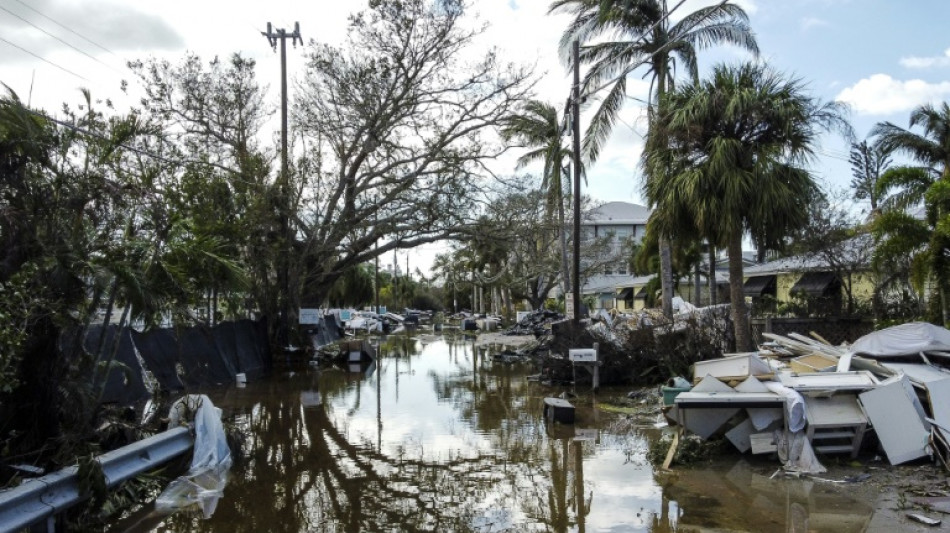
US braces for intense hurricane season as climate agency is gutted / Photo: CHANDAN KHANNA - AFP/File

 S.African women runners arm themselves after string of killings

 Indonesia fires threatens critically-endangered orangutan: IUCN

 Iran proposes Hormuz plan, Trump reportedly refuses
 El Nino rewrites the menu in the world's top restaurants

 Jay-Z rape accuser says she made 'false accusations'

 Trump's photo of Xi greeting carries signs of AI

 First US trial against TikTok to open Monday

 French literary prize removes novel from longlist after AI claims

 Trump accuser E. Jean Carroll finally has her damages

 Heavy fighting, internet disruption as Ethiopia conflict rages

 Asian markets mixed after oil gains

 UN approves resolution on dealing with rising sea levels

 Global stocks mostly fall as oil prices and bond yields rise

 Starbucks to close 250 more cafes in North America

 Stocks fall as oil prices rise and bonds back under pressure
 Top ECB official to resign to take up IMF role

 Eviction of pensioner puts Spain housing crisis in spotlight

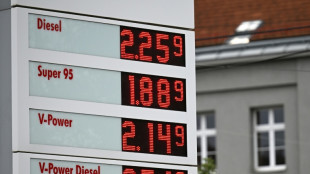 Average EU diesel price hits record 2.23 euros a litre: AFP analysis

 Whitetip Investments Marks 10 Years of Regulation, Transparency & Responsible Trading

 Stocks fall, oil prices rise as global bonds under pressure

 Hungary detects invasive spotted lanternfly for first time in EU

 Forex Expo Dubai 2026 Breaks Guinness World Record Again With 23,816 Attendees

 Asian markets fall on US-China jitters as leaders meet

 As Moscow steps up attacks, Kyiv residents brace for harsh winter

 Markets mixed as China's Xi arrives for US talks

The US National Oceanic and Atmospheric Administration (NOAA) on Thursday predicted a more intense Atlantic hurricane season this year -- even as the Trump administration moves to gut the agency's workforce and slash its budget.
NOAA is forecasting a 60 percent chance of an above-normal season, with between 13 to 19 named storms with winds of 39 mph (63 kph) or higher.
Of those, six to 10 are expected to become hurricanes with winds of 74 mph or higher, including three to five major hurricanes classed as categories three, four, or five, with sustained winds of at least 111 mph.
There is also a 30 percent chance of a near-normal season and a 10 percent chance of a below-normal season, the agency said.
The administration is also seeking to dismantle the Federal Emergency Management Agency (FEMA), calling for it to be shut down and its duties instead handed to individual states.
FEMA's acting head, Cameron Hamilton -- who was appointed by the Trump administration -- was fired earlier this month after saying that eliminating the agency was not "in the best interests of the American people."
- Warming oceans -
The forecast cites a confluence of factors: neutral conditions in the El Nino–Southern Oscillation (ENSO) climate pattern, warmer-than-average ocean temperatures, predictions of weak wind shear, and increased activity from the West African Monsoon -- the starting point for Atlantic hurricanes.
"As we witnessed last year with significant inland flooding from hurricanes Helene and Debby, the impacts of hurricanes can reach far beyond coastal communities," said Acting NOAA Administrator Laura Grimm in a statement.
"NOAA is critical for the delivery of early and accurate forecasts and warnings, and provides the scientific expertise needed to save lives and property."
But Rick Spinrad, the former NOAA administrator, told AFP he was deeply concerned about the agency's ability to respond following mass layoffs of meteorologists, technicians and other key personnel, spearheaded by Elon Musk's so-called "Department of Government Efficiency."
"I worry about the ability to fly the aircraft, run the models, answer the phones as these storms start bearing down on the country -- at the same time that the Weather Service is going to have to be dealing with tornadoes, wildfires, floods, extreme precipitation," said Spinrad.
Seawater temperatures have been rising for decades as a result of burning fossil fuels, Spinrad added. "So it's not a surprise, and undoubtedly, climate change has contributed to some of the ocean temperatures that are a major factor in this forecast."
President Donald Trump is seeking to cut NOAA's research operations budget by $1.3 billion next year. Project 2025 -- the conservative blueprint the administration is using to guide its second-term agenda -- has labeled the agency a key driver of "climate alarmism."
Last year, five storms that were big enough that they were assigned names caused economic losses exceeding a billion dollars, adjusted for inflation, according to NOAA.
The deadliest of these was Helene, responsible for 250 US deaths — the most since Hurricane Katrina in 2005.
The Trump administration announced earlier this month it will stop updating its billion-dollar disaster database, which for 44 years illustrated the rising cost of climate destabilization.
C.Smith--CPN