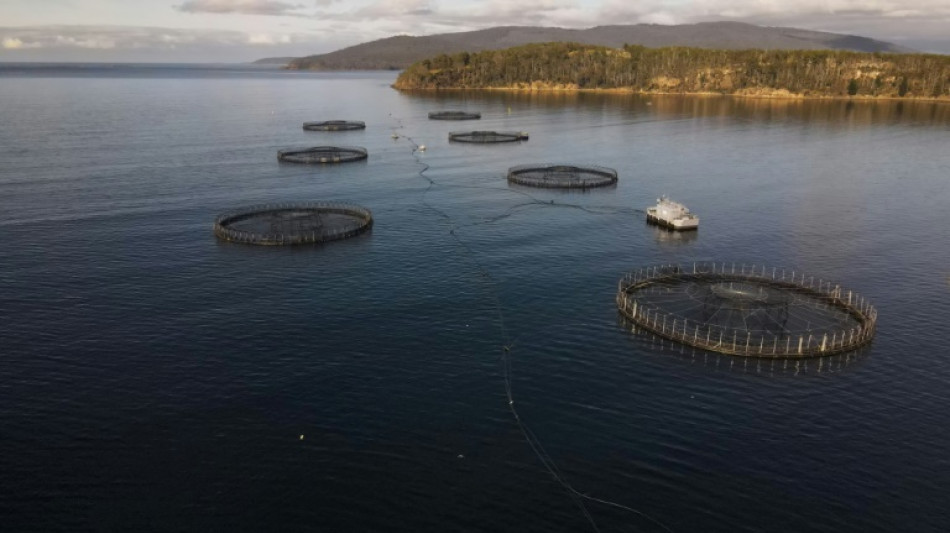
Dead salmon create election stink on Australian island / Photo: Gregory PLESSE - AFP

 Kenya's economy faces climate change risks: World Bank

 'Beginning of the end': Relief but no party as French wildfire winds down

 Southern Europe 'becoming more flammable' in hotter climate, experts say

 Mammoth bones found on parched bed of Danube in Bulgaria

 MEXC Lists Grvt (GRVT) with $60,000 Worth of GRVT and 10,000 USDT in Airdrop+ Rewards

 George and Amal Clooney flee French home due to wildfire

 MEXC Ventures Supports Alpha Arena's APAC Debut at Coinfest Bali

 AI data centre supplier Zhongji InnoLight slips on Hong Kong debut

 May, June heatwaves caused 2,877 extra deaths in England: govt

 BMW profit down a third as carmaker plans job cuts

 Seoul extends losses as most Asian markets drop, oil rises again

 Gambling.com Group Is Now Grandstand

 Meet the astronomer digging into the Milky Way's 'fossils'

 AI data centre supplier Zhongji InnoLight falls on Hong Kong debut

 Samsung operating profit up 1,800% in second quarter on AI boom

 Japanese population below 120 million for first time in decades

 US actor Jared Leto denies latest accusations of sexual assault
 Danube drops to 'historic lows' as fresh heatwave hits

 BTS pulls out of Grammys after Asian pop category introduction

 OpenAI says rogue AI agent attack hit other companies

 How an AFP beach snap became emblem of Europe's wildfire summer

 TRX Spot and Perpetuals Listing Launches on Backpack, Expanding Access to the TRON Ecosystem

 Nepal's tiger numbers climb 20 percent to estimated 429: survey
 FIFA's plans to sell $4.2bn stake in its tournaments widely criticised

 BMW aims to cut 8,000 jobs by end 2027: company source

On a tree-lined beach in Australia's rugged island state of Tasmania, locals discovered popcorn-sized bits of dead salmon washed up along the sand.
When the stinky remains landed in Verona Sands, population 131, they stirred up a festering environment-versus-industry row shortly before Saturday's general elections.
The fish remnants found in February were traced to a mass die-off from vast, circular salmon farming pens set up in the waters of the surrounding Tasman Sea estuary.
The Tasmanian fish farming industry produces 75,000 tonnes of Atlantic salmon a year -- 90 percent of Australia's total output.
But in the warm, summer temperatures, a bacterium had taken hold in some of the salmon pens.
"What I saw was little chunks, the size of small plums, and they were scattered the entire length of the beach," said Jess Coughlin, a campaigner with community group Neighbours of Fish Farming.
When she sought advice to identify the mystery morsels, a diver who had worked in fish farms told her the industry referred to them as popcorn.
"It's a common occurrence when the fish are left dead in the pens for a number of days and they start to rot and break down," Coughlin told AFP.
- Rotting salmon -
At first, the dead salmon sink.
"The flesh and fat pull away from the body and, because of the pressure of the water and the wave action, as it makes its way up to the surface it clumps into these balls."
Dead salmon falling apart within pens where fish are still being grown for human consumption is "incredibly disturbing", she said.
Tasmania's environmental regulator described the die-off in salmon pens in the area -- the D'Entrecasteaux Channel -- as an "unprecedented salmon mortality event".
The state's chief veterinary officer, Kevin de Witte, reported that in the warm, summer waters, the fish had been infected with an endemic bacterium, Piscirickettsia salmonis.
"P. salmonis fish bacterium does not grow in humans and do not present a human or animal health, or food safety risk," he assured people.
Industry body Salmon Tasmania said the microbe had devastated some farms in the area, and operators worked around the clock to clean up the mess and keep fish healthy.
- 'Catastrophe' -
"While industry always does its utmost to raise healthy fish, just like all animals and primary producers, salmon and our farms are not immune to the vagaries of our natural environment," it said.
Some estimates put the number of dead salmon in the millions, said the Bob Brown Foundation, named after its co-founder, an environmentalist and former lawmaker.
"This catastrophe is not just a 'natural vagary'," the foundation said.
"This is the direct result of excessive nitrogen pollution, overstocking of pens, corrupt governance and a consequent failure to regulate, all directly attributable to the foreign-owned salmon corporations' endless greed."
The salmon industry is notably blamed for threatening the existence of the endangered Maugean skate, a species of ray that grows to about the length of an adult person's arm.
An estimated 4,100 Maugean skates remain in the world, and fewer than 120 of them are old enough to reproduce, according to the Australian Marine Conservation Society.
They are found only in western Tasmania's Macquarie Harbour, which is also home to about 10 percent of the state's salmon industry.
Official advice to the federal government in November 2023 said it may have to reconsider the industry's legality -- and eventually even suspend its operations -- due to scientific findings of an "increased extinction risk" to the skates.
- 'Anger and distress' -
Less than six weeks before the elections, Prime Minister Anthony Albanese's government intervened to block that possibility, saying it had to protect jobs.
Parliament adopted a law curbing the environment minister's power to review years-old rulings -- effectively shielding the Macquarie Bay salmon farmers.
But the bay only represents 10 percent of Tasmania's salmon industry and it is a gateway to rural tourism, the environmentalist Bob Brown told AFP in the weeks leading up to the election.
"There's a mood of anger and distress that I haven't seen for decades and it's getting stronger and there's a lot of young people involved and it's very heartening," Brown said.
Some candidates in Tasmania are campaigning to bring a halt to salmon farming operations based in the open sea.
"I think there will be a bigger vote away from the big parties," Brown predicted.
"I think the vote against them will be a record."
H.Meyer--CPN