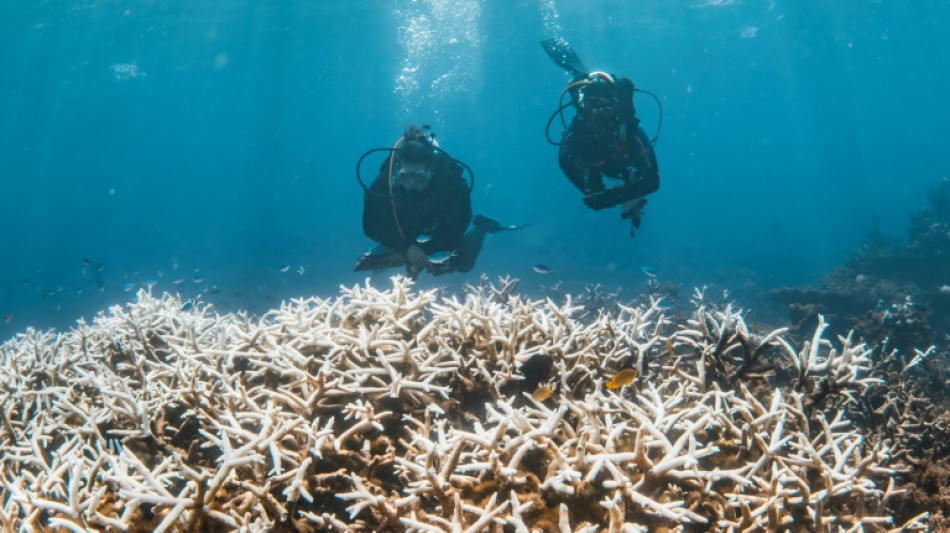
Coral reefs pushed to brink as bleaching crisis worsens / Photo: Violeta J Brosig - Minderoo Foundation/AFP

 Kenya's economy faces climate change risks: World Bank

 'Beginning of the end': Relief but no party as French wildfire winds down

 Southern Europe 'becoming more flammable' in hotter climate, experts say

 Mammoth bones found on parched bed of Danube in Bulgaria

 MEXC Lists Grvt (GRVT) with $60,000 Worth of GRVT and 10,000 USDT in Airdrop+ Rewards
 George and Amal Clooney flee French home due to wildfire

 MEXC Ventures Supports Alpha Arena's APAC Debut at Coinfest Bali

 AI data centre supplier Zhongji InnoLight slips on Hong Kong debut

 May, June heatwaves caused 2,877 extra deaths in England: govt

 BMW profit down a third as carmaker plans job cuts

 Seoul extends losses as most Asian markets drop, oil rises again

 Gambling.com Group Is Now Grandstand

 Meet the astronomer digging into the Milky Way's 'fossils'

 AI data centre supplier Zhongji InnoLight falls on Hong Kong debut

 Samsung operating profit up 1,800% in second quarter on AI boom

 Japanese population below 120 million for first time in decades

 US actor Jared Leto denies latest accusations of sexual assault

 Danube drops to 'historic lows' as fresh heatwave hits

 BTS pulls out of Grammys after Asian pop category introduction

 OpenAI says rogue AI agent attack hit other companies

 How an AFP beach snap became emblem of Europe's wildfire summer

 TRX Spot and Perpetuals Listing Launches on Backpack, Expanding Access to the TRON Ecosystem

 Nepal's tiger numbers climb 20 percent to estimated 429: survey
 FIFA's plans to sell $4.2bn stake in its tournaments widely criticised

 BMW aims to cut 8,000 jobs by end 2027: company source

An unprecedented coral bleaching episode has spread to 84 percent of the world's reefs in an unfolding human-caused crisis that could kill off swathes of the essential ecosystems, scientists warned Wednesday.
Since it began in early 2023, the global coral bleaching event has mushroomed into the biggest and most intense on record, with reefs across the Pacific, Indian and Atlantic oceans affected.
Coral turns ghostly white under heat stress and the world's oceans have warmed over the last two years to historic highs, driven by humanity's release of planet-warming greenhouse gases.
Reefs can rebound from the trauma but scientists told AFP the window for recovery was getting shorter as ocean temperatures remained higher for longer.
Conditions in some regions were extreme enough to "lead to multi-species or near complete mortality on a coral reef", said the US National Oceanic and Atmospheric Administration (NOAA).
This latest episode was so severe and lasting that even more resilient coral was succumbing, said Melanie McField from the Healthy Reefs for Healthy People initiative, which specialises in the Caribbean.
"If you continue to have heatwave after heatwave, it's hard to see how that recovery is going to happen," the veteran reef scientist told AFP from Florida.
Bleaching occurs when coral expels algae that provides not just their characteristic colour but food and nutrients, leaving them exposed to disease and possibly eventually death.
Live coral cover has halved since the 1950s due to climate change and environmental damage, the International Coral Reef Initiative, a global conservation partnership, said in a statement Wednesday.
Scientists forecast that at 1.5C of warming, some 70 to 90 percent of the world's coral reefs could disappear -- a disastrous prospect for people and the planet.
Coral reefs support not just marine life but hundreds of millions of people living in coastal communities around the world by providing food, protection from storms, and liveloods through fishing and tourism.
- Coral crisis -
Mass coral bleaching was first observed in the early 1980s and is one of the best known and most visible consequences of steadily rising ocean temperatures caused by global warming.
The latest coral bleaching event is the fourth and largest yet, and the second in a decade, exceeding the record area affected during the last episode of 2014-2017.
"From 1 January 2023 to 20 April 2025, bleaching-level heat stress has impacted 83.7 percent of the world's coral reef area", NOAA said in its latest update on Monday.
Oceans store 90 percent of the excess heat caused by humanity's burning of fossil fuels, causing warmer sea temperatures, which are the leading cause of coral bleaching.
"The link between fossil fuel emissions and coral mortality is direct and undeniable," said Alex Sen Gupta, a climate scientist at the University of New South Wales in Australia.
To accurately accommodate the increased risk of mass coral death due to this event, NOAA was forced to add three new levels to a widely used bleaching alert scale.
"It's the coral reef equivalent of adding Category 6 and 7 to the tropical cyclone scale," said Sen Gupta.
- 'Mass mortalities' -
McField said in September 2023, an iconic reef off Honduras was suffering bleaching but still boasted 46 percent average living coral coverage.
"By February 2024, all of that died, and it was down to five percent living coral... We never saw that before, these mass mortalities," McField said.
The planet has already warmed at least 1.36 degrees Celsius above pre-industrial times, says the EU's climate monitor Copernicus.
Scientists predict the 1.5C threshold could be crossed early in the next decade.
At 2C almost all corals would disappear.
If the current climate policies of all governments were implemented in full, the world could warm by up to 3.1C by 2100.
P.Kolisnyk--CPN