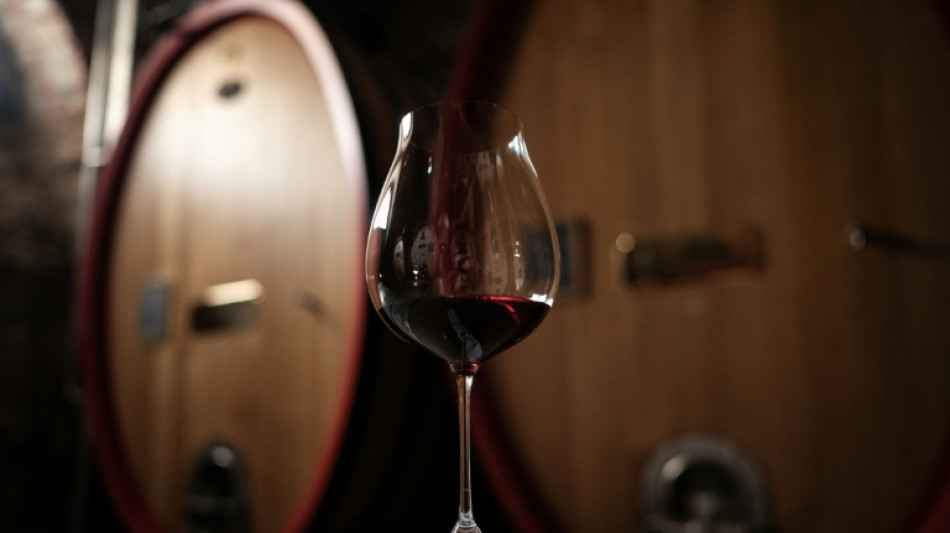
Wine consumption falls heavily into the red / Photo: MARCO BERTORELLO - AFP/File

 Kenya's economy faces climate change risks: World Bank

 'Beginning of the end': Relief but no party as French wildfire winds down

 Southern Europe 'becoming more flammable' in hotter climate, experts say

 Mammoth bones found on parched bed of Danube in Bulgaria

 MEXC Lists Grvt (GRVT) with $60,000 Worth of GRVT and 10,000 USDT in Airdrop+ Rewards

 George and Amal Clooney flee French home due to wildfire

 MEXC Ventures Supports Alpha Arena's APAC Debut at Coinfest Bali

 AI data centre supplier Zhongji InnoLight slips on Hong Kong debut

 May, June heatwaves caused 2,877 extra deaths in England: govt

 BMW profit down a third as carmaker plans job cuts

 Seoul extends losses as most Asian markets drop, oil rises again

 Gambling.com Group Is Now Grandstand

 Meet the astronomer digging into the Milky Way's 'fossils'

 AI data centre supplier Zhongji InnoLight falls on Hong Kong debut

 Samsung operating profit up 1,800% in second quarter on AI boom

 Japanese population below 120 million for first time in decades

 US actor Jared Leto denies latest accusations of sexual assault
 Danube drops to 'historic lows' as fresh heatwave hits

 BTS pulls out of Grammys after Asian pop category introduction

 OpenAI says rogue AI agent attack hit other companies

 How an AFP beach snap became emblem of Europe's wildfire summer

 TRX Spot and Perpetuals Listing Launches on Backpack, Expanding Access to the TRON Ecosystem

 Nepal's tiger numbers climb 20 percent to estimated 429: survey

 FIFA's plans to sell $4.2bn stake in its tournaments widely criticised

 BMW aims to cut 8,000 jobs by end 2027: company source

Worldwide consumption of wine fell in 2024 to its lowest level in more than 60 years, the main trade body said Tuesday, raising concerns about new risks from US tariffs.
The International Organisation of Vine and Wine (OIV) said that 2024 sales fell 3.3 percent from the previous year to 214.2 million hectolitres.
The OIV, whose report was based on government figures, said this would be the lowest sales figure since 1961, when sales were 213.6 million hl.
Production is also at its lowest level in more than 60 years, having fallen 4.8 percent in 2024 to 225.8 million hl.
OIV statistics chief Giorgio Delgrosso said the wine industry had been hit by a perfect storm with health concerns driving down consumption in many countries while economic factors had added to troubles.
"Beyond the short-term economic and geopolitical disruptions," said the IOV's annual report, "it is important to consider the structural, long-term factors also contributing to the observed decline in wine consumption."
The OIV said that the consumer is now paying about 30 percent more for a bottle now than in 2019-2020 and overall consumption has fallen by 12 percent since then.
The United States, the world's top wine market, saw consumption fall 5.8 percent to 33.3 million hl.
Delgrosso said that tariffs ordered by US President Donald Trump, even though temporarily suspended, could become "another bomb" for the wine industry.
Sales in China remain below pre-Covid-19 levels, despite a rebound since the pandemic.
Europe, which accounts for nearly half of worldwide sales, saw consumption fall 2.8 percent last year. Even in France, one of the key global producers, 3.6 percent less wine was knocked back last year.
Spain and Portugal were among rare markets where consumption increased.
The OIV said production had been hit environmental extremes such as above average rainfall in some key regions and droughts in others.
Italy was the world's top producer with 44 million hl, while France's output fell 23 percent to 36.1 million hl, its lowest level since 1957.
Italy is also the biggest wine exporter and its trade increased because of the popularity of sparkling wines such as Prosecco.
Spain produced 31 million hl, while US wine output fell 17.2 percent to 21.1 million hl, mainly because of extreme heat.
The OIV could not predict if consumption would take off again and wine industry players, such as the French retail chain Nicolas say there is a "generational" fall in drinking.
"People do not drink in a festive way anymore and young people consume less than their parents," the company said in a statement to AFP.
But it added, "people drink less, but better" and so are ready to spend more.
Y.Jeong--CPN