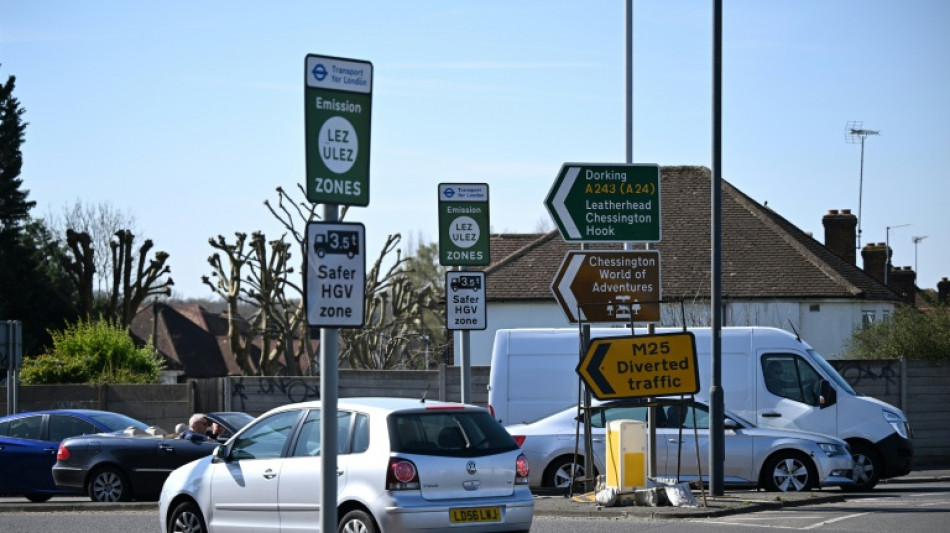
Clean streets vs business woes: pollution charge divides Londoners / Photo: Justin TALLIS - AFP

 Kenya's economy faces climate change risks: World Bank

 'Beginning of the end': Relief but no party as French wildfire winds down

 Southern Europe 'becoming more flammable' in hotter climate, experts say

 Mammoth bones found on parched bed of Danube in Bulgaria

 MEXC Lists Grvt (GRVT) with $60,000 Worth of GRVT and 10,000 USDT in Airdrop+ Rewards

 George and Amal Clooney flee French home due to wildfire

 MEXC Ventures Supports Alpha Arena's APAC Debut at Coinfest Bali

 AI data centre supplier Zhongji InnoLight slips on Hong Kong debut

 May, June heatwaves caused 2,877 extra deaths in England: govt

 BMW profit down a third as carmaker plans job cuts

 Seoul extends losses as most Asian markets drop, oil rises again

 Gambling.com Group Is Now Grandstand

 Meet the astronomer digging into the Milky Way's 'fossils'

 AI data centre supplier Zhongji InnoLight falls on Hong Kong debut

 Samsung operating profit up 1,800% in second quarter on AI boom

 Japanese population below 120 million for first time in decades

 US actor Jared Leto denies latest accusations of sexual assault

 Danube drops to 'historic lows' as fresh heatwave hits

 BTS pulls out of Grammys after Asian pop category introduction

 OpenAI says rogue AI agent attack hit other companies

 How an AFP beach snap became emblem of Europe's wildfire summer

 TRX Spot and Perpetuals Listing Launches on Backpack, Expanding Access to the TRON Ecosystem

 Nepal's tiger numbers climb 20 percent to estimated 429: survey
 FIFA's plans to sell $4.2bn stake in its tournaments widely criticised

 BMW aims to cut 8,000 jobs by end 2027: company source

For Londoner Beau Boka-Batesa, air quality has drastically improved in the British capital following the rollout and expansion of a contested car pollution toll two years ago.
Now, Boka-Batesa, 21, feels like they can walk down a high street and "not cough as much".
"It's so much more evident that things aren't as bad as they used to be," said Boka-Batesa, who co-founded the "Choked Up" campaign group for young, ethnic minority Londoners living in areas of high pollution.
As French lawmakers debate doing away with their version of a low-emissions zone on Tuesday, UK researchers and campaigners have hailed the effectiveness of the toll in improving London's air quality.
The Ultra Low Emissions Zone (ULEZ) -- the world's largest pollution charging scheme -- was implemented in central London in 2019, before expanding to Greater London's nine million residents in 2023.
It requires motorists to switch to low-emission vehicles or face a daily charge of £12.50 ($15.90, 14.60 euros) for driving a polluting car within the zone.
Its expansion saw fierce opposition from outer London residents, with local councils launching unsuccessful legal challenges and hundreds of ULEZ cameras vandalised by disgruntled residents.
While many Londoners are still holding out against the policy championed by Mayor Sadiq Khan, others are resigned or have even come around to its benefits.
A study published by Khan's government last month showed a significant drop in air pollution compared to a scenario without ULEZ, including 27 percent lower levels of toxic NO2 gas emitted from vehicle exhausts across London.
And nearly 97 percent of London vehicles were compliant with low emissions standards as of September 2024, compared to just 39 percent in 2017.
- 'Kills businesses' -
But according to music business owner Roger Tichborne, some polluting car owners are simply being shut out of the capital, with residents on the outer edges avoiding coming into London.
Since ULEZ was expanded to his Mill Hill neighbourhood in northwest London in 2023, his studio business has seen a 15-20 percent drop in bands coming from outside the zone to use his rehearsal space.
"They've just stopped coming because it's too expensive," Tichborne, 62, told AFP, adding his adjoining music shop had taken a 30 percent cut in business.
Like many outer London residents, Tichborne has also resorted to measures like taking longer detours in his Ford Galaxy diesel car to avoid ULEZ cameras and charges.
Alongside ULEZ, Khan had introduced a "scrappage" scheme providing financial support for replacing non-compliant cars, however, Tichborne said changing cars was still too expensive.
The music studio owner accused Khan of providing insufficient help for small businesses and musicians -- many of whom rely on older, polluting vans to transport their equipment.
"When you design measures that are going to affect large amounts of the population, you have to do it in a way that you don't kill businesses," he said.
"My issue with it is not the fact that the air is cleaner. My issue with it is the fact that it's badly implemented."
While he is still opposed to the scheme, Tichborne conceded that "people in London have, by and large, changed their cars or learnt to live with it".
- Effective tool -
For Boka-Batesa, "transparency and open communication" were necessary to "ensure that people's needs are at the forefront of it all".
According to another study into the impacts of ULEZ on children's health published in March, the scheme had the capacity to "both narrow and exacerbate inequities".
While some outer London families struggled to replace cars or switch to public transport, the report found that more primary school students were choosing "active" modes of travelling to school, such as cycling and walking.
"Introducing a clean air zone, in particular ULEZ, has wider societal benefits," said Christopher Griffiths, senior author and professor at London's Queen Mary University.
"It goes beyond just cleaning the air, it's about how we live."
Respondents from deprived areas who reported living in the most polluted parts of central London experienced the "greatest impact of reduced pollution levels", according to the study.
The "data is clear that the ULEZ has delivered a massive improvement in air quality beyond what was expected or predicted", Griffiths said.
According to the researcher, ULEZ, France's under-threat "Zones a Faibles Emissions" (ZFE) -- and over 300 similar "clean air schemes" across Europe -- are vital solutions.
"They're the one public health tool that we have that is being shown to be effective."
J.Bondarev--CPN