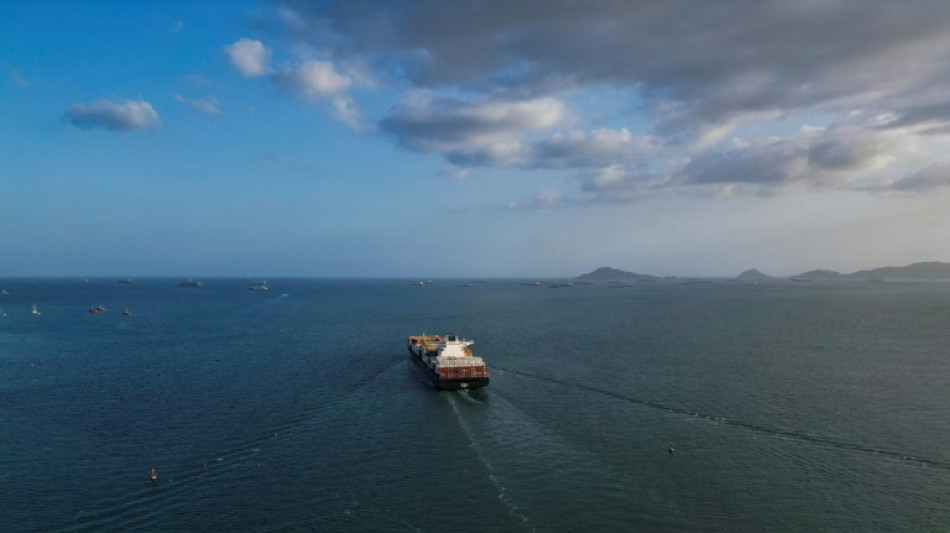
Nations divided ahead of decisive week for shipping emissions / Photo: MARTIN BERNETTI - AFP

 Kenya's economy faces climate change risks: World Bank

 'Beginning of the end': Relief but no party as French wildfire winds down

 Southern Europe 'becoming more flammable' in hotter climate, experts say

 Mammoth bones found on parched bed of Danube in Bulgaria

 MEXC Lists Grvt (GRVT) with $60,000 Worth of GRVT and 10,000 USDT in Airdrop+ Rewards
 George and Amal Clooney flee French home due to wildfire

 MEXC Ventures Supports Alpha Arena's APAC Debut at Coinfest Bali
 AI data centre supplier Zhongji InnoLight slips on Hong Kong debut

 May, June heatwaves caused 2,877 extra deaths in England: govt

 BMW profit down a third as carmaker plans job cuts

 Seoul extends losses as most Asian markets drop, oil rises again
 Gambling.com Group Is Now Grandstand

 Meet the astronomer digging into the Milky Way's 'fossils'
 AI data centre supplier Zhongji InnoLight falls on Hong Kong debut

 Samsung operating profit up 1,800% in second quarter on AI boom

 Japanese population below 120 million for first time in decades

 US actor Jared Leto denies latest accusations of sexual assault

 Danube drops to 'historic lows' as fresh heatwave hits

 BTS pulls out of Grammys after Asian pop category introduction

 OpenAI says rogue AI agent attack hit other companies

 How an AFP beach snap became emblem of Europe's wildfire summer

 TRX Spot and Perpetuals Listing Launches on Backpack, Expanding Access to the TRON Ecosystem

 Nepal's tiger numbers climb 20 percent to estimated 429: survey

 FIFA's plans to sell $4.2bn stake in its tournaments widely criticised

 BMW aims to cut 8,000 jobs by end 2027: company source

Members of the International Maritime Organization (IMO) are divided over whether to approve a carbon tax on international shipping, ahead of a meeting starting on Monday to finalise emissions-reduction measures.
The carbon tax, the most ambitious measure on the table, would make it more expensive for shipping companies to emit greenhouse gases, encouraging them to curtail emissions.
But some member states, including China and Brazil, are proposing other measures, arguing the carbon levy would increase the cost of goods and contribute to food insecurity.
The IMO expects to come to an initial agreement by Friday next week on which mechanism to adopt to help reach carbon neutrality in shipping by 2050.
The stakes are high as shipping accounts for nearly three percent of global greenhouse gas emissions, according to the IMO.
"(It is) difficult to say what will happen next week," Fanny Pointet, sustainable shipping manager at European advocacy group, Transport and Environment, told AFP.
The United States has been notably quiet about the issue, having not commented since President Donald Trump returned to the White House.
The Pacific and Caribbean island states are leading the group pushing for a carbon tax, with support from other countries including the UK.
They argue that funds raised from a levy could be redistributed to nations most vulnerable to climate change to help adapt and mitigate its effects.
"Climate change is a terrifying lived reality for my country," said Albon Ishoda, the Marshall Islands' representative to the IMO.
- 'Terrifying lived reality' -
However, around 15 countries strongly oppose the carbon levy, arguing it would exacerbate inequalities between nations and raise the costs of goods such as palm oil, cereals and corn.
Concerns are also mounting that the European Union, once a supporter of a carbon tax, could water down the measure in favour of a carbon credit system.
Such a system would allow companies or countries to buy and sell credits representing the right to emit a certain amount of carbon dioxide.
According to University College London research, the option of no levy presents the biggest risk to meeting the shipping sector's climate goals.
It could also distort fuel prices and create an uneven playing field, favouring states with strong industrial polices, such as China, researchers said.
"The fastest and cheapest energy transition is brought about by a strong levy," combined with a global fuel standard to reduce the carbon intensity of fuels used by ships, they added.
Challenges also remain with the fuel standard system, particularly the risk of using alternative fuels such as palm oil and soybean oil, which indirectly contribute to emissions through deforestation, Pointet explained.
While Brazil defends the key role of these biofuels, more than 60 environmental protection NGOs have raised objections to their inclusion in the future shipping fuel mix.
Other potential solutions include synthetic hydrogen-based fuels, currently very expensive to produce, or the installation of wind-powered propulsion systems onboard ship.
Y.Uduike--CPN