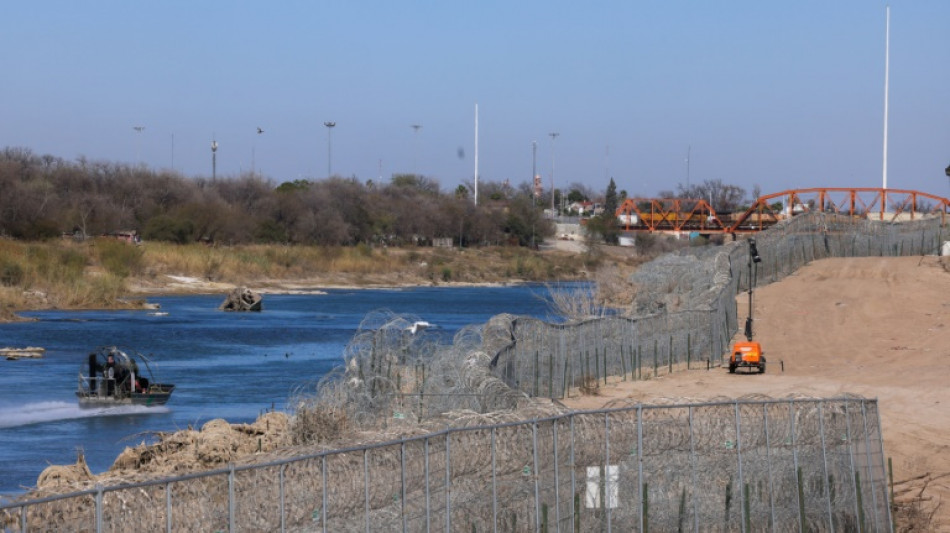
Why has Mexico's water debt opened new battle line with US? / Photo: CHARLY TRIBALLEAU - AFP/File

 Kenya's economy faces climate change risks: World Bank

 'Beginning of the end': Relief but no party as French wildfire winds down

 Southern Europe 'becoming more flammable' in hotter climate, experts say

 Mammoth bones found on parched bed of Danube in Bulgaria

 MEXC Lists Grvt (GRVT) with $60,000 Worth of GRVT and 10,000 USDT in Airdrop+ Rewards
 George and Amal Clooney flee French home due to wildfire

 MEXC Ventures Supports Alpha Arena's APAC Debut at Coinfest Bali
 AI data centre supplier Zhongji InnoLight slips on Hong Kong debut

 May, June heatwaves caused 2,877 extra deaths in England: govt

 BMW profit down a third as carmaker plans job cuts
 Seoul extends losses as most Asian markets drop, oil rises again

 Gambling.com Group Is Now Grandstand

 Meet the astronomer digging into the Milky Way's 'fossils'
 AI data centre supplier Zhongji InnoLight falls on Hong Kong debut

 Samsung operating profit up 1,800% in second quarter on AI boom

 Japanese population below 120 million for first time in decades

 US actor Jared Leto denies latest accusations of sexual assault
 Danube drops to 'historic lows' as fresh heatwave hits

 BTS pulls out of Grammys after Asian pop category introduction
 OpenAI says rogue AI agent attack hit other companies

 How an AFP beach snap became emblem of Europe's wildfire summer
 TRX Spot and Perpetuals Listing Launches on Backpack, Expanding Access to the TRON Ecosystem
 Nepal's tiger numbers climb 20 percent to estimated 429: survey
 FIFA's plans to sell $4.2bn stake in its tournaments widely criticised

 BMW aims to cut 8,000 jobs by end 2027: company source

Mexico's water debt to the United States under a decades-old supply treaty has opened a new battlefront between the two countries, in addition to US President Donald Trump's threatened tariffs.
Mexico's shortfalls, which it blames on an extraordinary drought, led the United States to refuse its neighbor's request for special delivery of water to the border city of Tijuana last week.
- What's the deal? -
Under a pact dating back to 1944, the neighboring countries share water from two major rivers flowing from the southwestern United States to Mexico.
The agreement obliges the United States to deliver 1.85 billion cubic meters of water a year from the Colorado River.
In return Mexico must supply an average of 432 million cubic meters annually over a five-year cycle from the Rio Grande, which forms part of the border between the two countries.
The current cycle expires in October and Mexico owes the United States more than 1.55 billion cubic meters, according to the two countries' boundary and water commission.
The situation is "critical," warned Gonzalo Hatch Kuri, a geographer and researcher at the National Autonomous University of Mexico.
"Only massive storms during the upcoming rainy season of August and September could, miraculously, make it possible to meet the deadline," he told AFP.
- What does US say? -
Washington said on March 20 that it was the first time it had rejected a request by Mexico for special delivery of water.
It said the Mexican delivery shortfalls were "decimating American agriculture -- particularly farmers in the Rio Grande valley."
US farmers and lawmakers complain that their southern neighbor has waited until the end of each cycle and has been coming up short in the latest period.
The Colorado River has seen its water levels shrink due to drought and heavy agricultural consumption in the southwestern United States, with around half of its water going to raise beef and dairy cattle.
Farmers in southern Texas have voiced fear for the future of cotton, citrus and other farming products.
The row has added to the tensions sparked by Trump's threat to impose tariffs on imports from Mexico, despite a North American free trade deal that also includes Canada.
- Why is Mexico falling short? -
The Mexican government says that the Rio Grande basin has suffered from two decades of drought that reached extreme levels in 2023.
Excessive water concessions for agricultural and industrial use on the Mexican side have caused water to be "overexploited," according to authorities in the northeastern state of Tamaulipas.
In November, the two countries signed an agreement aimed at preventing water shortages in parched southern US states with more reliable Mexican deliveries of river water.
The accord -- the result of more than 18 months of negotiations -- provides Mexico with "tools and flexibility" to provide water earlier in a five-year cycle to reduce or prevent shortfalls, the boundary and water commission said.
Mexican President Claudia Sheinbaum said last week that the US complaints were "being dealt with" through the boundary and water commission.
"There's been less water. That's part of the problem," she told reporters.
Mexico's attempts to comply with the treaty have resulted in civil unrest in the past.
In 2020, farmers in the northern state of Chihuahua seized a dam to prevent the government from supplying water from a reservoir to the United States, leading to clashes between protesters and the National Guard that left one person dead.
A.Levy--CPN