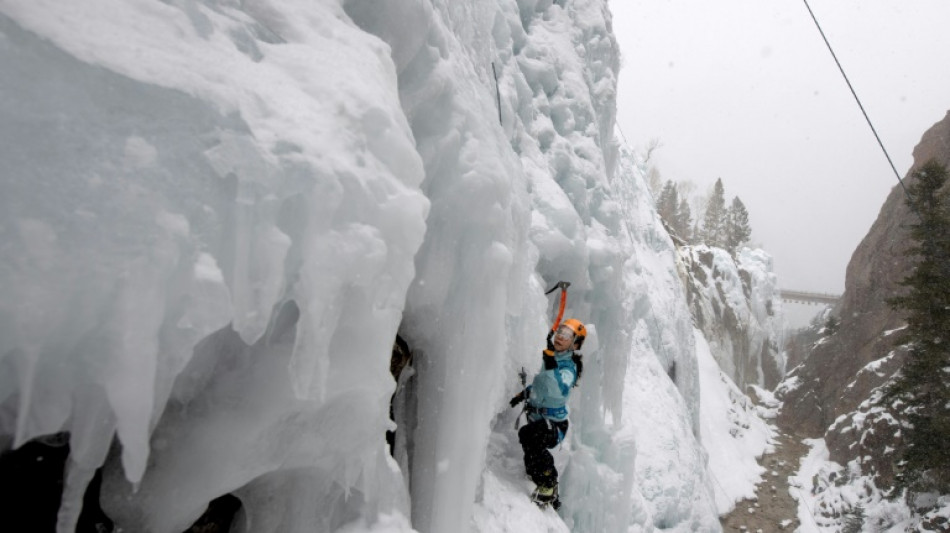
Ice park threatened by climate change finds an ally in US silver mine / Photo: Jason Connolly - AFP

 Kenya's economy faces climate change risks: World Bank

 'Beginning of the end': Relief but no party as French wildfire winds down

 Southern Europe 'becoming more flammable' in hotter climate, experts say

 Mammoth bones found on parched bed of Danube in Bulgaria

 MEXC Lists Grvt (GRVT) with $60,000 Worth of GRVT and 10,000 USDT in Airdrop+ Rewards
 George and Amal Clooney flee French home due to wildfire

 MEXC Ventures Supports Alpha Arena's APAC Debut at Coinfest Bali

 AI data centre supplier Zhongji InnoLight slips on Hong Kong debut

 May, June heatwaves caused 2,877 extra deaths in England: govt
 BMW profit down a third as carmaker plans job cuts
 Seoul extends losses as most Asian markets drop, oil rises again

 Gambling.com Group Is Now Grandstand

 Meet the astronomer digging into the Milky Way's 'fossils'

 AI data centre supplier Zhongji InnoLight falls on Hong Kong debut

 Samsung operating profit up 1,800% in second quarter on AI boom

 Japanese population below 120 million for first time in decades

 US actor Jared Leto denies latest accusations of sexual assault
 Danube drops to 'historic lows' as fresh heatwave hits
 BTS pulls out of Grammys after Asian pop category introduction
 OpenAI says rogue AI agent attack hit other companies

 How an AFP beach snap became emblem of Europe's wildfire summer

 TRX Spot and Perpetuals Listing Launches on Backpack, Expanding Access to the TRON Ecosystem

 Nepal's tiger numbers climb 20 percent to estimated 429: survey
 FIFA's plans to sell $4.2bn stake in its tournaments widely criticised

 BMW aims to cut 8,000 jobs by end 2027: company source

America's ice-climbing epicenter was facing a bleak future, with climate change endangering its water supply, until an unlikely savior came to its rescue: a nearby silver mine.
Nestled in the heart of the Rockies, at an altitude of 2,400 meters (7,800 feet), Ouray is famous among mountaineers around the world for its artificial ice park.
For 30 years, the village has piped in water that washes down the walls of a nearby gorge in winter, freezing in place and creating dozens of climbing routes.
"It's definitely an ice climbing Mecca," said mountain guide Clint Cook.
"I can't think of anywhere else that attracts this many people specifically to one place, just for ice climbing."
But a damaging decades-long drought threatened the area's water source, even as the number of winter visitors exploded.
"I can remember some people going around town and be like 'Don't shower tonight! We need that water in the tank to build ice,'" said Cook, 47.
But starting next season, all that is set to change, after Ouray Silver Mines stepped in and offered to lease the rights to millions of liters (gallons) of water every year -- for a meager $1 fee.
"The water from the mine will give us anywhere from three- to five-times more water than we have access to right now," said Peter O'Neil, executive director of the nonprofit Ouray Ice Park.
"And we're not dependent on the city water tanks."
- 'Ghost town' -
That should secure the park's future not only for the "next generation of ice climbers," but also for all the local businesses that depend on tourists.
"If there was no ice park in the winter, the town would be a ghost town," said O'Neil.
"Most of the hotels and motels would be closed."
Ouray, a village of around 900 people, was founded in the 19th century during the Colorado Silver Rush -- a history that is commemorated by a statue of a miner found the town.
Silver mining dwindled over the 20th century, but renewed demand from new technologies like solar panels has reinvigorated the industry.
Brian Briggs, the former CEO of Ouray Silver Mines, who sealed the partnership transferring water rights to the ice park, said the alliance was a win for everyone.
Under Colorado's water use rights, the mine was entitled to millions of gallons for "recreational use," simply by dint of being a significant land owner.
It wasn't using them, and Briggs recognized the need to improve the image of his industry.
"Most people don't like things in their backyard that are mining or industrial," he said.
Donating the water, he figured, was a nice way to give back to the community in an effort to build good will.
"People need to know that the mine's not just this bad group of people," Briggs said.
- 'What if there's no ice?' -
Earth's warming climate, caused chiefly by humanity's unchecked burning of fossil fuels, has not only hit water supplies, but also causes problems with rising temperatures.
Ideally, the park needs several consecutive days where the temperatures stays below -7C (19 Fahrenheit) for the ice to form properly, hence the importance of being able to turn the taps on when the weather is right.
For the thousands of people who travel to the self-proclaimed "Switzerland of America" spending around $18 million a year, the deal is a real boost.
Jen Brinkley, from California, has been visiting Ouray almost every season for 30 years.
When she was younger, she said, she would ask: "How many times can we get up there this year? It was more about like, how many trips could we take?"
"There was never a thought of, 'oh, wait, what if there's no ice?'"
Brinkley hopes the water from the mine will secure the park's future and make the climbing there even better.
"With more routes open you definitely have people that can spread out and so everybody can have a chance to climb," she said.
P.Gonzales--CPN