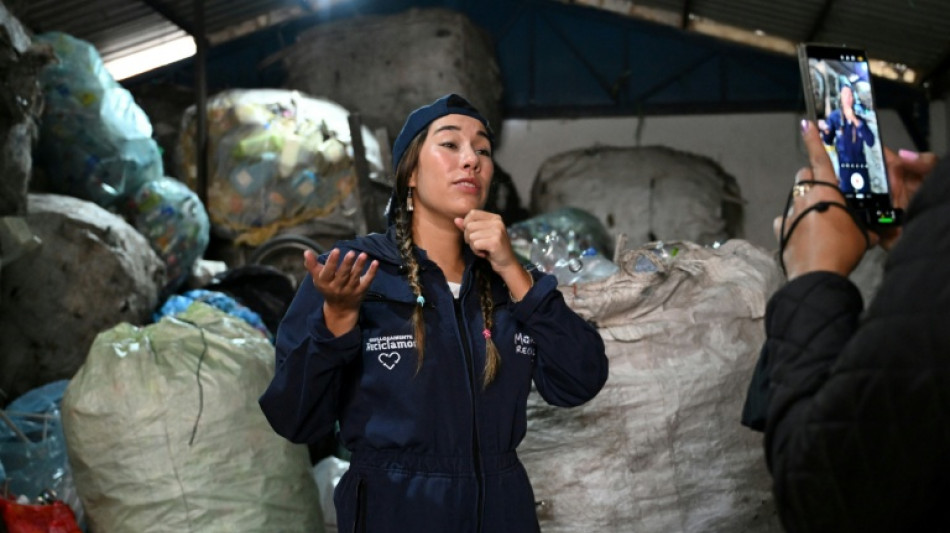
Colombian influencer puts the pizzazz into recycling / Photo: Raul ARBOLEDA - AFP

 Kenya's economy faces climate change risks: World Bank

 'Beginning of the end': Relief but no party as French wildfire winds down

 Southern Europe 'becoming more flammable' in hotter climate, experts say

 Mammoth bones found on parched bed of Danube in Bulgaria

 MEXC Lists Grvt (GRVT) with $60,000 Worth of GRVT and 10,000 USDT in Airdrop+ Rewards

 George and Amal Clooney flee French home due to wildfire

 MEXC Ventures Supports Alpha Arena's APAC Debut at Coinfest Bali

 AI data centre supplier Zhongji InnoLight slips on Hong Kong debut

 May, June heatwaves caused 2,877 extra deaths in England: govt

 BMW profit down a third as carmaker plans job cuts

 Seoul extends losses as most Asian markets drop, oil rises again

 Gambling.com Group Is Now Grandstand

 Meet the astronomer digging into the Milky Way's 'fossils'

 AI data centre supplier Zhongji InnoLight falls on Hong Kong debut

 Samsung operating profit up 1,800% in second quarter on AI boom

 Japanese population below 120 million for first time in decades

 US actor Jared Leto denies latest accusations of sexual assault
 Danube drops to 'historic lows' as fresh heatwave hits

 BTS pulls out of Grammys after Asian pop category introduction

 OpenAI says rogue AI agent attack hit other companies

 How an AFP beach snap became emblem of Europe's wildfire summer

 TRX Spot and Perpetuals Listing Launches on Backpack, Expanding Access to the TRON Ecosystem

 Nepal's tiger numbers climb 20 percent to estimated 429: survey

 FIFA's plans to sell $4.2bn stake in its tournaments widely criticised

 BMW aims to cut 8,000 jobs by end 2027: company source

Colombian influencer Sara Samaniego braids her long straight hair, checks her make-up in a mirror, places her phone in the center of a ring light and flashes a big smile for the camera.
"Hola mis recicla-amores! (Hello my recycling loves)," the 32-year-old, who is on a mission to teach Colombians how to sort their waste, says to greet her half-a-million Instagram followers.
Samaniego, who wears blue overalls and a baseball cap on backwards as part of her "Marce, la recicladora" (Marce, the recycler) social media alter ego, has also become an unofficial spokeswoman for the 74,000 people who rummage through the garbage of Latin America's fourth-biggest economy every day.
Colombian cities have no public recycling systems.
Instead, they rely on informal waste pickers to go through bins and garbage left out for collection to salvage cardboard, glass, plastic and other reusable materials.
Across the world, between 20 and 34 million people play a crucial role in environmental protection by collecting and sorting waste recyclables -- dirty, dangerous work for which most are paid a pittance.
- Making ends meet -
Throughout the developing world, waste pickers can be seen pulling carts laden high with bric-a-brac through dense traffic.
Samaniego tries to boost their visibility by profiling waste pickers on her YouTube and Instagram accounts.
She "encourages people to understand the work of recyclers from the inside," Zoraya Avendano, the manager of a warehouse where the recyclers sell their wares for a few pesos, told AFP.
Bogota, a city of eight million people, produces 9,000 tons of waste each day, according to a 2023 Greenpeace report, of which 17 percent is recycled -- the same proportion as New York, according to the GrowNYC recycling group.
Recycler Mary Luz Torres, 50, spends two hours travelling by bus from her home in the working-class south of Bogota to the wealthier north, where she plies her trade.
A fluorescent vest is her only form of protection from the cars and trucks zooming past, as she lugs a cart spray-painted with her name through the street.
"You have to go out and find a way to make ends meet," she said.
Pedro Talero, 55, spends his days collecting trash, which he sorts by night under a bridge.
On a good day he earns around $20, double the minimum wage.
"Some people look down on us," he said, but added that growing environmental awareness is leading to greater recognition of "our services to the planet."
- Growing recognition -
Colombia's leftist President Gustavo Petro last year rewarded the work of waste pickers by giving them a monopoly on recycling for 15 years.
"If traditional informal recyclers are compensated, we lift many people out of poverty. We lift many children out of child labor. We lift many women out of indignity," Petro said, crediting them with "improving the balance between humankind and nature."
Samaniego's contribution has been an attempt to glamorize the trade, with how-to posts set to tracks by Colombian stars such as Shakira and Karol G.
Born in Bogota, she developed a passion for nature on childhood holidays in the countryside.
Making a documentary about recycling while studying communications put her on the path to environmental influencer.
When she launched her YouTube channel six years ago, she said, there were "a lot of videos about music, dance, cooking, sports but the environment was rarely discussed."
Samaniego's winning formula is to inject levity into a subject characterized by earnestness.
The response has been thousands of questions and comments on her posts each day, and growing renown.
She gets stopped on the street for selfies, was recently a special guest on a TV reality show and is regularly invited to give talks at schools and businesses.
She owes much of her knowledge to informal recyclers, whom she calls her teachers.
To repay them, she fundraises on social media to buy them equipment, such as safety gloves and face masks, or to send them on a well-deserved holiday to the sea.
"I am fulfilling my goal of being an agent of change in the country," she says.
X.Wong--CPN