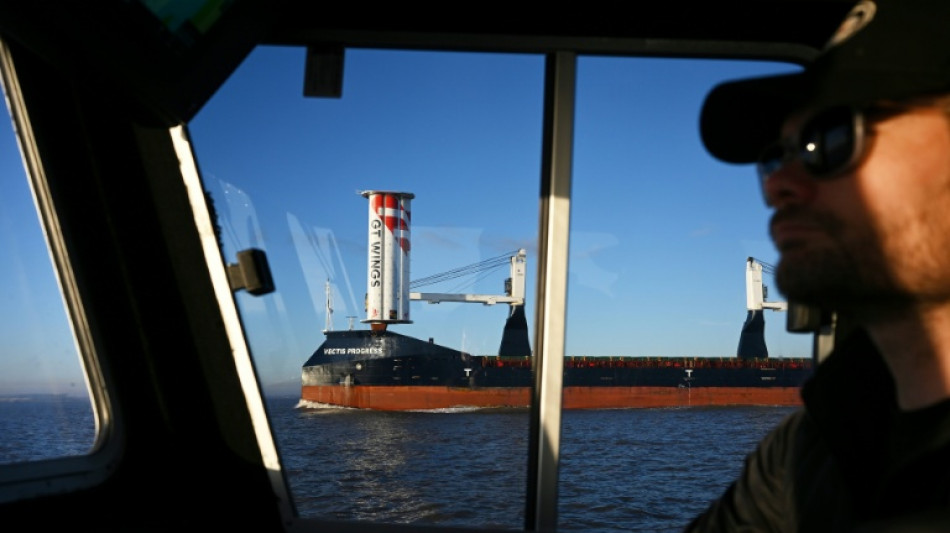
Wind-powered mast to cut emissions sets sail to Canada / Photo: Paul ELLIS - AFP

 Kenya's economy faces climate change risks: World Bank

 'Beginning of the end': Relief but no party as French wildfire winds down

 Southern Europe 'becoming more flammable' in hotter climate, experts say

 Mammoth bones found on parched bed of Danube in Bulgaria

 MEXC Lists Grvt (GRVT) with $60,000 Worth of GRVT and 10,000 USDT in Airdrop+ Rewards
 George and Amal Clooney flee French home due to wildfire

 MEXC Ventures Supports Alpha Arena's APAC Debut at Coinfest Bali

 AI data centre supplier Zhongji InnoLight slips on Hong Kong debut

 May, June heatwaves caused 2,877 extra deaths in England: govt
 BMW profit down a third as carmaker plans job cuts

 Seoul extends losses as most Asian markets drop, oil rises again

 Gambling.com Group Is Now Grandstand

 Meet the astronomer digging into the Milky Way's 'fossils'

 AI data centre supplier Zhongji InnoLight falls on Hong Kong debut

 Samsung operating profit up 1,800% in second quarter on AI boom

 Japanese population below 120 million for first time in decades

 US actor Jared Leto denies latest accusations of sexual assault

 Danube drops to 'historic lows' as fresh heatwave hits

 BTS pulls out of Grammys after Asian pop category introduction
 OpenAI says rogue AI agent attack hit other companies

 How an AFP beach snap became emblem of Europe's wildfire summer

 TRX Spot and Perpetuals Listing Launches on Backpack, Expanding Access to the TRON Ecosystem

 Nepal's tiger numbers climb 20 percent to estimated 429: survey

 FIFA's plans to sell $4.2bn stake in its tournaments widely criticised

 BMW aims to cut 8,000 jobs by end 2027: company source

A pioneering rigid shipping mast has set off on its first journey, harnessing the wind to propel a cargo ship from England to Canada and using less fuel to help reduce emissions.
After a night of work and a short nap, George Thompson, the founder of GT Wings -- the startup that produced this 20-metre-high mast -- was back on the ship's main deck.
"We haven't had much sleep over the last few days," Thompson told AFP, as he looked out onto the shipyard workers in white helmets and fluorescent vests, still making adjustments a few hours before departure.
"This is very high-tech," said GT Wings product manager Martin Harrop, pointing to the imposing white and red structure on the bow of the cargo ship in Hull, northeastern England.
Like several other wind propulsion systems, this one works like a vertical aeroplane wing. It harnesses the wind that hits its surface to propel the ship.
However, its internal fans set it apart. They accelerate the air passing through it to speed up the ship, Harrop explained.
- America's Cup and Formula 1 -
"There was a gap in the market for a new type of technology," said Thompson, a sailing enthusiast. "One that was able to produce a lot of thrust but from a much smaller, much more compact size."
Since it was set up three years ago, GT Wings has attracted funding from private investors as well as the British government, which has invested £3.7 million ($4.8 million) as part of its maritime decarbonisation programme.
It now has nine employees, including those who have taken part in the America's Cup, a high-level sailing competition, and those from the Formula 1 racing world.
"The aerodynamics and all the science behind the America's Cup really plays a big part in what we're doing," Thompson said, adding the same was true for motor sports and Formula 1.
But building the project within 12 months was a challenge.
It required modifying the ship's structure using an additional nine tonnes of steel, installing over 7.5 kilometres (4 and a half miles) of electric cables and finding space for the AirWing.
"We had a very small footprint on the bow of the ship to install the wing, where it wouldn't impact on the ship's operation," said Simon Merritt from Carisbrooke Shipping, which owns a fleet of vessels including the cargo ship, Vectis Progress.
To overcome the lack of visibility, the company had to fit navigational cameras, a radar system on the bow and navigation lights, Merritt explained, squinting his eyes in the winter sun.
- Fuel savings -
During the first phase of the project, the company managed to use eight percent less fuel.
It now hopes to target up to 10 percent fuel savings on the vessel.
"This ship trades on transatlantic voyages between Europe and Canada, and we hope to harness more wind on these longer voyages with stronger wind conditions," Merritt said.
Depending on the price of fuel, Carisbrooke estimates that it could save nearly $1,000 per day in fuel costs.
The project is one of only around 80 ships globally that use this type of propulsion system, Thompson said.
He hopes that new European legislation -- that requires a reduction of the carbon intensity of ships -- could make technology like the AirWing more appealing.
The International Maritime Organization hopes to achieve carbon neutrality in the maritime sector by 2050 -- and is expected to present measures in April to support this aim.
"The industry was a bit slow to start," said Lise Detrimont, who runs the Wind Ship association, a specialist maritime wind power group.
"But the number of wind-related installations is expected to double every year in coming years."
P.Gonzales--CPN