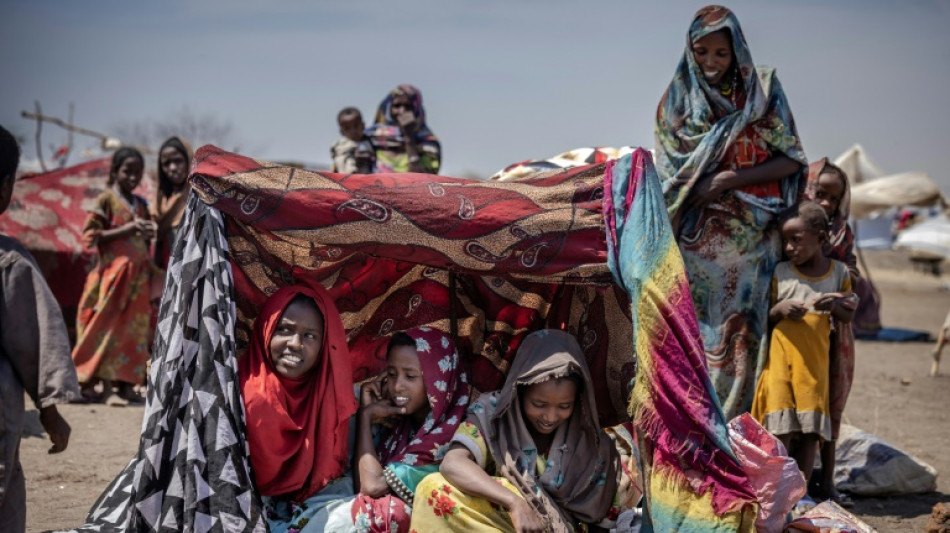
S.Sudan heatwave 'more likely' due to climate change: study / Photo: LUIS TATO - AFP

 Kenya's economy faces climate change risks: World Bank

 'Beginning of the end': Relief but no party as French wildfire winds down

 Southern Europe 'becoming more flammable' in hotter climate, experts say

 Mammoth bones found on parched bed of Danube in Bulgaria

 MEXC Lists Grvt (GRVT) with $60,000 Worth of GRVT and 10,000 USDT in Airdrop+ Rewards

 George and Amal Clooney flee French home due to wildfire

 MEXC Ventures Supports Alpha Arena's APAC Debut at Coinfest Bali

 AI data centre supplier Zhongji InnoLight slips on Hong Kong debut

 May, June heatwaves caused 2,877 extra deaths in England: govt

 BMW profit down a third as carmaker plans job cuts

 Seoul extends losses as most Asian markets drop, oil rises again

 Gambling.com Group Is Now Grandstand

 Meet the astronomer digging into the Milky Way's 'fossils'

 AI data centre supplier Zhongji InnoLight falls on Hong Kong debut

 Samsung operating profit up 1,800% in second quarter on AI boom

 Japanese population below 120 million for first time in decades

 US actor Jared Leto denies latest accusations of sexual assault

 Danube drops to 'historic lows' as fresh heatwave hits

 BTS pulls out of Grammys after Asian pop category introduction

 OpenAI says rogue AI agent attack hit other companies

 How an AFP beach snap became emblem of Europe's wildfire summer

 TRX Spot and Perpetuals Listing Launches on Backpack, Expanding Access to the TRON Ecosystem

 Nepal's tiger numbers climb 20 percent to estimated 429: survey
 FIFA's plans to sell $4.2bn stake in its tournaments widely criticised

 BMW aims to cut 8,000 jobs by end 2027: company source

Man-made climate change increased the likelihood of the heatwave gripping South Sudan, a study said Friday, saying soaring temperatures were disproportionately affecting women and girls.
The impoverished nation has been plagued by insecurity and instability since declaring independence in 2011, and is ill-equipped to counter increasing environmental disasters.
The heatwave comes as South Sudan endures yet another bout of political turmoil, provoking fears that a 2018 agreement -- which ended the vicious five-year civil war -- might be unravelling.
A February heatwave has seen temperatures hit 40 degrees Celsius (104 Fahrenheit) in parts of the country, according to a recent report from IGAD (the Intergovernmental Authority on Development).
The heatwave prompted the government to close the capital's schools, noting that an "average of 12 students had been collapsing in Juba city every day", and order citizens to remain at home.
Climate change "made the extreme heat at least 2C hotter and at least 10 times more likely", according to a new study from the World Weather Attribution, a network of researchers examining links between environmental change and extreme weather events.
"Climate change is clearly making life even more difficult in South Sudan, a country already facing economic challenges and periods of instability," Kiswendsida Guigma, a climate scientist for the Red Cross and Red Crescent in Burkina Faso and one of the study's authors.
- 'New normal' -
Significant numbers of people work outdoors in South Sudan, where many houses have tin roofs and no air conditioning -- conditions that make it difficult to follow government directives to remain inside, the study said.
Drinking water remains in short supply, while access to electricity was 8.4 percent in 2022, according to the World Bank.
It said women and girls were disproportionately affected because daily tasks -- such as collecting water, cooking, and other household chores -- are usually carried out by women.
Elizabeth Lodou Lochapio told AFP from the southeastern town of Kapoeta that women were bearing the brunt of the burden.
"They have to go out there to make a living despite the heat wave," she said.
When the sun was at its hottest, between midday and 3:00 pm, she said, "I don't move, I make sure that I stay in one place."
"Climate change means that dangerous heatwaves exceeding 40 degrees are becoming the new normal in South Sudan," said Sarah Kew, a researcher at the Netherlands Meteorological Institute and one of the study's authors.
"Once rare, these high temperature events are occurring every two years, posing enormous challenges for the people of South Sudan."
The heat is expected to persist throughout March, according to the projections noted in the study.
C.Peyronnet--CPN