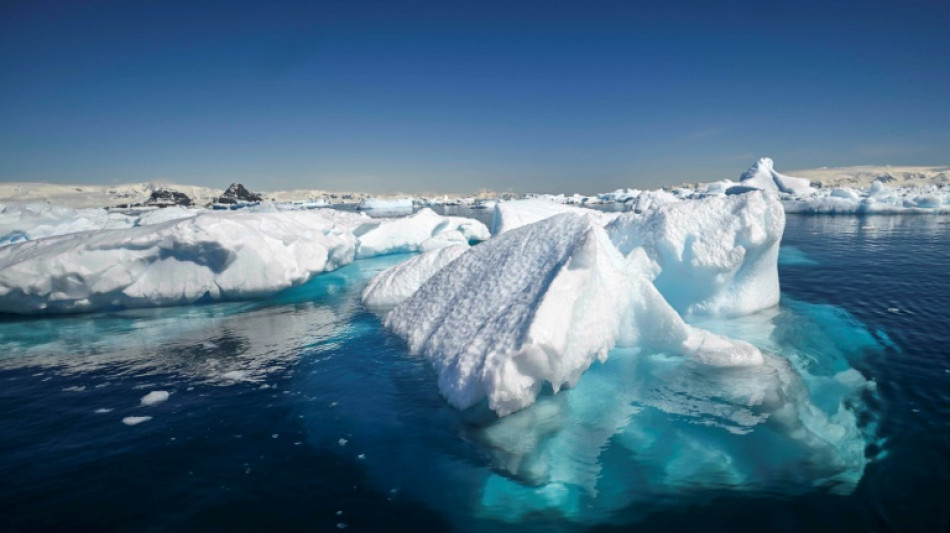
Melting ice could slow vital Antarctic ocean current: study / Photo: Juan BARRETO - AFP

 Kenya's economy faces climate change risks: World Bank

 'Beginning of the end': Relief but no party as French wildfire winds down

 Southern Europe 'becoming more flammable' in hotter climate, experts say

 Mammoth bones found on parched bed of Danube in Bulgaria

 MEXC Lists Grvt (GRVT) with $60,000 Worth of GRVT and 10,000 USDT in Airdrop+ Rewards

 George and Amal Clooney flee French home due to wildfire

 MEXC Ventures Supports Alpha Arena's APAC Debut at Coinfest Bali

 AI data centre supplier Zhongji InnoLight slips on Hong Kong debut

 May, June heatwaves caused 2,877 extra deaths in England: govt

 BMW profit down a third as carmaker plans job cuts

 Seoul extends losses as most Asian markets drop, oil rises again

 Gambling.com Group Is Now Grandstand

 Meet the astronomer digging into the Milky Way's 'fossils'

 AI data centre supplier Zhongji InnoLight falls on Hong Kong debut

 Samsung operating profit up 1,800% in second quarter on AI boom

 Japanese population below 120 million for first time in decades

 US actor Jared Leto denies latest accusations of sexual assault

 Danube drops to 'historic lows' as fresh heatwave hits

 BTS pulls out of Grammys after Asian pop category introduction

 OpenAI says rogue AI agent attack hit other companies

 How an AFP beach snap became emblem of Europe's wildfire summer

 TRX Spot and Perpetuals Listing Launches on Backpack, Expanding Access to the TRON Ecosystem

 Nepal's tiger numbers climb 20 percent to estimated 429: survey
 FIFA's plans to sell $4.2bn stake in its tournaments widely criticised

 BMW aims to cut 8,000 jobs by end 2027: company source

The world's strongest ocean current could slow as melting Antarctic ice sheets flood it with fresh water, according to research published on Monday that warned of "severe" climate consequences.
Scientists used one of Australia's most powerful supercomputers to model how melting ice sheets might change the Antarctic Circumpolar Current, which plays a major role in global climate patterns.
If fossil fuel emissions increased over the next 25 years -- a so-called high emissions scenario -- the current could slow by around 20 percent, the peer-reviewed research found.
"The ocean is extremely complex and finely balanced," said University of Melbourne scientist Bishakhdatta Gayen.
"If this current 'engine' breaks down, there could be severe consequences, including more climate variability -- with greater extremes in certain regions, and accelerated global warming due to a reduction in the ocean's capacity to act as a carbon sink."
The Antarctic Circumpolar Current acted as a kind of "ocean conveyor belt" shifting immense columns of water through the Indian, Atlantic and Pacific Oceans, Gayen said.
Melting ice sheets would "dump vast quantities of fresh water" into the current, the modelling found.
This would change the ocean's salt content, making it harder for cold water to circulate between the surface and the depths.
Oceans play vital roles as climate regulators and carbon sinks.
Cooler waters can absorb greater amounts of heat from the atmosphere.
The strength of the current -- which flows clockwise around Antarctica -- also acts as a barrier that stops invasive species washing up on the continent's shores.
Algae and molluscs could more easily colonise Antarctica if the current slowed down, the researchers wrote.
Even if global warming was limited to a threshold of 1.5 degrees Celsius, the Antarctic current could still slow down.
"The 2015 Paris Agreement aimed to limit global warming to 1.5 degrees Celsius above pre-industrial levels," said climate scientist and co-author Taimoor Sohail.
"Many scientists agree that we have already reached this 1.5 degree target, and it is likely to get hotter, with flow-on impacts on Antarctic ice melting."
The research team, which included scientists from Australia, India and Norway, noted that their findings contrasted with previous studies that observed the current speeding up.
They said further observation and modelling was needed to understand how the "poorly observed region" was responding to climate change.
The research was published in the Environmental Research Letters journal.
C.Peyronnet--CPN