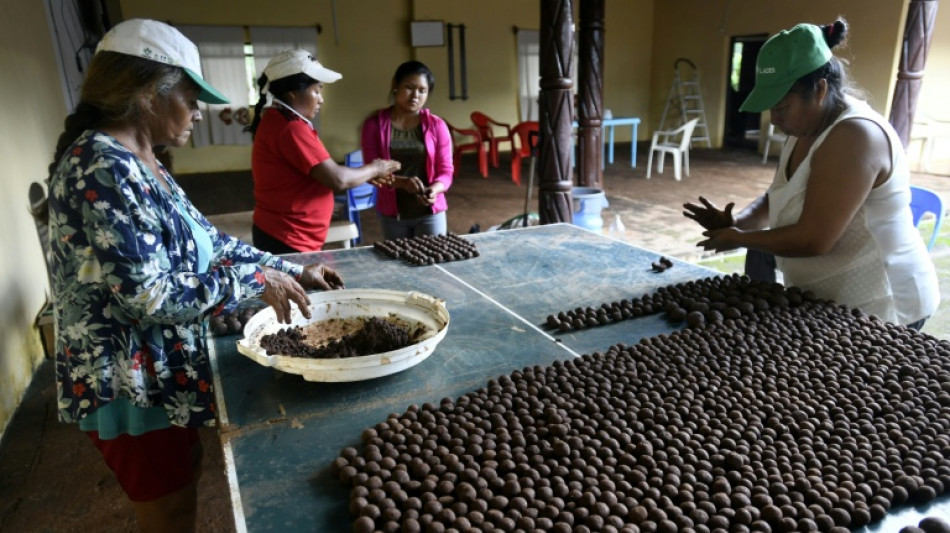
Burn land or plant trees? Bolivian farmers weigh their options / Photo: RODRIGO URZAGASTI - AFP

 Kenya's economy faces climate change risks: World Bank

 'Beginning of the end': Relief but no party as French wildfire winds down

 Southern Europe 'becoming more flammable' in hotter climate, experts say

 Mammoth bones found on parched bed of Danube in Bulgaria

 MEXC Lists Grvt (GRVT) with $60,000 Worth of GRVT and 10,000 USDT in Airdrop+ Rewards

 George and Amal Clooney flee French home due to wildfire

 MEXC Ventures Supports Alpha Arena's APAC Debut at Coinfest Bali

 AI data centre supplier Zhongji InnoLight slips on Hong Kong debut

 May, June heatwaves caused 2,877 extra deaths in England: govt

 BMW profit down a third as carmaker plans job cuts

 Seoul extends losses as most Asian markets drop, oil rises again

 Gambling.com Group Is Now Grandstand

 Meet the astronomer digging into the Milky Way's 'fossils'

 AI data centre supplier Zhongji InnoLight falls on Hong Kong debut

 Samsung operating profit up 1,800% in second quarter on AI boom

 Japanese population below 120 million for first time in decades

 US actor Jared Leto denies latest accusations of sexual assault

 Danube drops to 'historic lows' as fresh heatwave hits

 BTS pulls out of Grammys after Asian pop category introduction

 OpenAI says rogue AI agent attack hit other companies

 How an AFP beach snap became emblem of Europe's wildfire summer

 TRX Spot and Perpetuals Listing Launches on Backpack, Expanding Access to the TRON Ecosystem

 Nepal's tiger numbers climb 20 percent to estimated 429: survey
 FIFA's plans to sell $4.2bn stake in its tournaments widely criticised

 BMW aims to cut 8,000 jobs by end 2027: company source

Less than a year after the worst wildfires in Bolivia's history, farmers face a choice: continue starting blazes to clear land for agriculture, or plant trees to mitigate worsening droughts.
Around 10.7 million hectares (26.4 million acres) of dry tropical forest -- an area about the size of Portugal -- went up in smoke in Bolivia's eastern lowlands last year, according to the non-profit Bolivian Institute for Forest Research (IBIF).
While the fires received less attention than those across the border in Brazil, they killed at least four people, according to Bolivian authorities, and churned up record carbon pollution, the European Union's climate monitor said.
Attempts to carry out controlled burns were widely blamed for the infernos, which spread quickly in a region parched by a prolonged drought that scientists attribute to climate change.
Julia Ortiz, a sesame grower, knows all too well the hazards of the "chaqueos" (slash-and-burn agriculture) practiced by farmers big and small in Bolivia, particularly in the tropical grasslands of Chiquitania region.
Five years ago, she and her family spent an entire night trying to bring a fire they had themselves set under control.
"It can happen to anybody. Most of us live off farming and we must do burns," the 46-year-old Indigenous farmer said as she harvested her plants and stacked them in the sun to dry.
Last year's fires were of a much greater magnitude.
Carmen Pena, a 59-year-old resident of Santa Ana de Velasco, a village with dirt roads surrounded by forest and prairies, lost her banana and yuca crops.
"I don't know how we will survive because our food is running out," said Pena, who like most of Santa Ana's residents depends entirely on farming for an income.
- No machinery -
As green shoots start to sprout from fire-scarred earth, new fires are being lit in other areas as some farmers in Santa Ana continue to clear vegetation to grow crops.
Charred tree trunks on Ortiz's land point to a recent fire, even as the community embarks on a major tree-planting program.
According to an IBIF report, 63.6 percent of the land damaged by last year's fires was in forested areas, which it said pointed to "strong pressure to expand the boundaries of farmland."
David Cruz, a climate change specialist at the Universidad Mayor de San Andres in Bolivia's capital La Paz, accuses the state of abetting deforestation by pardoning people found responsible for starting fires, giving farmers extensions on deadlines to comply with environmental regulations and allowing them to burn large tracts of land.
Ortiz argues that fires are the only way farmers have of clearing land, in the absence of machinery to bury felled trees.
"If we had tractors, we would not need to do burns," she said.
But neither she nor her 1,700 fellow villagers can afford to rent a tractor, much less buy one, and those belonging to the municipality are all undergoing repairs.
"That's why we work as we do, running the risk that the fire would rage out of control. But it's the only choice we have," she argued.
- Tree-planting 'bombs' -
Faced with ongoing water shortages, which is causing crops to wither in the fields, a group of local women -- most of the men have left the village to find work -- have joined forces to try to replant trees using a method pioneered in Nepal.
Using their hands they knead "bombitas" (little spheres) of earth, which they fill with the seeds of indigenous trees.
Drones are then used to drop them over 500 hectares of deforested land, with funding from the Swiss NGO Swisscontact and Bolivia's own Flades foundation.
Some 250,000 "bombitas' will be airdropped starting in March.
Similar reforestation techniques have also been used in Peru and Brazil.
"Without forests, we'll have no water," Joaquin Sorioco, a farmer and forestry technician in Santa Ana said, expressing hope that the planting "will help (the soil) retain more humidity."
The Flades foundation hopes that last year's fires served as a wake-up call on the ravages of land-clearing practices.
"We went through very difficult times," the foundation's director Mario Rivera said. "But in a way it helped create awareness."
H.Cho--CPN