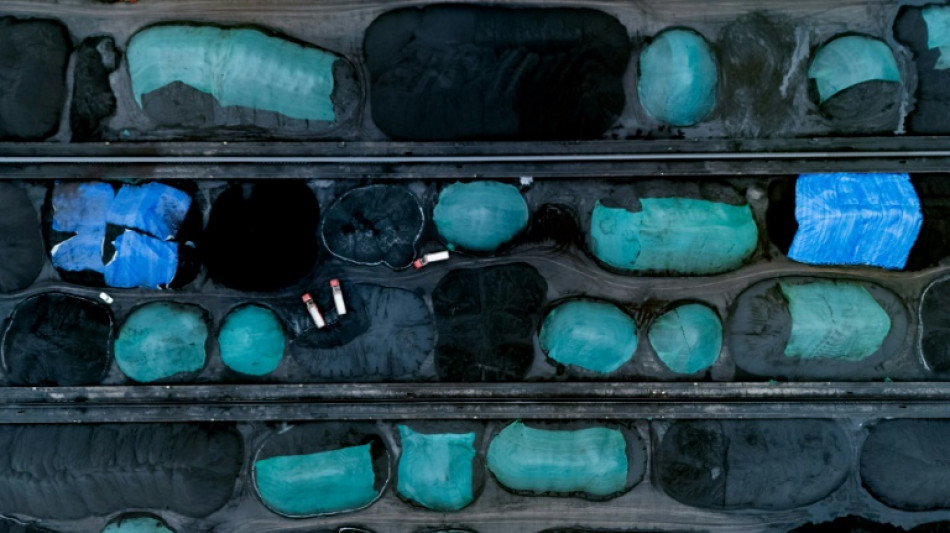
China missed key climate target last year: official data / Photo: - - AFP

 Kenya's economy faces climate change risks: World Bank

 'Beginning of the end': Relief but no party as French wildfire winds down

 Southern Europe 'becoming more flammable' in hotter climate, experts say

 Mammoth bones found on parched bed of Danube in Bulgaria

 MEXC Lists Grvt (GRVT) with $60,000 Worth of GRVT and 10,000 USDT in Airdrop+ Rewards

 George and Amal Clooney flee French home due to wildfire

 MEXC Ventures Supports Alpha Arena's APAC Debut at Coinfest Bali

 AI data centre supplier Zhongji InnoLight slips on Hong Kong debut

 May, June heatwaves caused 2,877 extra deaths in England: govt

 BMW profit down a third as carmaker plans job cuts

 Seoul extends losses as most Asian markets drop, oil rises again

 Gambling.com Group Is Now Grandstand

 Meet the astronomer digging into the Milky Way's 'fossils'

 AI data centre supplier Zhongji InnoLight falls on Hong Kong debut

 Samsung operating profit up 1,800% in second quarter on AI boom

 Japanese population below 120 million for first time in decades

 US actor Jared Leto denies latest accusations of sexual assault

 Danube drops to 'historic lows' as fresh heatwave hits

 BTS pulls out of Grammys after Asian pop category introduction

 OpenAI says rogue AI agent attack hit other companies

 How an AFP beach snap became emblem of Europe's wildfire summer

 TRX Spot and Perpetuals Listing Launches on Backpack, Expanding Access to the TRON Ecosystem

 Nepal's tiger numbers climb 20 percent to estimated 429: survey

 FIFA's plans to sell $4.2bn stake in its tournaments widely criticised

 BMW aims to cut 8,000 jobs by end 2027: company source

China missed a key climate target in 2024 and emissions in the world's second-largest economy rose slightly as coal remained dominant despite record renewable additions, official data showed Friday.
The figures mean the world's biggest emitter is off-track on a key commitment under the Paris climate agreement, analysts said.
Beijing's National Bureau of Statistics (NBS) said carbon intensity, which measures emissions of planet-warming carbon dioxide per unit of GDP, fell 3.4 percent in 2024 -- short of an official goal of 3.9.
That also put the country well behind on its goal for an 18-percent reduction from 2020 to 2025.
The data showed carbon emissions rose slightly from last year, though far short of previous jumps, as experts speculate about whether China may have reached peak emissions ahead of a 2030 target.
Still, the data showed it will be "extremely hard" for China to meet a pledge to reduce carbon intensity by 65 percent of 2005 levels by 2030, said Lauri Myllyvirta, lead analyst at the Centre for Research on Energy and Clean Air.
"Even with optimistic assumptions for 2025, carbon dioxide intensity must fall by 22 percent in (the period) 2026-2030 to meet China's key Paris target", Myllyvirta said.
"This is a key test of China's commitment to its pledges under the agreement."
- Coal to decline -
Despite being the largest emitter of the greenhouse gases that drive climate change, China is also a renewable energy powerhouse.
It plans to peak carbon emissions by 2030 and reach net zero by 2060, and some analysts had speculated that slowing growth and rapid renewable installations would see emissions fall in 2024.
Determining an emissions peak is likely to require several more years of data and will only be possible retrospectively.
For now, growth in China's carbon-hungry industrial sector is holding back progress towards its climate goals, said Muyi Yang, senior energy analyst for Asia at think tank Ember.
"Rapid industrial growth has driven energy demand to increase at a pace that outstrips the buildup of clean energy infrastructure", he told AFP.
Reforms like increasing flexibility in the energy market and adding clean energy infrastructure are needed to ensure industrial output growth "doesn't come at the expense of a sustainable energy future", he added.
Total energy consumption was up 4.3 percent over that of 2023, the NBS report said.
Coal, a major source of carbon emissions, provided over half the country's energy, though renewables also saw a sharp jump last year.
"China is fast approaching the stage where all incremental electricity demand will be satisfied by renewable sources", analyst Yang said.
Once that threshold is crossed and new demand is covered by solar and other renewables, "coal power will start declining in absolute terms."
Beijing is due to announce details of its 15th Five-Year Plan -- for 2026 to 2030 –- later this year, likely including updated emissions and energy goals.
In February, it was also due to submit new emissions targets, known as Nationally Determined Contributions (NDCs), under the Paris agreement. The submission is meant to update its goals and detail plans through 2035.
Like many countries, it missed that deadline, though UN officials have said they expect most NDCs to be submitted this year.
S.F.Lacroix--CPN