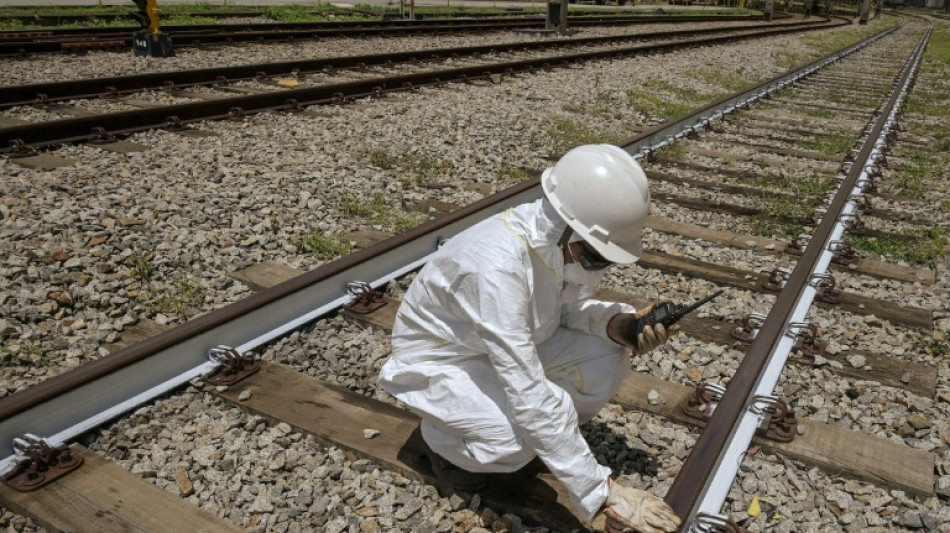
Paint them white: how Brazil is keeping trains on track / Photo: Nelson ALMEIDA - AFP

 Kenya's economy faces climate change risks: World Bank

 'Beginning of the end': Relief but no party as French wildfire winds down

 Southern Europe 'becoming more flammable' in hotter climate, experts say

 Mammoth bones found on parched bed of Danube in Bulgaria

 MEXC Lists Grvt (GRVT) with $60,000 Worth of GRVT and 10,000 USDT in Airdrop+ Rewards

 George and Amal Clooney flee French home due to wildfire

 MEXC Ventures Supports Alpha Arena's APAC Debut at Coinfest Bali

 AI data centre supplier Zhongji InnoLight slips on Hong Kong debut

 May, June heatwaves caused 2,877 extra deaths in England: govt

 BMW profit down a third as carmaker plans job cuts

 Seoul extends losses as most Asian markets drop, oil rises again

 Gambling.com Group Is Now Grandstand

 Meet the astronomer digging into the Milky Way's 'fossils'

 AI data centre supplier Zhongji InnoLight falls on Hong Kong debut

 Samsung operating profit up 1,800% in second quarter on AI boom

 Japanese population below 120 million for first time in decades

 US actor Jared Leto denies latest accusations of sexual assault
 Danube drops to 'historic lows' as fresh heatwave hits
 BTS pulls out of Grammys after Asian pop category introduction

 OpenAI says rogue AI agent attack hit other companies

 How an AFP beach snap became emblem of Europe's wildfire summer

 TRX Spot and Perpetuals Listing Launches on Backpack, Expanding Access to the TRON Ecosystem

 Nepal's tiger numbers climb 20 percent to estimated 429: survey
 FIFA's plans to sell $4.2bn stake in its tournaments widely criticised

 BMW aims to cut 8,000 jobs by end 2027: company source

Few people suspect that when they board a train during a heatwave they may be risking their lives, as high temperatures can warp tracks and maybe even cause the train to derail.
Yet just last week, a train in the Brazilian state of Rio de Janeiro derailed after the tracks expanded and buckled after being heated to a sizzling 71 degrees Celsius (160 degrees Fahrenheit) by the sun.
No-one was injured in the incident but it highlighted the need for a solution to the search for a way to keep the country's tracks cool in increasingly sweltering temperatures.
A railway company in Sao Paulo, Brazil's most populous city, claims to have found a solution: give the tracks a lick of white paint to reflect the sun's rays and prevent the steel from overheating.
"We have recorded temperatures of up to 60°C on the tracks, which can lead to deformations and be dangerous for trains," Alan Santana de Paula, maintenance manager for ViaMobilidade, a company that operates two commuter train lines in Sao Paulo, told AFP.
ViaMobilidade transport 800,000 passengers a day.
Last year, it counted 20 deformations on the tracks during periods of intense heat.
Brazil, like the planet as a whole, experienced its hottest year on record in 2024, a situation scientists have linked to climate change.
The experiment of painting rails in light colors has already been carried out elsewhere in the world, and opinions are divided on its effectiveness.
Tests carried out by ViaMobilidade showed that white paint can help lower the temperature of the tracks by six degrees Celsius because white absorbs much less heat than dark colors.
"It doesn't completely eliminate the effect (of the heat) but it does diminish it," said Santana de Paula, who is heading a project to paint 35 kilometers (22 miles) of tracks by the end of February.
To achieve its aim ViaMobilidade has come up with a novel device: a pick-up truck is fitted with sprayers at the back and drives the length of the track, dousing it with a water-based paint.
Sao Paulo, like other parts of Brazil, suffered scorching temperatures earlier this month, with temperatures in Rio rising above 40 degrees Celsius for several days in a row -- the highest in the city in over a decade.
While Latin America's largest country has few long-distance rail links, people in big cities often use trains to move about.
Santana said train traffic was being impacted by all kinds of severe weather, from heatwaves to torrential rain and gusting winds.
Sao Paulo was in the past few weeks lashed by heavy storms which caused widespread flooding and power outages.
J.Bondarev--CPN