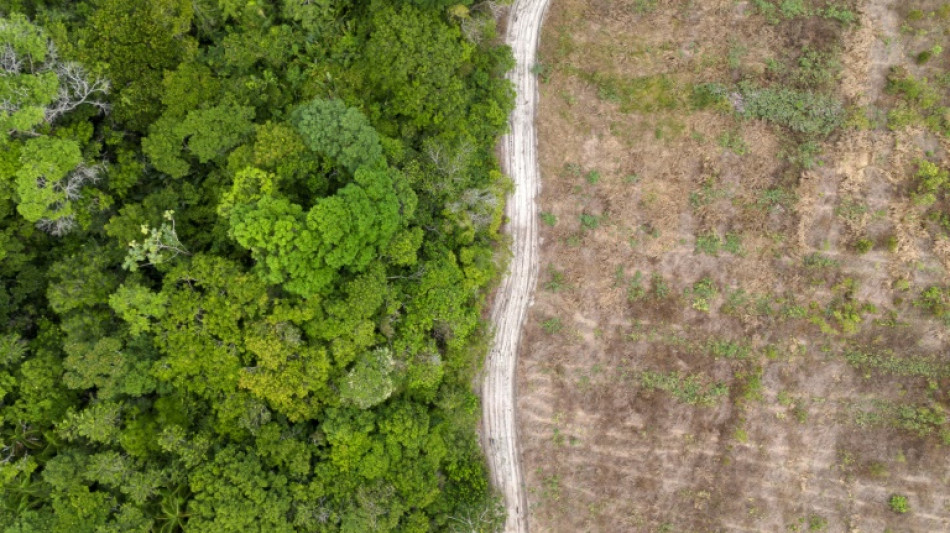
'Matter of survival': Nations spar over nature funding at UN talks / Photo: Pablo PORCIUNCULA - AFP/File

 Kenya's economy faces climate change risks: World Bank

 'Beginning of the end': Relief but no party as French wildfire winds down

 Southern Europe 'becoming more flammable' in hotter climate, experts say

 Mammoth bones found on parched bed of Danube in Bulgaria

 MEXC Lists Grvt (GRVT) with $60,000 Worth of GRVT and 10,000 USDT in Airdrop+ Rewards

 George and Amal Clooney flee French home due to wildfire

 MEXC Ventures Supports Alpha Arena's APAC Debut at Coinfest Bali

 AI data centre supplier Zhongji InnoLight slips on Hong Kong debut

 May, June heatwaves caused 2,877 extra deaths in England: govt

 BMW profit down a third as carmaker plans job cuts

 Seoul extends losses as most Asian markets drop, oil rises again

 Gambling.com Group Is Now Grandstand

 Meet the astronomer digging into the Milky Way's 'fossils'

 AI data centre supplier Zhongji InnoLight falls on Hong Kong debut

 Samsung operating profit up 1,800% in second quarter on AI boom

 Japanese population below 120 million for first time in decades

 US actor Jared Leto denies latest accusations of sexual assault

 Danube drops to 'historic lows' as fresh heatwave hits

 BTS pulls out of Grammys after Asian pop category introduction

 OpenAI says rogue AI agent attack hit other companies

 How an AFP beach snap became emblem of Europe's wildfire summer

 TRX Spot and Perpetuals Listing Launches on Backpack, Expanding Access to the TRON Ecosystem

 Nepal's tiger numbers climb 20 percent to estimated 429: survey
 FIFA's plans to sell $4.2bn stake in its tournaments widely criticised

 BMW aims to cut 8,000 jobs by end 2027: company source

Global talks to protect nature restarted Tuesday with a call for humanity to come together to "sustain life on the planet" and overcome a fight over funding that caused a previous meeting last year to end in disarray.
More than two years after a landmark deal on nature -- including a pledge to protect 30 percent of the world's land and seas by 2030 -- nations are still haggling over the money needed to reverse destruction that scientists say threatens a million species.
Negotiators meeting at the UN's Food and Agriculture Organization headquarters in Rome this week are tasked with resolving a deadlock between rich and developing countries over whether or not to create a specific fund to finance nature conservation.
Disagreement over this saw the previous UN COP16 talks in Cali, Colombia in November stretch hours into extra time and end without agreement.
Speaking at the opening of the talks in Rome, many developing nations urged the meeting to unblock funds and called on wealthy countries to make good on their pledge to provide $20 billion a year for poorer nations by 2025.
"Without this trust might be broken," Panama's representative said, urging the international community to ensure that overall financing beyond 2030 reflects the "urgency of the biodiversity crisis".
"This is a matter of survival for ecosystems, economy and humanity. We cannot repeat the failures of climate finance, COP16.2 must deliver more than words, it must deliver funding. The world is out of time."
- 'Unite the world' -
The talks come at a moment of geopolitical upheaval with countries facing a range of challenges from trade tensions and debt worries to Russia's invasion of Ukraine.
While Washington has not signed up to the UN's Convention on Biological Diversity, new US President Donald Trump has moved to halt development funding through the United States Agency for International Development.
COP16 president Susana Muhamad urged countries to work together "in a collaborative manner for something that probably is the most important purpose of humanity in the 21st century, which is our collective capacity to sustain life in this planet".
Protecting nature "has the power to unite the world", the Colombian environment minister added.
Far from the record 23,000 participants at the Cali conference, the talks resumed in a smaller format, with 1,400 people accredited and just a few hundred country representatives at the opening plenary in a hall overlooking the rain-drenched ruins of Rome's Circus Maximus.
Muhamad, who resigned from her position in the Colombian government but will continue to serve as a minister until after the COP16 conference, has said she was "hopeful" that discussions since the Cali meeting have helped to lay the groundwork for a resolution in Rome.
- Funding fight -
Countries have until Thursday to hammer out a plan over a promised $200 billion a year in finance for nature by 2030, including $30 billion a year from wealthier countries to poorer ones.
The total for 2022 was about $15 billion, according to the OECD.
Debate mainly centres on the way in which funding is delivered.
Developing nations -- led by Brazil and the African group -- want the creation of a new, dedicated biodiversity fund, saying they are not adequately represented in existing mechanisms.
Wealthy nations -- led by the European Union, Japan and Canada -- say setting up multiple funds fragments aid.
On Friday, the COP16 presidency published a new text that proposed kicking the ultimate decision on a new biodiversity fund to future UN talks, while suggesting reforming existing financing for nature conservation.
In 2022, nations identified 23 goals to be achieved within the decade, aiming to protect the planet and its living creatures from deforestation, over-exploitation of resources, climate change, pollution and invasive species.
The true cost of such destruction of nature is often hidden or ignored, scientists warned last year in a landmark report for the UN's expert biodiversity panel.
They estimated that fossil fuels, farming and fisheries could inflict up to $25 trillion a year in accounted costs -- equivalent to a quarter of global GDP.
The failure to reach agreement in Cali was the first in a string of disappointing outcomes for the planet at UN summits last year.
A climate finance deal at COP29 in Azerbaijan in November was slammed as disappointing by developing nations, while separate negotiations about desertification and plastic pollutions stalled in December.
M.Davis--CPN