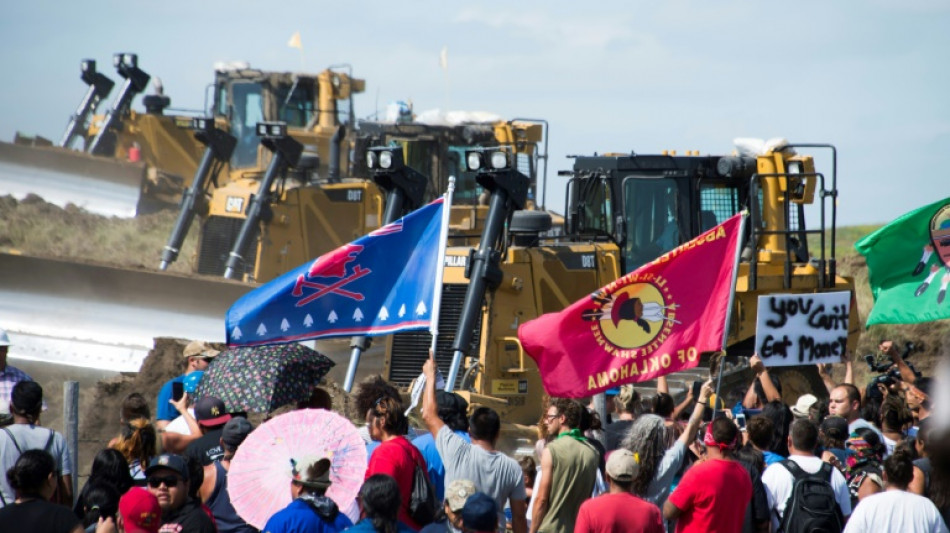
Greenpeace trial begins in North Dakota in key free speech case / Photo: Robyn BECK - AFP/File

 Kenya's economy faces climate change risks: World Bank

 'Beginning of the end': Relief but no party as French wildfire winds down

 Southern Europe 'becoming more flammable' in hotter climate, experts say

 Mammoth bones found on parched bed of Danube in Bulgaria

 MEXC Lists Grvt (GRVT) with $60,000 Worth of GRVT and 10,000 USDT in Airdrop+ Rewards

 George and Amal Clooney flee French home due to wildfire

 MEXC Ventures Supports Alpha Arena's APAC Debut at Coinfest Bali

 AI data centre supplier Zhongji InnoLight slips on Hong Kong debut

 May, June heatwaves caused 2,877 extra deaths in England: govt

 BMW profit down a third as carmaker plans job cuts

 Seoul extends losses as most Asian markets drop, oil rises again

 Gambling.com Group Is Now Grandstand

 Meet the astronomer digging into the Milky Way's 'fossils'

 AI data centre supplier Zhongji InnoLight falls on Hong Kong debut

 Samsung operating profit up 1,800% in second quarter on AI boom

 Japanese population below 120 million for first time in decades

 US actor Jared Leto denies latest accusations of sexual assault

 Danube drops to 'historic lows' as fresh heatwave hits

 BTS pulls out of Grammys after Asian pop category introduction

 OpenAI says rogue AI agent attack hit other companies

 How an AFP beach snap became emblem of Europe's wildfire summer

 TRX Spot and Perpetuals Listing Launches on Backpack, Expanding Access to the TRON Ecosystem

 Nepal's tiger numbers climb 20 percent to estimated 429: survey
 FIFA's plans to sell $4.2bn stake in its tournaments widely criticised

 BMW aims to cut 8,000 jobs by end 2027: company source

A US oil pipeline operator's lawsuit seeking millions of dollars from Greenpeace for allegedly orchestrating a campaign of violence and defamation begins Monday in a North Dakota court, in a case with broad free speech implications.
At the heart of the case is the Dakota Access Pipeline, where nearly a decade ago, the Standing Rock Sioux tribe led one of the largest anti-fossil fuel protests in US history. Hundreds were arrested and injured, prompting concerns from the United Nations over violations of Indigenous sovereignty.
The pipeline, which transports fracked crude oil to refineries and global markets, has been operational since 2017.
But its operator, Energy Transfer, has continued pursuing legal action against Greenpeace -- first in a federal lawsuit seeking $300 million, which was dismissed, and now in a state court in Mandan, North Dakota, where jury selection began Monday.
Critics call the case a clear example of a Strategic Lawsuit Against Public Participation (SLAPP), designed to silence dissent and drain financial resources. Notably, North Dakota is among the minority of US states without anti-SLAPP protections.
"Big Oil is trying to send a message to us, and they're trying to silence Greenpeace as well as the wider movement," said Sushma Raman, Greenpeace's interim executive director, in a statement to AFP.
"But let us be clear: the limited actions Greenpeace took related to Standing Rock were peaceful, lawful, and in line with our values of non-violence and our work for a green and peaceful future."
Waniya Locke, a member of Standing Rock Grassroots, rejected the idea that Greenpeace led the movement.
"I want it to be very clear that no NGOs started or organized our resistance. It was matriarch-led. It was led by women who stood strong, who stood on the riverbanks unarmed," she said in a statement.
Energy Transfer for its part denies attempting to suppress free speech.
"Our lawsuit against Greenpeace is about them not following the law," the company said in a statement to AFP.
"We support the rights of all Americans to express their opinions and lawfully protest. However, when it is not done in accordance with our laws, we have a legal system to address that. Beyond that, we will let our case speak for itself."
Greenpeace is fighting back. This month, it became the first group to test the European Union's anti-SLAPP directive by suing Energy Transfer in The Netherlands. The group is seeking damages with interest and demanding that Energy Transfer publish the court's findings on its website.
More than 400 organizations, along with public figures such as singer Billie Eilish and actors Jane Fonda and Susan Sarandon have signed an open letter in support of Greenpeace, as have hundreds of thousands of individuals globally.
The trial is expected to last up to five weeks.
Y.Tengku--CPN