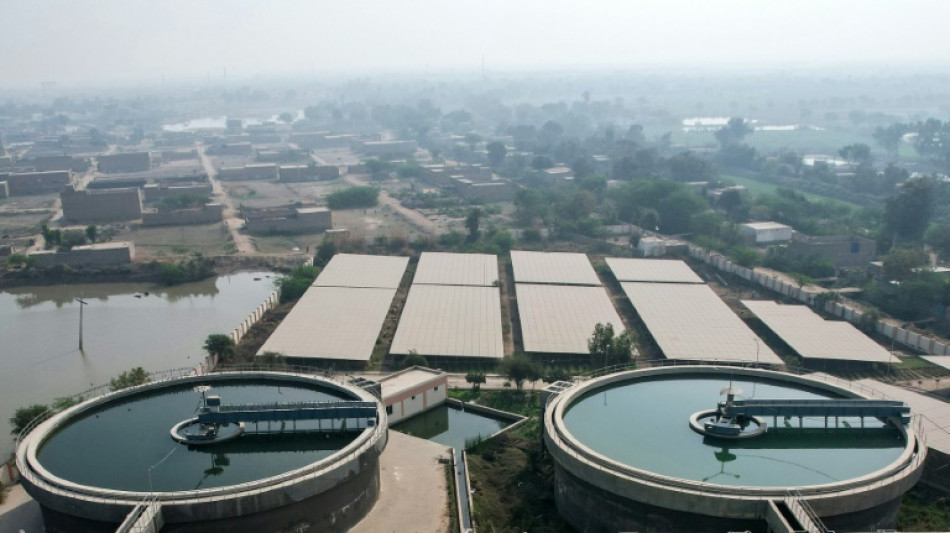
Trump aid cut imperils water scheme in scorching Pakistan city / Photo: Fida HUSSAIN - AFP

 Kenya's economy faces climate change risks: World Bank

 'Beginning of the end': Relief but no party as French wildfire winds down

 Southern Europe 'becoming more flammable' in hotter climate, experts say

 Mammoth bones found on parched bed of Danube in Bulgaria

 MEXC Lists Grvt (GRVT) with $60,000 Worth of GRVT and 10,000 USDT in Airdrop+ Rewards

 George and Amal Clooney flee French home due to wildfire

 MEXC Ventures Supports Alpha Arena's APAC Debut at Coinfest Bali

 AI data centre supplier Zhongji InnoLight slips on Hong Kong debut

 May, June heatwaves caused 2,877 extra deaths in England: govt

 BMW profit down a third as carmaker plans job cuts

 Seoul extends losses as most Asian markets drop, oil rises again

 Gambling.com Group Is Now Grandstand

 Meet the astronomer digging into the Milky Way's 'fossils'
 AI data centre supplier Zhongji InnoLight falls on Hong Kong debut

 Samsung operating profit up 1,800% in second quarter on AI boom

 Japanese population below 120 million for first time in decades

 US actor Jared Leto denies latest accusations of sexual assault
 Danube drops to 'historic lows' as fresh heatwave hits

 BTS pulls out of Grammys after Asian pop category introduction

 OpenAI says rogue AI agent attack hit other companies

 How an AFP beach snap became emblem of Europe's wildfire summer

 TRX Spot and Perpetuals Listing Launches on Backpack, Expanding Access to the TRON Ecosystem

 Nepal's tiger numbers climb 20 percent to estimated 429: survey
 FIFA's plans to sell $4.2bn stake in its tournaments widely criticised

 BMW aims to cut 8,000 jobs by end 2027: company source

In one of the world's hottest cities, fresh and filtered water can quench the searing onslaught of climate change -- but US President Donald Trump's foreign aid freeze threatens its vital supply, an NGO says.
Pakistan's sun-parched Jacobabad city in southern Sindh province sometimes surpasses 50 degrees Celsius (122 degrees Fahrenheit) in increasing heatwaves causing critical health problems like dehydration and heat-stroke.
In 2012, USAID committed a $66 million grant to uplift Sindh's municipal services, including the flagship renovation of a plant pumping and purifying water from a canal 22 kilometres (14 miles) away.
But Pakistani non-profit HANDS says Trump's aid embargo has blocked $1.5 million earmarked to make the scheme viable in the long-term, putting the project at risk "within a few months".
"This has transformed our lives," 25-year-old Tufail Ahmed told AFP in Jacobabad, where wintertime temperatures are already forecast to pass 30C next week.
"If the water supply is cut off it will be very difficult for us," he added. "Survival will be challenging, as water is the most essential thing for life."
Between September and mid-January Sindh saw rainfall 52 percent below average according to the Pakistan Meteorological Department, with "moderate drought" predicted in the coming months.
Heatwaves are becoming hotter, longer and more frequent due to climate change, scientists say.
- Services withdrawn -
The project pipes in 1.5 million gallons (5.7 million litres) daily and serves about 350,000 people in Jacobabad, HANDS says -- a city where grinding poverty is commonplace.
HANDS said it discovered Trump's 90-day freeze on foreign assistance through media reports with no prior warning.
"Since everything is just suspended we have to withdraw our staff and we have to withdraw all services for this water project," HANDS CEO Shaikh Tanveer Ahmed told AFP.
Forty-seven staff, including experts who manage the water purification and service the infrastructure, have been sent home.
The service will likely stop functioning "within the next few months", Ahmed predicted, and the project will be "a total failure" unless another funder steps in.
The scheme is currently in the hands of the local government who lack the technical or revenue collection expertise HANDS was developing to fund the supply from bill payments, rather than donations.
The international aid community has been in a tailspin over Trump's campaign to downsize or dismantle swathes of the US government -- led by his top donor and the world's richest man Elon Musk.
The most concentrated fire has been on Washington's aid agency USAID, whose $42.8 billion budget represents 42 percent of humanitarian aid disbursed worldwide.
But it accounts for only between 0.7 and 1.4 percent of total US government spending in the last quarter century, according to the Pew Research Center.
Trump has claimed USAID is "run by radical lunatics" while Musk has described it as a "criminal organisation" needing to be put "through the woodchipper".
In Jacobabad, 47-year-old local social activist Abdul Ghani pleaded for its work to continue.
"If the supply is cut off it will severely affect the public," he said. "Poverty is widespread here and we cannot afford alternatives."
- 'Supply cannot be stopped' -
Residents complain the Jacobabad supply is patchy but still describe it as an invaluable service in a city where the alternative is buying water from private donkey-drawn tankers.
Eighteen-year-old student Noor Ahmed said before "our women had to walk for hours" to collect water.
HANDS says the private tankers have a monthly cost of up to 10 times more than their rate of 500 rupees ($1.80) and often contain contaminants like arsenic.
"The dirty water we used to buy was harmful to our health and falling ill would cost us even more," said 55-year-old Sadruddin Lashari.
"This water is clean. The supply cannot be stopped," he added.
Pakistan -- home to more than 240 million people -- ranks as the nation most affected by climate change, according to non-profit Germanwatch's Climate Risk Index released this year and analysing data from 2022.
That year a third of the country was inundated by unprecedented monsoon floods killing more than 1,700 and causing an estimated $14.9 billion in damages after a punishing summer heatwave.
Jacobabad's water system also suffered heavy damage in the 2010 floods which killed almost 1,800 and affected 21 million.
Pakistan produces less than one percent of global greenhouse gas emissions which scientists say are driving human-made climate change.
Islamabad has consistently called for countries which emit more to contribute to aid for its population suffering on the front line of climate change.
"It's incredibly hot here year-round," said Lashari. "We need water constantly."
Ch.Lefebvre--CPN