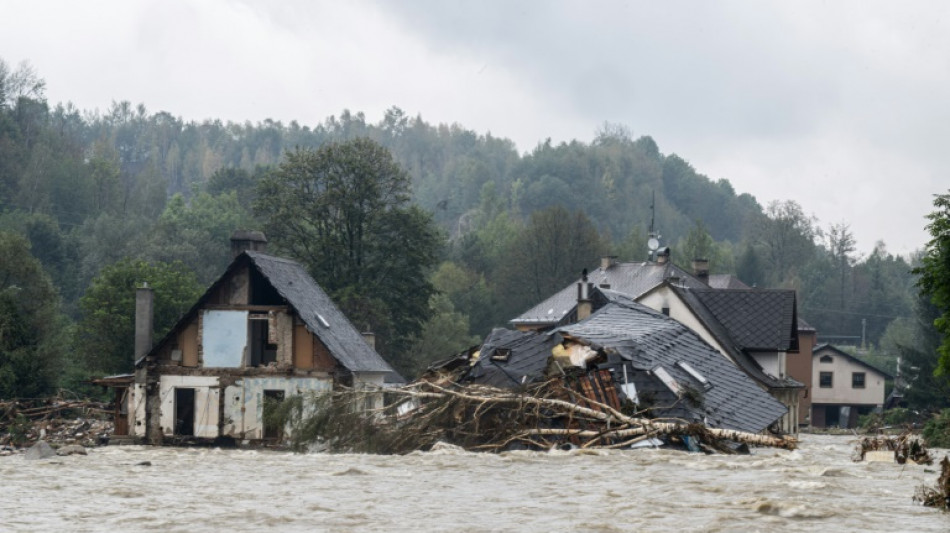
Toll hits 17 as Storm Boris lashes central Europe / Photo: Michal Cizek - AFP

 Kenya's economy faces climate change risks: World Bank

 Tech rebound fuels record-breaking rally in South Korean stocks

 Cables and cooling bring AI windfall to Indian suppliers
 Anthropic's models gained unauthorized 'real-world' access during testing

 Apple tops estimates in CEO Cook's final quarter, but shares fall

 Milei demands expulsion of foreigners expressing 'hate' against Argentina

 Italy's Po River valley on drought alert

 Prada profits pinched as growth hard to chase

 Stocks climb on earnings and rates, oil retreats

 US economic growth slows in second quarter, missing expectations

 Russia adds Telegram founder Durov to 'terrorist' blacklist

 Stocks diverge on earnings, as oil steadies

 Eurozone economy grows despite Middle East war

 Singapore group will develop 'most promising' Ebola vaccine

 Shell profit surges as Mideast war fuels oil prices

 Car maker Stellantis says back in profit in second quarter

 Samsung quarterly operating profit up 1,800% on AI boom

 South Korean stocks bounce after rout, oil holds gains on Mideast woes

 South Korea's women web sleuths fight AI deepfake porn

 Anything but programmable: New cost-efficient EC-power-supply-series for the DIN rail by CAMTEC PS

 Meta misses profit expectations, sticks to massive AI spending

 Campari - king of the spritz - hopes to conquer American heartland

 Air France-KLM and Lufthansa bid for Portugal's TAP airline

 Profits soar at Airbus as it delivers more planes

 Rheinmetall shares surge after armsmaker reports record profit
Flooding sparked by Storm Boris in central Europe has burst dams, knocked out power and killed at least 17 people, authorities said Monday as some communities were cut off four days into the disaster.
High winds and unusually heavy rainfall have hit swathes of Austria, the Czech Republic, Hungary, Poland, Romania and Slovakia since Friday.
The rains have flooded streets and submerged entire neighbourhoods in some places, while shutting down public transport and electricity in others.
So far, the storm has caused the deaths of seven people in Romania, four in Poland, three in Austria and three in the Czech Republic, according to the latest tallies. Several people remain missing.
"I have lived here for 16 years, and I have never seen such flooding," Judith Dickson, who lives in Austria's Sankt Poelten city, told the national broadcaster ORF.
Experts say climate change caused by greenhouse gas emissions generated by human activities is increasing the frequency and intensity of extreme weather events such as torrential rains and floods.
- Docked boats -
In Austria, three people -- a 70-year-old, an 80-year-old and a firefighter -- have died in Lower Austria, the worst-effected province in the Alpine nation.
Parts of Austria have been hit since Thursday by five times the average amount of rain they get for the entire month of September, according to forecaster Geosphere.
The flooding has broken 12 dams, with muddy rivers raging, while thousands of households were without electricity and water in Lower Austria, authorities said.
Several communities also remain cut off and hundreds of people have been evacuated by helicopter from car roofs and other places, with the country earmarking 300 million euros ($330 million) to deal with the catastrophe.
The flooding has forced a river cruise ship with 142 people aboard -- mostly Swiss tourists -- to dock in Vienna, the Swiss-based company Thurgau Travel said, together with some 70 other boats, which also cannot continue their journeys on the swollen Danube.
Further north, in eastern Germany, mobile flood protection walls were set up in some area Monday to protect Dresden's old city as the Elbe river level rose, with the peak expected mid-week.
German Chancellor Olaf Scholz said Germany was "deeply touched" by "dramatic" images and news about the flooding in neighbouring countries.
- 'Nightmare' -
The Czech Republic and Poland have also reported deaths, evacuations and significant destruction in the worst-hit areas.
Czech police said on Monday three people have been killed as a result of the storm and eight remain missing.
In the eastern Czech city of Krnov, residents began to cart away debris.
"All pavements are destroyed, everything's toppled here, everything's broken around the shop... it's a nightmare," Eliska Cokreska, a 76-year-old pensioner, told AFP.
Polish police updated the disaster's death toll to four -- up from one previously -- adding however that the exact causes of death still needed to be clarified.
Poland's Prime Minister Donald Tusk announced one billion zloty ($260 million) in aid for those hit by the storm, which has forced thousands to be evacuated from their homes.
While the water in some cities, such as Klodzko, is starting to recede, revealing destruction and desolation, more flooding was feared in the north.
A video shot in Klodzko showed water covering a debris-strewn street with shop windows destroyed.
Water has also submerged the town of Glucholazy on the Polish-Czech border with many residents taking refuge in a school.
"This flood is the worst ever in Glucholazy. We are trying to talk to people, support them, offer them tea and, above all, show them that they are not alone," said Paulina Grzesiowska-Nowak, a Red Cross rescuer.
- 'Fury of nature' -
The flooding death toll in Romania -- where people climbed on to roofs to escape the water -- has climbed to seven, according to rescuers.
"Compared to 2013 the amount of water was almost three times bigger. It was hard to handle that kind of fury of nature," Prime Minister Marcel Ciolacu told reporters on Monday.
Hungary has deployed more than 350 soldiers to reinforce flood barriers as the Danube and rivers along its basin are expected to surge.
burs-jza/yad
Y.Ponomarenko--CPN