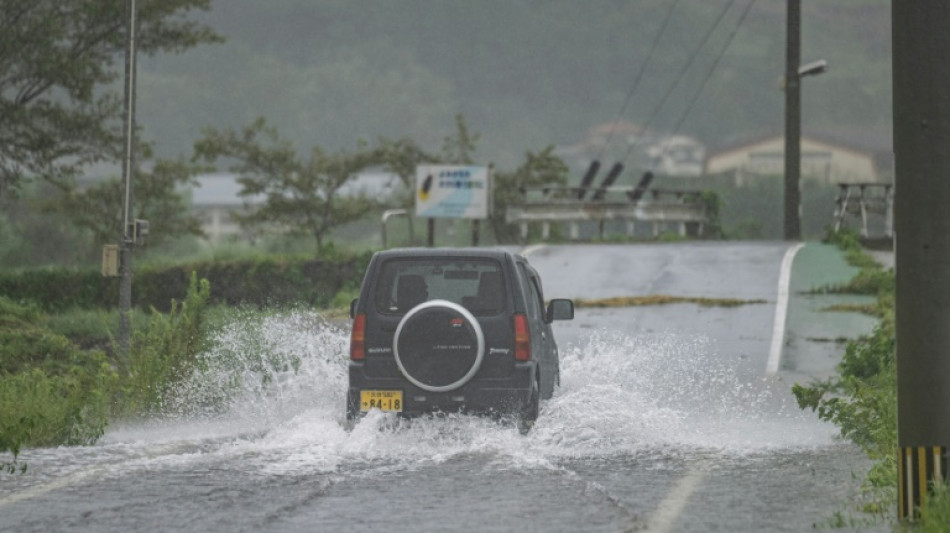
Typhoon Shanshan churns up Japan, up to six dead / Photo: Yuichi YAMAZAKI - AFP

 Kenya's economy faces climate change risks: World Bank

 Far right and far left battle for power in polarised Berlin

 The last trio: S.Africa's zoo elephants await their fate

 Oil industry sees war windfall but girds for political blowback

 Amazon beats expectations with cloud and AI growth

 Blowout Microsoft results lift US stocks as oil retreats

 'Beginning of the end': Relief but no party as French wildfire winds down

 Southern Europe 'becoming more flammable' in hotter climate, experts say

 Mammoth bones found on parched bed of Danube in Bulgaria

 MEXC Lists Grvt (GRVT) with $60,000 Worth of GRVT and 10,000 USDT in Airdrop+ Rewards

 George and Amal Clooney flee French home due to wildfire

 MEXC Ventures Supports Alpha Arena's APAC Debut at Coinfest Bali

 AI data centre supplier Zhongji InnoLight slips on Hong Kong debut

 May, June heatwaves caused 2,877 extra deaths in England: govt

 BMW profit down a third as carmaker plans job cuts

 Seoul extends losses as most Asian markets drop, oil rises again

 Gambling.com Group Is Now Grandstand

 Meet the astronomer digging into the Milky Way's 'fossils'

 AI data centre supplier Zhongji InnoLight falls on Hong Kong debut

 Samsung operating profit up 1,800% in second quarter on AI boom

 Japanese population below 120 million for first time in decades

 US actor Jared Leto denies latest accusations of sexual assault

 Danube drops to 'historic lows' as fresh heatwave hits

 BTS pulls out of Grammys after Asian pop category introduction

 OpenAI says rogue AI agent attack hit other companies

Typhoon Shanshan dumped record rains Friday as it slowly churned up through Japan, triggering transport havoc and widespread warnings of landslides with up to six people killed.
The typhoon, one of the fiercest to hit Japan in decades, has weakened and was forecast to ease to tropical cyclone strength by Monday, though gusts were still reaching 126 kilometres (78 miles) per hour early Friday.
Even before making landfall on the island of Kyushu, a landslide caused by the heavy rains preceding it killed three members of the same family late Tuesday in Aichi prefecture, around 1,000 kilometres (600 miles) away.
Government spokesman Yoshimasa Hayashi confirmed four deaths but said that in one case, "the relation to the typhoon was being studied". Two more were feared dead and two others were missing, Hayashi said.
Eight people were seriously hurt and 70 others had light injuries, he said, with many hurt by broken glass after the typhoon smashed windows and ripped tiles off roofs when it slammed into Kyushu on Thursday with gusts up to 252 kph.
Almost 200 buildings were damaged.
- Climate change -
Typhoons in the region have been forming closer to coastlines, intensifying more rapidly and lasting longer over land due to climate change, according to a study released in July.
Another published by World Weather Attribution (WWA) on Thursday said that climate change had turbocharged Typhoon Gaemi, which killed dozens of people across the Philippines, Taiwan and China last month.
A similar rapid attribution analysis from Imperial College London using peer-reviewed methodology calculated that Typhoon Shanshan's winds were made 26 percent more likely by a warming planet.
"Without phasing out fossil fuels, the root cause of climate change, typhoons will bring even greater devastation to Japan," said Ralf Toumi, director of the Grantham Institute at Imperial.
Japanese authorities issued their highest alert in several areas, with more than five million people advised to evacuate, although it was unclear how many did.
The Japan Meteorological Agency issued alerts for possible landslides in many parts of Kyushu and as far away as Shizuoka on the main island of Honshu, the Tokyo region and nearby Kanagawa.
Footage from Japanese broadcaster NHK showed a car park in Kanagawa prefecture with vehicles half-submerged in brown water, with authorities there urging residents to move to higher floors after a local river flooded.
Some parts of Kyushu saw record rains for August, with the town of Misato recording a staggering 791.5 millimetres (31 inches) in 48 hours, the Japan Meteorological Agency said.
Kitakyushu in Kyushu saw 474 mm in the 24 hours to Friday morning, the most since 2012, when comparative data began to be collected. Nearby Kunimi had 384.5 mm, the most since records began in 1977.
- Inconvenient -
The holiday resort of Beppu in Kyushu suffered no major damage, but the typhoon left tourists stranded and bored, with the onsen hot springs, a monkey park and even 24-hour convenience stores shut.
"This is my first time (here). I was very looking forward to it," morose visitor Nobuhiko Takagishi from Tokyo told AFP. "But it will be a trip to remember. A trip when I couldn't do anything."
"Tourists must be in big trouble. They came here with no preparation, and they are stranded," said resident Hiroko Handa, 48.
Power cuts hit more than 250,000 Kyushu households but the utility operator said Friday that only 6,500 were still without electricity as engineers repaired transmission lines.
Shinkansen bullet trains remained suspended in Kyushu and were also halted on the major route between Tokyo and Osaka, with operators warning of disruptions elsewhere.
Japan Airlines and ANA had already announced the cancellation of more than 600 flights between them for Friday, having scrapped a similar number the previous day, affecting almost 50,000 passengers.
T.Morelli--CPN