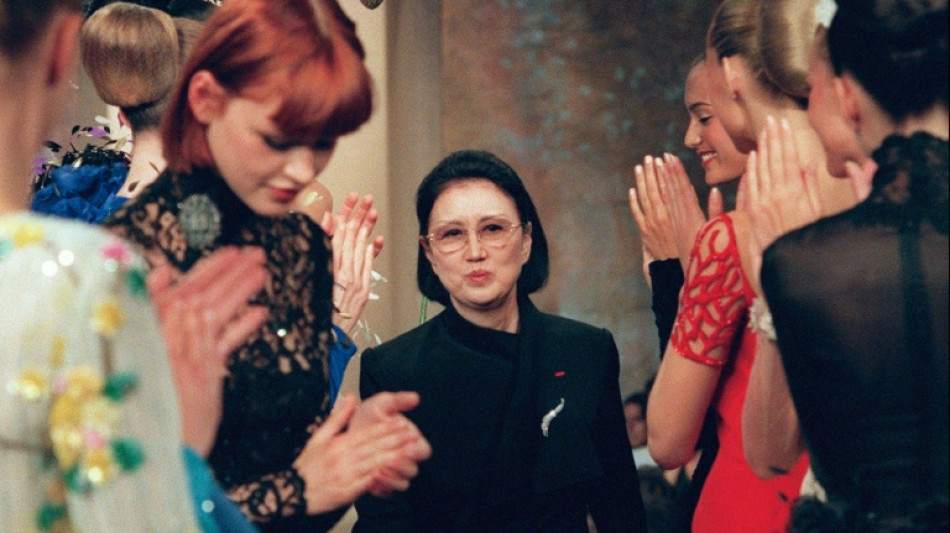
Hanae Mori: grande dame of Japanese fashion / Photo: Thomas COEX - AFP/File

 Kenya's economy faces climate change risks: World Bank

 MEXC Ventures Supports Alpha Arena's APAC Debut at Coinfest Bali

 AI data centre supplier Zhongji InnoLight slips on Hong Kong debut

 May, June heatwaves caused 2,877 extra deaths in England: govt

 BMW profit down a third as carmaker plans job cuts

 Seoul extends losses as most Asian markets drop, oil rises again

 Gambling.com Group Is Now Grandstand

 Meet the astronomer digging into the Milky Way's 'fossils'

 AI data centre supplier Zhongji InnoLight falls on Hong Kong debut

 Samsung operating profit up 1,800% in second quarter on AI boom

 Japanese population below 120 million for first time in decades

 US actor Jared Leto denies latest accusations of sexual assault

 Danube drops to 'historic lows' as fresh heatwave hits

 BTS pulls out of Grammys after Asian pop category introduction

 OpenAI says rogue AI agent attack hit other companies

 How an AFP beach snap became emblem of Europe's wildfire summer

 TRX Spot and Perpetuals Listing Launches on Backpack, Expanding Access to the TRON Ecosystem

 Nepal's tiger numbers climb 20 percent to estimated 429: survey

 FIFA's plans to sell $4.2bn stake in its tournaments widely criticised

 BMW aims to cut 8,000 jobs by end 2027: company source

 On London streets, homeless wary at PM's vow to end rough sleeping

 South Korean stocks collapse amid Asian tech rout

 Japan coral protectors race to save reefs from heat 'bomb'

 Senate advances sweeping Russia sanctions bill

 AI glasses help propel EssilorLuxottica sales growth

Japanese designer Hanae Mori, who cracked the Parisian haute couture world and was dubbed "Madame Butterfly" for her signature motif, has died in Tokyo aged 96, her office told AFP.
Over the decades Mori's luxurious creations were worn by Nancy Reagan, Grace Kelly and countless members of high society.
But she was also a pioneer for Japanese women, one of a tiny number to head an international corporation.
An employee at Mori's office said Thursday that she died at home "of old age" on August 11, and that a private funeral had taken place.
The designer's trailblazing career took her from Tokyo, where she started out making costumes for cinema, to New York and Paris -- and in 1977 her label became the first Asian fashion house to join the rarefied ranks of haute couture.
The exclusive French club sets exacting standards for their hand-crafted, and extremely expensive, garments.
"When humans work with their hands, their creativity expands," Mori told AFP during a 2006 retrospective in Tokyo, where a robot modelled a replica of her classic "Chrysanthemum Pyjamas" -- a kimono-like robe made from hot-pink chiffon and silk.
In January, the designer summed up her feelings toward the industry in a special column for Japan's Yomiuri Shimbun daily.
"Fashion is something that pushes you, gives you courage to spread your wings and allows you to have adventures," she said.
- Encounter with Chanel -
Born in 1926 in a rural corner of western Japan, Mori studied literature at Tokyo Women's Christian University before turning her hand to design.
She opened her first atelier above a noodle shop in Tokyo, and came to specialise in dressing the stars of the silver screen.
As Japan's postwar economy grew, so did her business, which she ran with her husband -- a textile executive who encouraged her to visit Paris and New York when the arrival of television made the film industry less profitable.
"This was a kind of turning point for me," she once said of the trips in the early 1960s, during which she met Coco Chanel in Paris.
It turned out to be an inspirational encounter.
When she stepped into Chanel's studio the iconic designer suggested she wear something in bright orange to contrast with her black hair.
Taken aback, it got Mori thinking.
"The whole Japanese concept of beauty is based on concealment... I suddenly realised that I should change my approach and make my dresses help a woman stand out," she said, according to the Washington Post.
- 'East Meets West' -
In 1965, Mori unveiled her first collection abroad, in New York, under the theme "East Meets West".
Her designs combined traditional patterns like cranes and cherry blossoms -- and her trademark butterflies -- with Western styles, from woollen suits to sharp satin tailoring.
Mori moved her brand from Tokyo to Paris in the late 1970s and was quickly embraced by fashion insiders.
She saw a distinction between herself and her Japanese peers who later made a global name for themselves -- such as Issey Miyake, Yohji Yamamoto and Rei Kawakubo of Comme des Garcons fame.
"The young Japanese designers who live in Paris are passionately avant-garde," she told the Washington Post. "I am not. I love to follow the traditional way."
Mori built her brand into a business empire, which in its heyday occupied a whole building in Tokyo designed by the architect Kenzo Tange -- later torn down and replaced with another structure at typical Japanese speed.
From the loss of the building to the retirement of her fashion house from haute couture, "not everything was positive", she reflected in her Yomiuri column.
"It was like my butterfly wings were torn off. But this butterfly was able to fly all over the world for 70 years, because I loved making clothes."
- 'Wanted to be different' -
Mori designed the gown worn by princess Masako -- now empress -- at her 1993 wedding, as well as uniforms for Japan Airlines flight attendants.
And in 1985, she created stage costumes for, appropriately, "Madame Butterfly" performed at La Scala in Milan.
But with growing losses in the early 2000s, her empire was largely sold off and she shuttered her Paris atelier in 2004 after her last couture show there.
Hanae Mori boutiques remain open in Tokyo and her fragrances are still sold worldwide.
As a powerful businesswoman, Mori was a rarity in Japan, where boardrooms are still heavily male-dominated.
Speaking of her early married life, she once remarked that she was never invited out with her husband's friends.
At that time "Japan was a gentlemen's country", she said, but "I wanted to be different".
P.Schmidt--CPN
