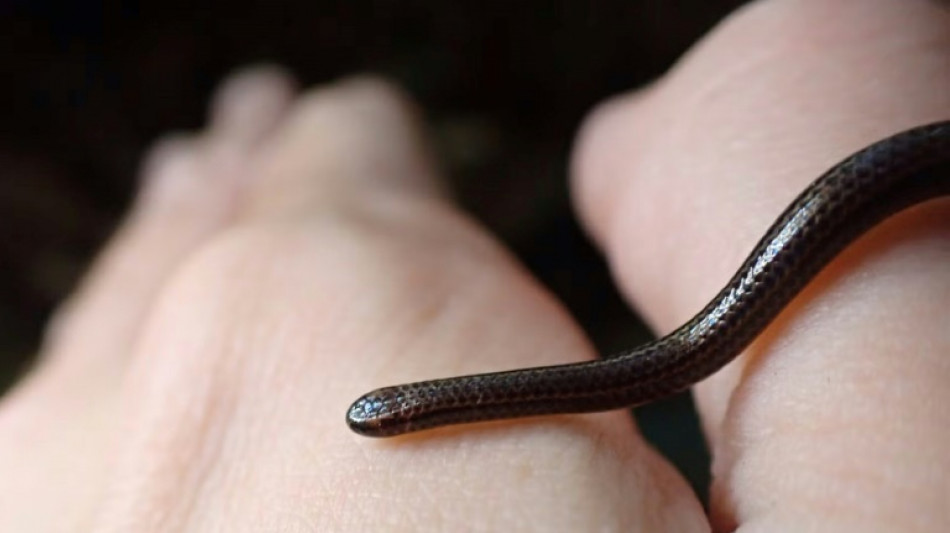
World's smallest snake makes big comeback / Photo: Connor Blades - Re:wild/AFP

 South Lebanon children return to school destroyed by Israel strike

 European stock markets climb as oil prices drop

 Asian markets mixed after recent oil surge

 Cash for nature protection: hotelier's offer to Principe islanders

 India rape cases turn focus back onto women's safety

 Rich nations should foot climate bill, says Nepal minister

 Italy bans burqas in schools, caps numbers of foreign students per class

 Napoli hoping to build new stadium, says owner

 What happens if the US bans diesel exports

 Oscar-winner Cotillard fears being moved by AI actor

 Stocks fall, oil prices rise as global bonds back under pressure

 Streamex Converts Interest Into Capital as GLDY Investment Strategy Secures $1M+ Institutional Allocation

 STARTRADER Named Best Fintech Forex Broker at Forex Expo Dubai 2026

 German think tanks urge Merz to stick with reforms after election defeats
 France's top-selling newspaper to slash jobs

 BaazEX Enters the Asian Trading Market With a New Approach to Online Forex Trading.

 Sao Tome voters want to stop exodus of 'neglected' youth

 Mexican cartels target Australia with their African meth

 Rapper-turned-PM faces first big test after Nepal disaster

 Meta launches camera-free AI glasses amid privacy pushback

 Anthropic touts AI-led biology discovery
 Stocks fall on soaring bond yields, higher oil prices

 ArcPoint Expands Globally with Institutional Intelligence Platform for Modern Investors

 Outgoing UN chief makes final climate push at New York summit

 Stocks dip, oil soars despite Trump hailing "productive" Iran talks

A snake so small it could be mistaken for a worm has been spotted in Barbados, nearly two decades after it was thought to have been "lost" to science.
The Barbados threadsnake (Tetracheilostoma carlae) was found hiding under a rock in central Barbados during an ecological survey in March by the Barbados Ministry of the Environment and National Beautification and conservation group Re:wild.
"Barbados threadsnakes are blind snakes, so they're very cryptic," said Connor Blades, a project officer with the Ministry of Environment in Barbados who helped make the finding, in a statement.
"They're quite rare also, it seems. There have only been a handful of confirmed sightings since 1889, so there are not many people who have ever seen it, unfortunately."
Measuring just three to four inches long (eight to 10 centimeters) when fully grown -- tiny enough to almost fit on a US quarter coin -- the Barbados threadsnake is the world's smallest species of snake.
It is distinguished by orange stripes along its back, eyes on the sides of its head and a small scale on its snout.
"When you are so accustomed to looking for things and you don't see them, you are shocked when you actually find it," said Justin Springer of Re:wild, who made the discovery alongside Blades.
"You can't believe it. That's how I felt. You don't want to get your hopes up too high."
The breakthrough came after more than a year of searching, as the pair upturned rocks trapped beneath a tree root.
The tiny snake, which was found alongside an earthworm, was taken to the University of West Indies for careful examination under a microscope -- it closely resembles the Brahminy blind snake, an invasive species, so the finding had to be validated -- before it was returned to the forest.
Only two percent of the Caribbean island's primary forest remains intact, with the rest cleared for agriculture since the start of the colonial era 400 years ago.
The Barbados threadsnake remains particularly vulnerable since it reproduces sexually and females lay a clutch of only one egg. Female Brahminy blind snakes, by contrast, can produce fertile eggs without mating.
"The threadsnake's rediscovery is also a call to all of us as Barbadians that forests in Barbados are very special and need protection," said Springer. "Not just for the threadsnake, but for other species as well. For plants, animals and our heritage."
U.Ndiaye--CPN