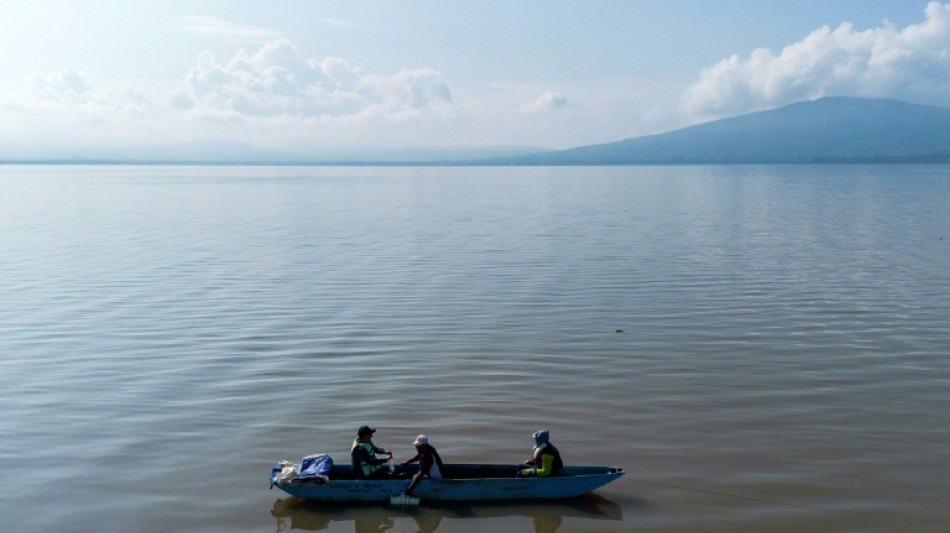
Mexican fishermen join fight to save extraordinary amphibian / Photo: Enrique Castro - AFP

 Trump's photo of Xi greeting carries signs of AI

 First US trial against TikTok to open Monday

 French literary prize removes novel from longlist after AI claims

 Trump accuser E. Jean Carroll finally has her damages

 Heavy fighting, internet disruption as Ethiopia conflict rages
 Asian markets mixed after oil gains

 UN approves resolution on dealing with rising sea levels

 Global stocks mostly fall as oil prices and bond yields rise

 Starbucks to close 250 more cafes in North America

 Stocks fall as oil prices rise and bonds back under pressure

 Top ECB official to resign to take up IMF role

 Eviction of pensioner puts Spain housing crisis in spotlight

 Average EU diesel price hits record 2.23 euros a litre: AFP analysis

 Whitetip Investments Marks 10 Years of Regulation, Transparency & Responsible Trading

 Stocks fall, oil prices rise as global bonds under pressure

 Hungary detects invasive spotted lanternfly for first time in EU

 Forex Expo Dubai 2026 Breaks Guinness World Record Again With 23,816 Attendees

 Asian markets fall on US-China jitters as leaders meet

 As Moscow steps up attacks, Kyiv residents brace for harsh winter

 Markets mixed as China's Xi arrives for US talks

 Archaeological 'breakthrough' could confirm origins of Paris

 Australian PM says OpenAI hacked government health website

 Rio breaks record for rainiest September amid powerful El Nino

 Mandela Digital Extends Early Access Programme to 11 February 2027 Following Strong Response

 McDonald's to boost franchisees as inflation weighs on consumers

After decades working as a fisherman on a high-altitude Mexican lake, Froylan Correa is now helping to save an endangered amphibian with gills resembling a lion's mane and a remarkable regenerative ability.
The achoque, also known as the Lake Patzcuaro salamander, is a lesser known relative of the axolotl, the small friendly- faced amphibian battling extinction in Mexico City.
Overfishing, pollution and reduced water levels in Lake Patzcuaro, its only natural habitat, mean that the achoque is listed as critically endangered by the International Union for Conservation of Nature.
In an attempt to prevent it disappearing, biologists from Michoacana University decided to pay the local Indigenous community of San Jeronimo Purenchecuaro to help the achoque to reproduce.
Correa, who knows the lake in the western state of Michoacan like the back of his hand, has a new job as an amphibian egg collector.
Now in his 60s, he remembers when the waters teemed with fish and there was no need to worry for the salamander.
"There used to be a lot of achoques," he told AFP.
"Now the new generation doesn't know about it."
- From lab to lake -
After the eggs are collected, biologist Rodolfo Perez takes them to his laboratory at Michoacana University to hatch, in the hope of giving the achoques a better chance of surviving.
After the hatchlings have grown enough, they are moved to the community's achoque protection reserve, where the fishermen care for them until they are ready to be released into the lake, said Israel Correa, a relative of Froylan Correa.
The achoque belongs to the Ambystoma group, keenly studied by scientists for an extraordinary ability to regenerate mutilated limbs and parts of organs such as the brain and heart.
If one loses a tail, it quickly grows another.
That has made the salamanders a subject of fascination for scientists hoping to learn lessons that could apply to humans.
Since pre-Hispanic times, the achoque has been a source of food as well as a remedy used by Indigenous people for respiratory illnesses.
Its skin color allows it to blend into its natural habitat.
According to a local legend, the achoque was first an evil god who hid in the lake mud to escape the punishment of other deities.
Perez is trying to hatch as many eggs as possible with the help of the locals to prevent its extinction.
"It's been a lot of work," he said, adding that the biggest challenge is finding money to compensate the fishermen, since the achoques require constant care.
Collaboration between scientists and the local community has helped to stabilize the achoque population, according to the researchers.
There are an estimated 80 to 100 individuals who live in a small part of the lake, said Luis Escalera, another biologist at Michoacana University.
The number, however, is "much lower than it was 40 years ago," he said.
For the fishermen fighting to save them, it is a labor of love.
"We can't miss a day without coming because otherwise they'll die," Israel Correa said at the achoque protection reserve on the shores of Lake Patzcuaro.
"Come rain or shine, even if there's a festival, we have to be here."
P.Kolisnyk--CPN