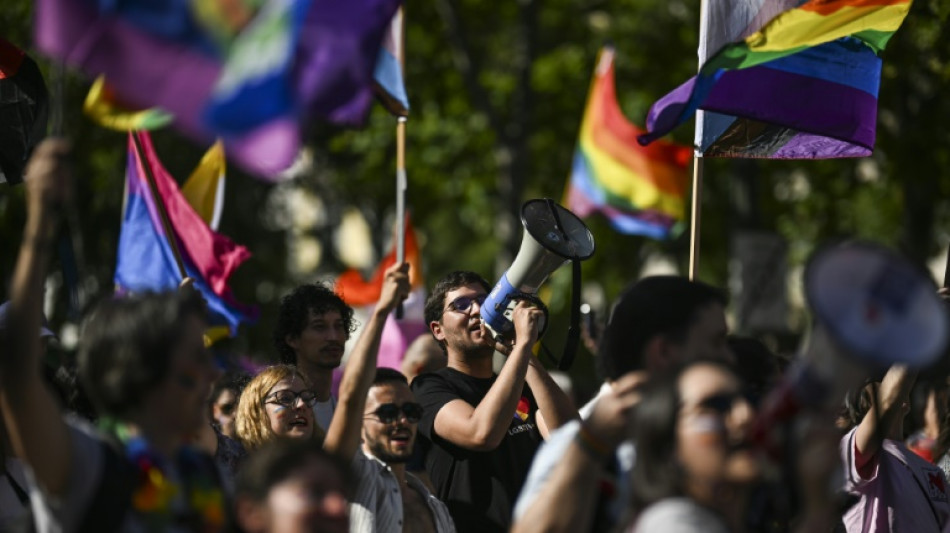
With EuroPride, Lisbon courts LGBTQ travellers / Photo: Patricia DE MELO MOREIRA - AFP

 Jay-Z rape accuser says she made 'false accusations'

 Trump's photo of Xi greeting carries signs of AI

 First US trial against TikTok to open Monday
 French literary prize removes novel from longlist after AI claims

 Trump accuser E. Jean Carroll finally has her damages

 Heavy fighting, internet disruption as Ethiopia conflict rages
 Asian markets mixed after oil gains
 UN approves resolution on dealing with rising sea levels
 Global stocks mostly fall as oil prices and bond yields rise

 Starbucks to close 250 more cafes in North America
 Stocks fall as oil prices rise and bonds back under pressure

 Top ECB official to resign to take up IMF role

 Eviction of pensioner puts Spain housing crisis in spotlight

 Average EU diesel price hits record 2.23 euros a litre: AFP analysis

 Whitetip Investments Marks 10 Years of Regulation, Transparency & Responsible Trading

 Stocks fall, oil prices rise as global bonds under pressure
 Hungary detects invasive spotted lanternfly for first time in EU
 Forex Expo Dubai 2026 Breaks Guinness World Record Again With 23,816 Attendees

 Asian markets fall on US-China jitters as leaders meet
 As Moscow steps up attacks, Kyiv residents brace for harsh winter

 Markets mixed as China's Xi arrives for US talks
 Archaeological 'breakthrough' could confirm origins of Paris

 Australian PM says OpenAI hacked government health website

 Rio breaks record for rainiest September amid powerful El Nino
 Mandela Digital Extends Early Access Programme to 11 February 2027 Following Strong Response

Rainbow flags will fill Lisbon's streets on Saturday when the Portuguese capital hosts the annual EuroPride parade in support of LGBTQ rights which organisers hope will cement its standing as a gay-friendly destination.
Tucked away in the cobbled alleys of the bohemian Bairro Alto neighbourhood, Carlos Sanches Ruivo, 57, proudly welcomes guests to his small queer-focused hotel, The Late Birds.
"We've had guests from 114 different nationalities," said Ruivo, a dual French-Portuguese citizen who quit his engineering job in France to move to Lisbon in 2012.
Perched between the Tagus River and the Atlantic Ocean, Lisbon is seen as "more relaxed" than other European capitals, he added.
Portugal, a nation of around 10 million people, was once deeply shaped by Catholic conservatism.
It only decriminalised homosexuality in 1982, eight years after a military coup toppled a decades-long rightist dictatorship.
But it has since emerged as a quiet leader in LGBTQ rights.
Portugal in 2010 became one of the first nations in Europe to legalise same-sex marriage.
This was followed by a law allowing gay people to adopt, legislation against transgender discrimination and, more recently, a ban on "conversion therapy" aimed at changing people's sexual orientation.
- 'Open society' -
While not on the same scale as Berlin or San Francisco, within the global LGBTQ community Lisbon's status as a gay-friendly city has steadily grown.
"This is now an open society," said Vitor Correia, a researcher who has studied social attitudes toward gay relationships in Portugal and recently published a book on the topic.
Paulo Morais, a 58-year-old Brazilian, said he has lived in Portugal for "nearly six years and never had any problems".
"Here, our rights are more respected," he added at a pride event in Lisbon earlier this month.
Nearby, 35-year-old Italian expat Sonia Montanari shared a similar view.
"I have never felt unsafe in Lisbon, even when I was first going out alone," she said.
With LGBTQ tourism booming, local business owners have organised to better serve and advocate for this growing demographic.
In 2018 they formed Variacoes, a chamber of commerce named after Antonio Variacoes, a groundbreaking pop icon who challenged cultural norms during Portugal's post-dictatorship period. He died in 1984 aged 39 from complications related to AIDS.
"We represent a niche market with strong growth potential" and above-average purchasing power, said Jose Marquina, president of the association and owner of Finalmente, a Lisbon nightclub famous for its drag shows.
- 'Not afraid' -
Around two million LGBTQ tourists visit Portugal annually, contributing nearly two billion euros to the economy, according to Variacoes.
The association is one of the organisers of this year's nine-day EuroPride festival, an event advocating for LGBTQ equality that is held in a different European city each year.
The highlight will be Saturday's parade which will make its way along main avenues under the motto "Proudly Yourselves". It will be followed by a concert and a series of parties.
"This will be a moment of strong affirmation," said Marquina.
He called for the community to "show our unity" in the face of the rise across Europe of far-right parties pushing a conservative social agenda opposed to LGBTQ rights.
In Portugal far-right party Chega won a record vote share in a snap general election last month to become the main opposition party in the country's parliament for the first time.
"They want to make us invisible again," said Marquina. "But we're not afraid, and we will defend our rights."
L.K.Baumgartner--CPN