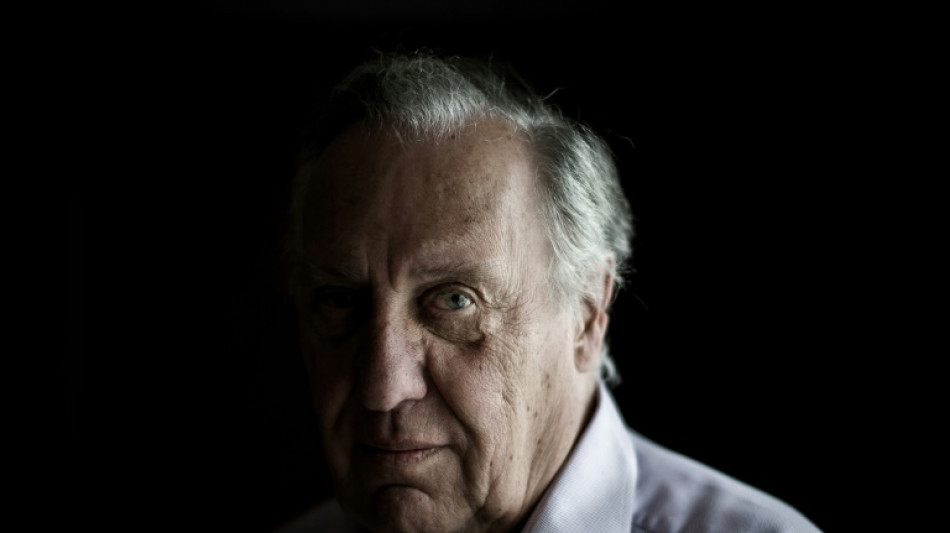
Frederick Forsyth: adventurer and bestselling spy novelist / Photo: PHILIPPE LOPEZ - AFP/File

 TikTok agrees to teen limits in US settlement following Meta
 Venezuela's oil cradle pins hopes on US energy deals

 Lula bans sports betting days ahead of Brazil's election
 Spotting AI writing: how reliable are the detectors?
 US court refuses to overturn Pentagon ban on Anthropic

 South Lebanon children return to school destroyed by Israel strike
 European stock markets climb as oil prices drop

 Asian markets mixed after recent oil surge

 Cash for nature protection: hotelier's offer to Principe islanders

 India rape cases turn focus back onto women's safety
 Rich nations should foot climate bill, says Nepal minister
 Italy bans burqas in schools, caps numbers of foreign students per class

 Napoli hoping to build new stadium, says owner
 What happens if the US bans diesel exports

 Oscar-winner Cotillard fears being moved by AI actor

 Stocks fall, oil prices rise as global bonds back under pressure

 Streamex Converts Interest Into Capital as GLDY Investment Strategy Secures $1M+ Institutional Allocation

 STARTRADER Named Best Fintech Forex Broker at Forex Expo Dubai 2026
 German think tanks urge Merz to stick with reforms after election defeats
 France's top-selling newspaper to slash jobs
 BaazEX Enters the Asian Trading Market With a New Approach to Online Forex Trading.
 Sao Tome voters want to stop exodus of 'neglected' youth

 Mexican cartels target Australia with their African meth
 Rapper-turned-PM faces first big test after Nepal disaster

 Meta launches camera-free AI glasses amid privacy pushback
A pilot who turned to writing to clear his debts, British author Frederick Forsyth, who died Monday aged 86, penned some 20 spy novels, often drawing on real-life experiences and selling 70 million copies worldwide.
In such bestsellers as "The Day of the Jackal" and "The Odessa File", Forsyth honed a distinctive style of deeply researched and precise espionage thrillers involving power games between mercenaries, spies and scoundrels.
For inspiration he drew on his own globe-trotting life, including an early stint as a foreign correspondent and assisting Britain's spy service on missions in Nigeria, South Africa, and the former East Germany and Rhodesia.
"The research was the big parallel: as a foreign correspondent you are probing, asking questions, trying to find out what's going on, and probably being lied to," he told The Bookseller magazine in 2015.
"Working on a novel is much the same... essentially it's a very extended report about something that never happened -- but might have."
- Dangerous research -
He wrote his first novel when he was 31, on a break from reporting and in dire need of money to fund his wanderlust.
Having returned "from an African war, and stony broke as usual, with no job and no chance of one, I hit on the idea of writing a novel to clear my debts," he said in his autobiography "The Outsider: My Life in Intrigue" published in 2015.
"There are several ways of making quick money, but in the general list, writing a novel rates well below robbing a bank."
But Forsyth's foray came good. Taking just 35 days to pen "The Day of the Jackal", his story of a fictional assassination attempt on French president Charles de Gaulle by right-wing extremists, met immediate success when it appeared in 1971.
The novel was later turned into a film and provided self-styled revolutionary Carlos the Jackal with his nickname.
Forsyth went on to write a string of bestsellers including "The Odessa File" (1972) and "The Dogs of War" (1974).
His eighteenth novel, "The Fox", was published in 2018.
Forsyth's now classic post-Cold War thrillers drew on drone warfare, rendition and terrorism -- and eventually prompted his wife to call for an end to his dangerous research trips.
"You're far too old, these places are bloody dangerous and you don't run as avidly, as nimbly as you used to," Sandy Molloy said after his last trip to Somalia in 2013 researching "The Kill List", as Forsyth recounted to AFP in 2016.
- Real-life spy -
There were also revelations in his autobiography about his links with British intelligence.
Forsyth recounted that he was approached in 1968 by "Ronnie" from MI6 who wanted "an asset deep inside the Biafran enclave" in Nigeria, where there was a civil war between 1967 and 1970.
While he was there, Forsyth reported on the situation and at the same time kept "Ronnie informed of things that could not, for various reasons, emerge in the media".
Then in 1973 Forsyth was asked to conduct a mission for MI6 in communist East Germany. He drove his Triumph convertible to Dresden to receive a package from a Russian colonel in the toilets of the Albertinum museum.
The writer claimed he was never paid by MI6 but in return received help with book research, submitting draft pages to ensure he was not divulging sensitive information.
- Flying dreams -
In later years Forsyth turned his attention to British politics, penning a regular column in the anti-EU Daily Express newspaper.
He also wrote articles on counter-terrorism issues, military affairs and foreign policy.
Despite his successful writing career, he admitted in his memoirs it was not his first choice.
"As a boy, I was obsessed by aeroplanes and just wanted to be a pilot," he wrote of growing up an only child in Ashford, southern England, where he was born on August 25, 1938.
He trained as a Royal Air Force pilot, before joining Reuters news agency in 1961 and later working for the BBC.
But after he wrote "Jackal", another career path opened up.
"My publisher told me, to my complete surprise, that it seemed I could tell a good story. And that is what I have done for the past forty-five years," he recalled in his autobiography.
C.Peyronnet--CPN