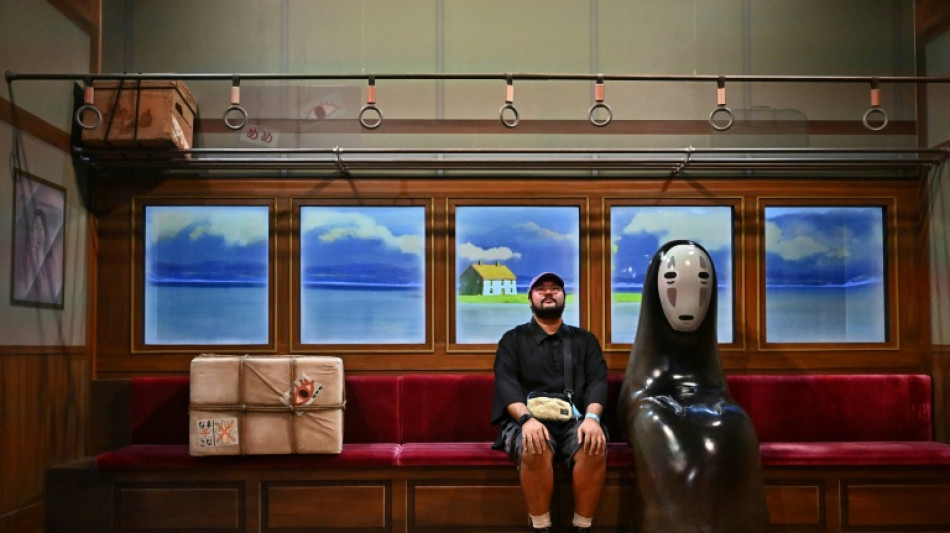
Studio Ghibli marks 40 years, but future looks uncertain / Photo: Lillian SUWANRUMPHA - AFP

 TikTok agrees to teen limits in US settlement following Meta

 Venezuela's oil cradle pins hopes on US energy deals

 Lula bans sports betting days ahead of Brazil's election

 Spotting AI writing: how reliable are the detectors?

 US court refuses to overturn Pentagon ban on Anthropic

 South Lebanon children return to school destroyed by Israel strike

 European stock markets climb as oil prices drop

 Asian markets mixed after recent oil surge

 Cash for nature protection: hotelier's offer to Principe islanders

 India rape cases turn focus back onto women's safety

 Rich nations should foot climate bill, says Nepal minister

 Italy bans burqas in schools, caps numbers of foreign students per class

 Napoli hoping to build new stadium, says owner

 What happens if the US bans diesel exports

 Oscar-winner Cotillard fears being moved by AI actor

 Stocks fall, oil prices rise as global bonds back under pressure

 Streamex Converts Interest Into Capital as GLDY Investment Strategy Secures $1M+ Institutional Allocation

 STARTRADER Named Best Fintech Forex Broker at Forex Expo Dubai 2026

 German think tanks urge Merz to stick with reforms after election defeats

 France's top-selling newspaper to slash jobs

 BaazEX Enters the Asian Trading Market With a New Approach to Online Forex Trading.

 Sao Tome voters want to stop exodus of 'neglected' youth

 Mexican cartels target Australia with their African meth

 Rapper-turned-PM faces first big test after Nepal disaster

 Meta launches camera-free AI glasses amid privacy pushback

Japan's Studio Ghibli turns 40 this month with two Oscars and legions of fans young and old won over by its complex plots and fantastical hand-drawn animation.
But the future is uncertain, with latest hit "The Boy and the Heron" likely -- but not certainly -- the final feature from celebrated co-founder Hayao Miyazaki, now 84.
The studio behind the Oscar-winning "Spirited Away" has become a cultural phenomenon since Miyazaki and the late Isao Takahata established it in 1985.
Its popularity has been fuelled of late by a second Academy Award in 2024 for "The Boy and the Heron", starring Robert Pattinson, and by Netflix streaming Ghibli movies around the world.
In March, the internet was flooded with pictures in its distinctively nostalgic style after the release of OpenAI's newest image generator -- raising questions over copyright.
The newly opened Ghibli Park has also become a major tourist draw for central Japan's Aichi region.
Julia Santilli, a 26-year-old from Britain living in northern Japan, "fell in love with Ghibli" after watching the 2001 classic "Spirited Away" as a child.
"I started collecting all the DVDs," she told AFP.
Ghibli stories are "very engaging and the artwork is stunning", said another fan, Margot Divall, 26.
"I probably watch 'Spirited Away' about 10 times a year still."
- 'Whiff of death' -
Before Ghibli, most cartoons in Japan -- known as anime -- were made for children.
But Miyazaki and Takahata, both from "the generation that knew war", included darker elements that appeal to adults, Miyazaki's son Goro told AFP.
"It's not all sweet -- there's also a bitterness and things like that which are beautifully intertwined in the work," he said, describing a "whiff of death" in the films.
For younger people who grew up in peacetime, "it is impossible to create something with the same sense, approach and attitude", Goro said.
Even "My Neighbor Totoro", with its cuddly forest creatures, is in some ways a "scary" movie that explores the fear of losing a sick mother, he explained.
Susan Napier, a professor at Tufts University in the United States and author of "Miyazakiworld: A Life in Art", agrees.
"In Ghibli, you have ambiguity, complexity and also a willingness to see that the darkness and light often go together" unlike good-versus-evil US cartoons, she said.
The post-apocalyptic "Nausicaa of the Valley of the Wind" -- considered the first Ghibli film despite its release in 1984 -- has no obvious villain, for example.
The movie featuring an independent princess curious about giant insects and a poisonous forest felt "so fresh" and a change from "a passive woman... having to be rescued", Napier said.
- Natural world -
Studio Ghibli films also depict a universe where humans connect deeply with nature and the spirit world.
A case in point was 1997's "Princess Mononoke", distributed internationally by Disney.
The tale of a girl raised by a wolf goddess in a forest threatened by humans is "a masterpiece -- but a hard movie", Napier said.
It's a "serious, dark and violent" film appreciated more by adults, which "was not what US audiences had anticipated with a movie about a princess".
Ghibli films "have an environmentalist and animistic side, which I think is very appropriate for the contemporary world with climate change", she added.
Miyuki Yonemura, a professor at Japan's Senshu University who studies cultural theories on animation, said watching Ghibli movies is like reading literature.
"That's why some children watch Totoro 40 times," she said, adding that audiences "discover something new every time".
- French connection -
Miyazaki and Takahata -- who died in 2018 -- could create imaginative worlds because of their openness to other cultures, Yonemura said.
Foreign influences included writer Antoine de Saint-Exupery and animator Paul Grimault, both French, and Canadian artist Frederic Back, who won an Oscar for his animation "The Man Who Planted Trees".
Takahata studying French literature at university "was a big factor", Yonemura said.
"Both Miyazaki and Takahata read a lot," she said. "That's a big reason why they excel at writing scripts and creating stories."
Miyazaki has said he was inspired by several books for "Nausicaa", including the 12th-century Japanese tale "The Lady who Loved Insects", and Greek mythology.
Studio Ghibli will not be the same after Miyazaki stops creating animation, "unless similar talent emerges", Yonemura said.
Miyazaki is "a fantastic artist with such a visual imagination" while both he and Takahata were "politically progressive", Napier said.
"The more I study, the more I realise this was a unique cultural moment," she said.
"It's so widely loved that I think it will carry on," said Ghibli fan Divall.
"As long as it doesn't lose its beauty, as long as it carries on the amount of effort, care and love," she said.
C.Peyronnet--CPN