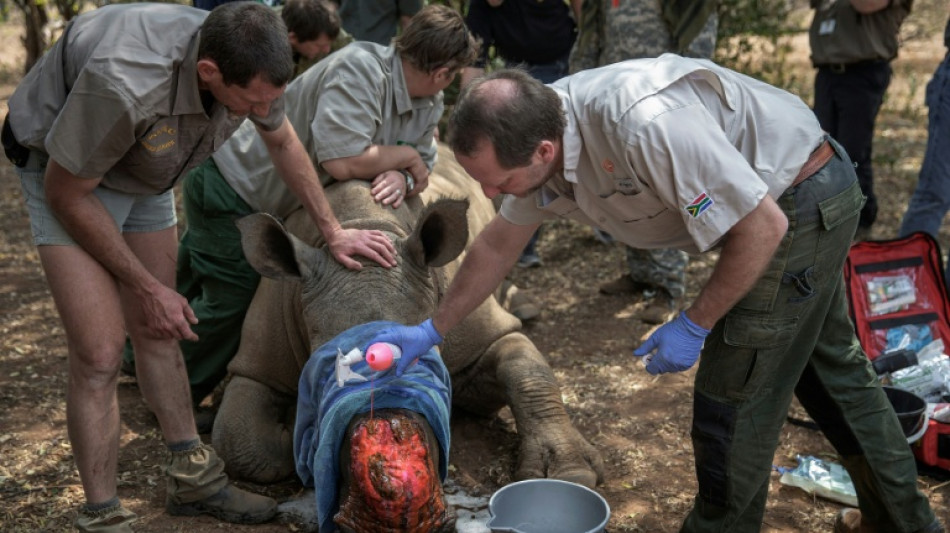
Dehorning of S.African rhinos slashed poaching: study / Photo: GIANLUIGI GUERCIA - AFP/File

 TikTok agrees to teen limits in US settlement following Meta

 Venezuela's oil cradle pins hopes on US energy deals

 Lula bans sports betting days ahead of Brazil's election

 Spotting AI writing: how reliable are the detectors?

 US court refuses to overturn Pentagon ban on Anthropic

 South Lebanon children return to school destroyed by Israel strike

 European stock markets climb as oil prices drop

 Asian markets mixed after recent oil surge

 Cash for nature protection: hotelier's offer to Principe islanders

 India rape cases turn focus back onto women's safety

 Rich nations should foot climate bill, says Nepal minister

 Italy bans burqas in schools, caps numbers of foreign students per class

 Napoli hoping to build new stadium, says owner

 What happens if the US bans diesel exports

 Oscar-winner Cotillard fears being moved by AI actor

 Stocks fall, oil prices rise as global bonds back under pressure

 Streamex Converts Interest Into Capital as GLDY Investment Strategy Secures $1M+ Institutional Allocation

 STARTRADER Named Best Fintech Forex Broker at Forex Expo Dubai 2026

 German think tanks urge Merz to stick with reforms after election defeats
 France's top-selling newspaper to slash jobs

 BaazEX Enters the Asian Trading Market With a New Approach to Online Forex Trading.

 Sao Tome voters want to stop exodus of 'neglected' youth

 Mexican cartels target Australia with their African meth

 Rapper-turned-PM faces first big test after Nepal disaster

 Meta launches camera-free AI glasses amid privacy pushback

The dehorning of rhinos resulted in a nearly 80-percent reduction in the poaching of the animals during a seven-year study in a major South African conservation area, researchers said Thursday.
Sawing off the sought-after horns was also a fraction of the cost of other counter-poaching measures such as deploying rangers or tracking dogs, according to the study published in the journal Science.
The study was carried out between 2017 and 2023 in 11 reserves around South Africa's famed Kruger National Park that protect the world's largest rhino population.
During this period, some 1,985 rhinos were poached in the reserves in the Greater Kruger area despite $74 million spent mostly on reactive law enforcement measures that netted around 700 poachers, it said.
By contrast, dehorning 2,284 rhinos cut poaching by 78 percent at just 1.2 percent of that budget, said the study published by the American Association for the Advancement of Science.
"Some poaching of dehorned rhinos continued because poachers targeted horn stumps and regrowth, signalling the need for regular dehorning alongside judicious use of law enforcement," the study said.
South Africa is home to most of the world's rhinos, including the critically endangered black rhino, and is a hotspot for poaching driven by demand in Asia where the horns are used in traditional medicine.
Rhino horn is highly sought after on the black market, where the price by weight rivals that of gold and cocaine.
Alongside ivory, the horns are coveted as status symbols or used in traditional medicine for their supposed aphrodisiac properties.
"Ongoing socioeconomic inequality incentivises a large pool of vulnerable and motivated people to join, or poach for, criminal syndicates even when the risks are high," the researchers said.
Corruption also played a role with gangs receiving insider tips to evade detection and arrest, they said.
- Impacts unclear -
"Although detecting and arresting poachers is essential, strategies that focus on reducing opportunities for and rewards from poaching may be more effective," the study said.
It added, however, that "the effects of dehorning on rhino biology are still unclear, with present research suggesting that dehorning may alter rhino space use but not survival and reproduction."
The co-authors of the study are from South Africa's Nelson Mandela University and the University of Cape Town, and various conservation groups including the Wildlife Conservation Network and United Kingdom's Save the Rhino International.
South Africa had more than 16,000 rhinos at the end of 2023, mostly white rhinos, according to government data.
But at least 34 rhinos were killed each month, the environment minister said in May.
In 2024 South African scientists injected radioactive material into live rhino horns to make them easier to detect at border posts in a pioneering project aimed at curbing poaching.
The radioactive material would not impact the animal's health or the environment in any way but make it poisonous for human consumption, according to the University of the Witwatersrand's radiation and health physics unit which spearheaded the initiative.
Black rhinos are listed by the International Union for Conservation of Nature (IUCN) as critically endangered.
A.Zimmermann--CPN