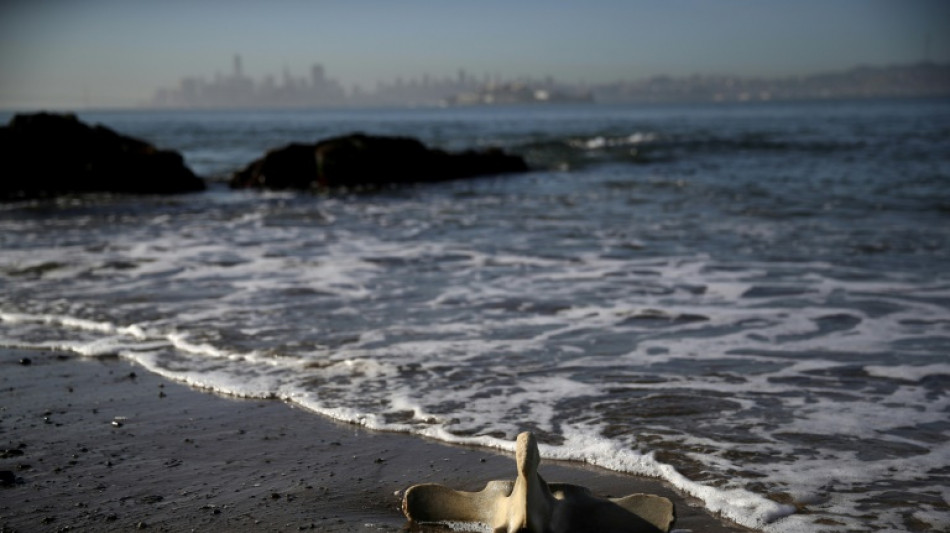
Earliest proof of humans using whale bone tools discovered / Photo: JUSTIN SULLIVAN - GETTY IMAGES NORTH AMERICA/AFP/File

 S.African women runners arm themselves after string of killings

 Indonesia fires threatens critically-endangered orangutan: IUCN

 Iran proposes Hormuz plan, Trump reportedly refuses
 El Nino rewrites the menu in the world's top restaurants

 Jay-Z rape accuser says she made 'false accusations'

 Trump's photo of Xi greeting carries signs of AI

 First US trial against TikTok to open Monday

 French literary prize removes novel from longlist after AI claims

 Trump accuser E. Jean Carroll finally has her damages

 Heavy fighting, internet disruption as Ethiopia conflict rages

 Asian markets mixed after oil gains

 UN approves resolution on dealing with rising sea levels

 Global stocks mostly fall as oil prices and bond yields rise

 Starbucks to close 250 more cafes in North America

 Stocks fall as oil prices rise and bonds back under pressure

 Top ECB official to resign to take up IMF role

 Eviction of pensioner puts Spain housing crisis in spotlight

 Average EU diesel price hits record 2.23 euros a litre: AFP analysis

 Whitetip Investments Marks 10 Years of Regulation, Transparency & Responsible Trading

 Stocks fall, oil prices rise as global bonds under pressure

 Hungary detects invasive spotted lanternfly for first time in EU

 Forex Expo Dubai 2026 Breaks Guinness World Record Again With 23,816 Attendees

 Asian markets fall on US-China jitters as leaders meet

 As Moscow steps up attacks, Kyiv residents brace for harsh winter

 Markets mixed as China's Xi arrives for US talks

Scientists announced Tuesday they have discovered the earliest evidence of humans using whale bones, finding weapons made from the remains of the massive mammals dating back more than 20,000 years.
The bones, found on the northern Spanish coast in the Bay of Biscay, show that we have been underestimating our prehistoric ancestors, the European-led team of scientists said.
Southwest Europe was much colder during the Upper Palaeolithic period, and the Atlantic Ocean was 120 metres (400 feet) lower than its current level.
As the seas rose over the millennia, it destroyed or buried much of the proof that these hunter-gatherers interacted with the marine world, French prehistoric archaeologist Jean-Marc Petillon told AFP.
This led to a "biased" vision that they only hunted inland beasts such as reindeer, bison and horses, the lead author of a new study in Nature Communications said.
"Fortunately for us, people at the time transported a number of marine products inland," he added.
Perched on a cliff, these humans would likely have been able to see blue, sperm, bowhead and other whales relatively near the shore, looking for food.
Among their discoveries, the researchers found more than 60 fragments of whale ribs or vertebrae. These huge bones were carried up to five kilometres (three miles) to the top of a steep cliff, possibly to extract their oil.
"These bones are very rich in fat," Petillon explained.
Most of the bone tools were parts of weapons, such as the tips of spears.
But it is "extremely unlikely" these ancient humans were able to hunt whales, the study said, adding that it was more likely that the huge animals had simply washed up on the beach.
Some of the bones were collected more than a century ago but were misidentified. The researchers used carbon-dating, as well as spectrometry analysis to determine what species the bones were from.
There was a boom in whale bones between 17,500 and 16,000 BC, when tools have been found as far away as Germany.
"Then it stopped quite abruptly" for reasons that are not clear, Petillon said.
The people of the time did not run out of bones, nor did they lose the bone-working techniques.
"It could be a choice... like a fashion that lasts a millennium or two and then, at some point, stops," Petillon said.
D.Philippon--CPN