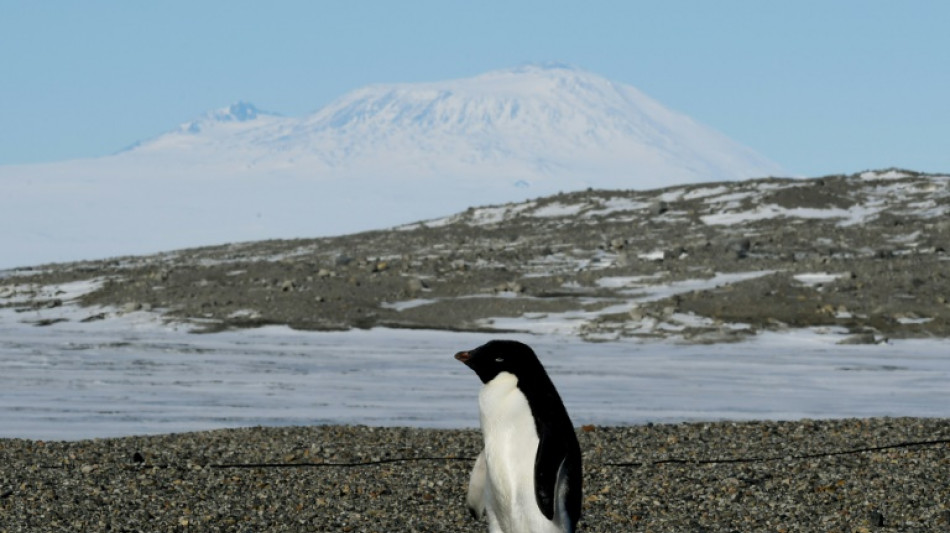
The surprising climate power of penguin poo / Photo: Mark RALSTON - AFP/File

 S.African women runners arm themselves after string of killings

 Indonesia fires threatens critically-endangered orangutan: IUCN

 Iran proposes Hormuz plan, Trump reportedly refuses

 El Nino rewrites the menu in the world's top restaurants

 Jay-Z rape accuser says she made 'false accusations'

 Trump's photo of Xi greeting carries signs of AI

 First US trial against TikTok to open Monday

 French literary prize removes novel from longlist after AI claims

 Trump accuser E. Jean Carroll finally has her damages

 Heavy fighting, internet disruption as Ethiopia conflict rages

 Asian markets mixed after oil gains

 UN approves resolution on dealing with rising sea levels

 Global stocks mostly fall as oil prices and bond yields rise

 Starbucks to close 250 more cafes in North America

 Stocks fall as oil prices rise and bonds back under pressure

 Top ECB official to resign to take up IMF role

 Eviction of pensioner puts Spain housing crisis in spotlight

 Average EU diesel price hits record 2.23 euros a litre: AFP analysis

 Whitetip Investments Marks 10 Years of Regulation, Transparency & Responsible Trading

 Stocks fall, oil prices rise as global bonds under pressure

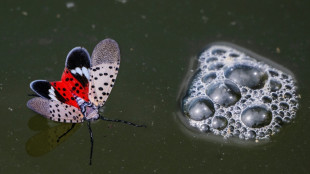 Hungary detects invasive spotted lanternfly for first time in EU

 Forex Expo Dubai 2026 Breaks Guinness World Record Again With 23,816 Attendees

 Asian markets fall on US-China jitters as leaders meet

 As Moscow steps up attacks, Kyiv residents brace for harsh winter

 Markets mixed as China's Xi arrives for US talks

Antarctica's icy wilderness is warming rapidly under the weight of human-driven climate change, yet a new study points to an unlikely ally in the fight to keep the continent cool: penguin poo.
Published Thursday in Communications Earth & Environment, the research shows that ammonia wafting off penguin guano seeds extra cloud cover above coastal Antarctica, likely blocking sunlight and nudging temperatures down.
Lead author Matthew Boyer, an atmospheric scientist at the University of Helsinki, told AFP that lab studies had long shown gaseous ammonia can help form clouds.
But "to actually quantify this process and to see its influence in Antarctica hasn't been done," he said.
Antarctica is an ideal natural laboratory. With virtually no human pollution and scant vegetation -- both alternative sources of cloud-forming gases -- penguin colonies dominate as ammonia emitters.
The birds' future, however, is under threat.
Shrinking sea ice disrupts their nesting, feeding and predator-avoidance routines -- making it all the more urgent to understand their broader ecological role.
Along with other seabirds such as Imperial Shags, penguins expel large amounts of ammonia through droppings, an acrid cocktail of feces and urine released via their multi-purpose cloacas.
When that ammonia mixes with sulfur-bearing gases from phytoplankton -- the microscopic algae that bloom in the surrounding ocean -- it boosts the formation of tiny aerosol particles that grow into clouds.
To capture the effect in the real world, Boyer and teammates set up instruments at Argentina's Marambio Base on Seymour Island, off the northern tip of the Antarctic Peninsula.
Over three summer months -- when penguin colonies are bustling and phytoplankton photosynthesis peaks -- they monitored wind direction, ammonia levels and newly minted aerosols.
When the breeze blew from a 60,000-strong Adelie penguin colony eight kilometers (five miles) away, atmospheric ammonia spiked to 13.5 parts per billion -- about a thousand times the background level.
For over a month after the birds had departed on their annual migration, concentrations stayed roughly 100 times higher, with the guano-soaked ground acting as a slow-release fertilizer.
Particle counters told the same story: cloud-seeding aerosols surged whenever air masses arrived from the colony, at times thick enough to generate a dense fog.
Chemical fingerprints in the particles pointed back to penguin-derived ammonia.
- Penguin-plankton partnership -
Boyer calls it a "synergistic process" between penguins and phytoplankton that supercharges aerosol production in the region.
"We provide evidence that declining penguin populations could cause a positive climate-warming feedback in the summertime Antarctic atmosphere," the authors write -- though Boyer emphasized that this remains a hypothesis, not a confirmed outcome.
Globally, clouds have a net cooling effect by reflecting solar radiation back into space. Based on Arctic modeling of seabird emissions, the team believes a similar mechanism is likely at play in Antarctica.
But the impact also depends on what's beneath the clouds.
Ice sheets and glaciers also reflect much of the Sun's energy, so extra cloud cover over these bright surfaces could trap infrared heat instead -- meaning the overall effect hinges on where the clouds form and drift.
Still, the findings highlight the profound interconnections between life and the atmosphere -- from the Great Oxygenation Event driven by photosynthesizing microbes billions of years ago to penguins influencing cloud cover today.
"This is just another example of this deep connection between the ecosystem and atmospheric processes, and why we should care about biodiversity and conservation," Boyer said.
S.F.Lacroix--CPN