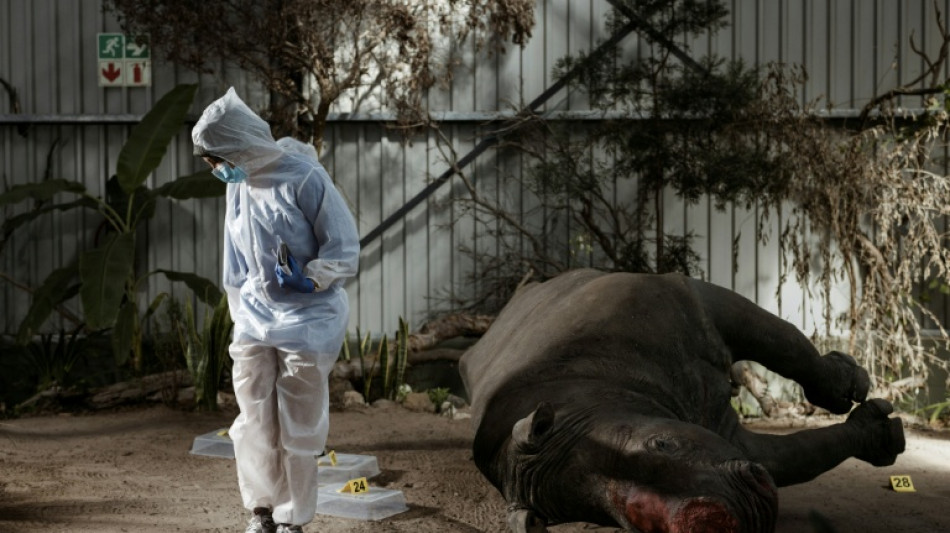
Inside South Africa's wildlife CSI school helping to catch poachers / Photo: MARCO LONGARI - AFP

 Kenya's economy faces climate change risks: World Bank

 'Beginning of the end': Relief but no party as French wildfire winds down

 Southern Europe 'becoming more flammable' in hotter climate, experts say

 Mammoth bones found on parched bed of Danube in Bulgaria

 MEXC Lists Grvt (GRVT) with $60,000 Worth of GRVT and 10,000 USDT in Airdrop+ Rewards

 George and Amal Clooney flee French home due to wildfire

 MEXC Ventures Supports Alpha Arena's APAC Debut at Coinfest Bali

 AI data centre supplier Zhongji InnoLight slips on Hong Kong debut

 May, June heatwaves caused 2,877 extra deaths in England: govt

 BMW profit down a third as carmaker plans job cuts

 Seoul extends losses as most Asian markets drop, oil rises again

 Gambling.com Group Is Now Grandstand

 Meet the astronomer digging into the Milky Way's 'fossils'

 AI data centre supplier Zhongji InnoLight falls on Hong Kong debut

 Samsung operating profit up 1,800% in second quarter on AI boom

 Japanese population below 120 million for first time in decades

 US actor Jared Leto denies latest accusations of sexual assault

 Danube drops to 'historic lows' as fresh heatwave hits

 BTS pulls out of Grammys after Asian pop category introduction

 OpenAI says rogue AI agent attack hit other companies

 How an AFP beach snap became emblem of Europe's wildfire summer

 TRX Spot and Perpetuals Listing Launches on Backpack, Expanding Access to the TRON Ecosystem

 Nepal's tiger numbers climb 20 percent to estimated 429: survey
 FIFA's plans to sell $4.2bn stake in its tournaments widely criticised

 BMW aims to cut 8,000 jobs by end 2027: company source

The rhino lay frozen in the sand, its grey legs stiff, glassy eyes open, horn crudely sawed off.
A dead giraffe slumped nearby and a lion's twisted body to the right -- a tableau of devastation.
Three figures in white hazmat suits tip-toed through the dust, marking every footprint. They were not first responders to another poaching tragedy, but students at South Africa's Wildlife Forensic Academy, a training centre aiming to fight poaching by teaching investigation skills to rangers, conservation officers and law enforcement.
Set inside a sunny warehouse in a private game reserve an hour north of Cape Town, the simulated carnage is staged with taxidermised animals, including rhino "Frikkie" who was poached a few years ago.
"The first people who arrive at the crime scene are absolutely crucial," said Phil Snijman, a former prosecutor and trainer at the academy.
"They are the ones who will secure the crime scene. In the absence of the necessary training... that might lead to losing a lot of your available evidence," he said, putting the last touches to an elaborate scene leading the students to a poacher's house in a corner of the warehouse.
South Africa faces an acute poaching crisis, with more than 10,000 rhinos killed since 2007 according to the International Rhino Foundation.
Yet only 36 cases were convicted in court in 2023, according to government figures, in the year almost 500 of the stocky animals were killed.
- 'Entire species disappearing' -
Killings of other species that receive less attention like reptiles and vultures, are even less likely to be prosecuted, said Snijman.
"Police aren't always available to come out, especially for a remote crime scene," he said.
That gap in justice is something Wendy Willson, a former police trainer and conservationist, sees often.
The legal head at Johannesburg's Wildlife Veterinary Hospital said cases of wildlife crime seldom make it to court, and "when they are actually prosecuted, we often end with a lenient sentence".
Willson, who is unaffiliated with the Wildlife Forensic Academy, has dedicated herself to "seeking justice for the little creatures" that don't draw public concern like rhinos and elephants.
"We are in a crisis where we are losing so many of our small animals. Entire species are completely disappearing, and nobody even knows about it," she told AFP.
While "having rangers understand the importance of the chain of custody is very important," she said, it is only one of many challenges to prosecuting wildlife crime -- which include law enforcement resources, community support and prosecutors' awareness of the crimes.
- No silver bullet -
Back at the academy, Mari-Su de Villiers -- wearing a mask and blue plastic gloves -- carefully laid down yellow markers next to each footprint surrounding Frikkie.
At 28, she works to protect endangered African wild dogs -- but it was a case of animal poisoning, and the help of a trained colleague, that led her to the academy.
"They helped our team know what evidence to look out for, anything that seems out of place in a natural environment," she told AFP.
Since opening in 2022, the academy has trained over 500 people but only 89 have been rangers, investigators, or conservation officers like De Villiers.
Much of the intake comes from European students, admits Snijman, noting that their fees help fund sponsorships for local rangers.
Improving the way evidence is gathered, especially forensic material that can stand up in court, will lead to more convictions and serve as a deterrent to future crimes, said Snijman.
"One would hope that you don't need an academy like this because there isn't any wildlife crime out there. This is not a perfect solution, but it is a small part of the bigger picture," he sighed, before returning to the dead rhino to imprint his footprints in the sand.
St.Ch.Baker--CPN