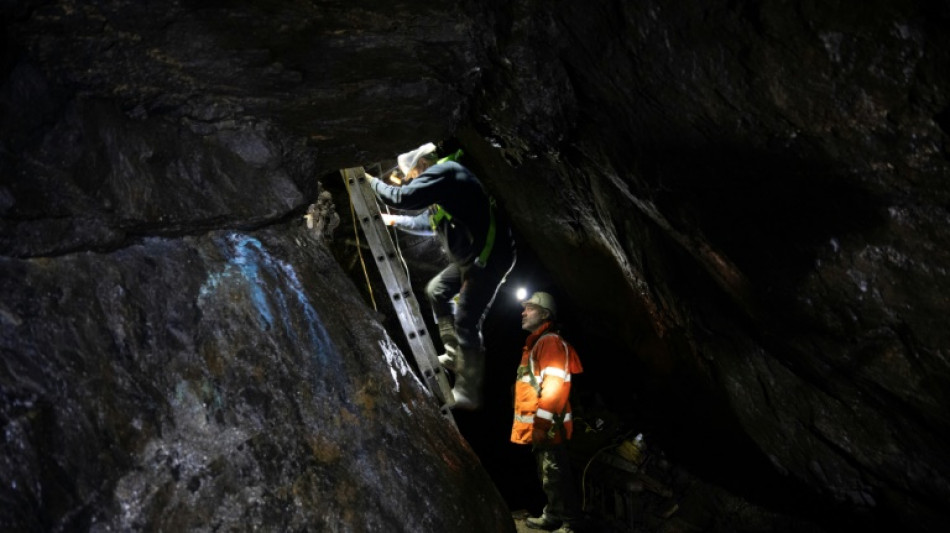
Long-abandoned Welsh mine revived as gold prices soar / Photo: Oli SCARFF - AFP

 Kenya's economy faces climate change risks: World Bank

 'Beginning of the end': Relief but no party as French wildfire winds down

 Southern Europe 'becoming more flammable' in hotter climate, experts say

 Mammoth bones found on parched bed of Danube in Bulgaria

 MEXC Lists Grvt (GRVT) with $60,000 Worth of GRVT and 10,000 USDT in Airdrop+ Rewards

 George and Amal Clooney flee French home due to wildfire

 MEXC Ventures Supports Alpha Arena's APAC Debut at Coinfest Bali

 AI data centre supplier Zhongji InnoLight slips on Hong Kong debut

 May, June heatwaves caused 2,877 extra deaths in England: govt

 BMW profit down a third as carmaker plans job cuts

 Seoul extends losses as most Asian markets drop, oil rises again

 Gambling.com Group Is Now Grandstand

 Meet the astronomer digging into the Milky Way's 'fossils'

 AI data centre supplier Zhongji InnoLight falls on Hong Kong debut

 Samsung operating profit up 1,800% in second quarter on AI boom

 Japanese population below 120 million for first time in decades

 US actor Jared Leto denies latest accusations of sexual assault

 Danube drops to 'historic lows' as fresh heatwave hits

 BTS pulls out of Grammys after Asian pop category introduction
 OpenAI says rogue AI agent attack hit other companies

 How an AFP beach snap became emblem of Europe's wildfire summer

 TRX Spot and Perpetuals Listing Launches on Backpack, Expanding Access to the TRON Ecosystem

 Nepal's tiger numbers climb 20 percent to estimated 429: survey
 FIFA's plans to sell $4.2bn stake in its tournaments widely criticised

 BMW aims to cut 8,000 jobs by end 2027: company source

At the bottom of a long-abandoned mine, 50 metres below the surface, one company searches for rare Welsh gold, attracted by soaring prices and its royal connection.
The Clogau-St David's mine, located in a national park near the coast of Wales, was flooded until its latest licence-holder, Alba Mineral Resources, spent months pumping out water to begin operations.
Down rickety ladders along narrow, damp tunnels, Alba focuses on finding quartz -- a snow-like white rock that indicates the presence of gold.
"The mine up to now has been in exploration phase. We're slowly transitioning" to proper operations, said Mark Austin, the project's chief geologist, who spent four decades working in mines in Africa.
From the depths of the mine, they drill, blast, and haul the ore to the surface.
The first pickaxes struck Clogau in 1854, initially aimed at finding lead, before quickly turning to gold.
Local legend has it that a miner discovered the first flakes by accident after kicking a piece of rock.
- Soaring gold price -
After six decades of prosperity, the mine shut in 1911, and only occasionally reopened in the years that followed.
At the time of its final shutdown in 1998, gold sold for $300 a troy ounce (31.1 grammes).
Today, the price of gold has soared beyond $3,000 an ounce -- and hit a new record on Monday, attracting investors seeking a safe-haven asset as US President Donald Trump's stop-start tariffs roil global markets.
"The economics of coming in and finding unworked seams of gold is obviously very attractive," said George Frangeskides, executive chairman of Alba.
"We had an idea that with modern techniques... we could find unworked seams of gold here," he told AFP.
Clogau gold is prized for its scarcity, Welsh heritage and ties to the British royal family, fetching up to 10 times the standard market rate.
Royal family members, including Queen Elizabeth II, King Charles III, Princess Diana and Princess Catherine have all worn a Clogau wedding ring -- a tradition that dates back a century to the wedding of King George VI.
The royal connection "adds, obviously, to the cachet, the allure of the project that we're involved with", Frangeskides told AFP.
Even with limited production -- a few hundred ounces per year -- he believes the venture will be profitable.
The company has invested £4 million ($5.3 million) into the site, where 10 people work.
Early test auctions of one-ounce pieces have been successful, with the first selling for £20,000 ($26,500) -- more than eight times the traded price of gold.
- Once-thriving mine -
Remaining features, like rusty rails and wooden foundations, serve as reminders of the history of this once-thriving mine.
Austin, donning a hard hat, pointed to the holes in the walls where explosives will be placed to extract tiny gold particles from crushed rocks.
A promising extension to the original quartz vein, around 120-metres long, has been identified in the exploration area measuring 107 square kilometres.
World Gold Council market strategist John Reade said it is not the quality of Clogau gold that attracts its premium price but the fact it is a small, "boutique mine".
Over the course of the mine's history, only 80,000 ounces (2.5 tonnes) of gold have been extracted.
That compares to global gold production of around 3,600 tonnes a year, he said.
But thanks to its royal connection, the Welsh gold may attract "traditionalists, people who may be strong monarchists" willing to pay more, Reade added.
In the nearby town of Dolgellau, some locals are more concerned with the potential environmental impact than the prospect of gold.
Alba said it has reassured authorities and is committed to protecting bats that live in the area.
At the bustling Cross Keys pub in the town centre, Will Williams, a 75-year-old retired doctor, chuckled: "I wouldn't be surprised if a lot of young people around here don't even know it exists."
M.García--CPN